
Can You Bring Ozempic, Wegovy or Mounjaro to Japan? Rules for Injectable Pens
Can you bring Ozempic, Wegovy or Mounjaro to Japan? In most cases, yes, if you carry your own supply for your own use and keep to the limits. They contain semaglutide or tirzepatide, injectable prescription medicines that Japan treats under its ordinary one-month personal-import rule rather than its narcotics or psychotropics rules.
Quick answer
For semaglutide (Ozempic, Wegovy) and tirzepatide (Mounjaro, Zepbound) injectable pens that you carry yourself for your own treatment: up to one month's supply by the label dose needs no special procedure, and pens may be carried together with their needles or syringes. For more than one month, obtain an Import Confirmation certificate before you enter Japan. Syringes without the medicine also need one. Their Japanese labels classify them as potent drugs, they are not among the narcotics or psychotropics examples, and all four are approved in Japan. Check your exact product and quantity, because the rules can change.
Not sure whether your pens and trip length fit the one-month rule? Check the ingredient, strength, dose and total quantity before you travel.
Check my medicationOn this page
Are Ozempic, Wegovy and Mounjaro allowed in Japan? Prescription injectables, not narcotics
Ozempic and Wegovy contain semaglutide. Mounjaro and Zepbound contain tirzepatide. Japan's rules follow the active ingredient and the dosage form, not the brand name, so each pair is treated alike. All four are approved in Japan, and each Japanese label classifies the medicine as a potent drug 劇薬 (Wegovy, Ozempic, Mounjaro, Zepbound).
The Narcotics Control Department's traveller guidance covers narcotics, psychotropics and stimulants' raw materials, and its examples do not include either ingredient. As a result, the Narcotics Control Department's two-week advance application and its psychotropic quantity table are not the relevant rules here. Instead, MHLW's ordinary personal-import rule applies: toxic drugs, potent drugs and prescription medicines are allowed up to one month's supply by the dosage and administration.
Not controlled does not mean unrestricted. The quantity limit, the injectable-device rules and the Import Confirmation process still apply, and your pharmacy label and prescription should show the ingredient name.
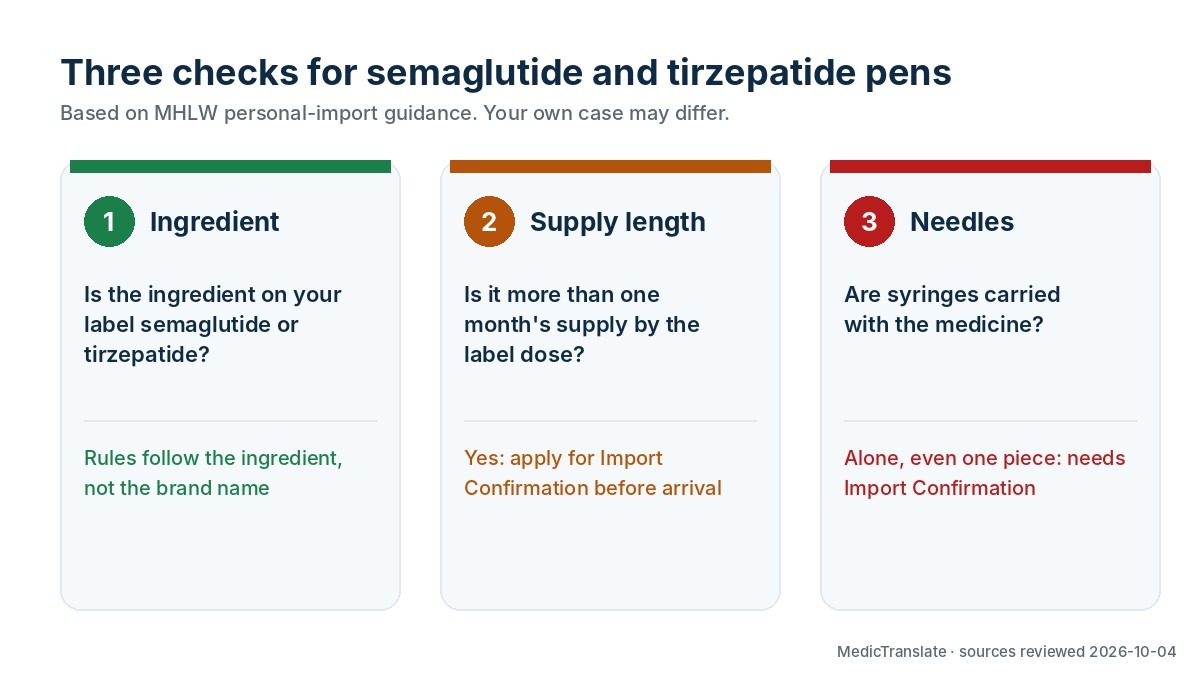
Three checks before you bring a semaglutide or tirzepatide pen to Japan
Semaglutide or tirzepatide
Identify the ingredient on your label. Ozempic and Wegovy are semaglutide; Mounjaro and Zepbound are tirzepatide.
One month
Up to one month's supply by the label dose needs no special procedure. More than that needs Import Confirmation before you arrive.
Syringes with the medicine
Carry self-injection devices together with the medicine. Syringes without the medicine need Import Confirmation, even one piece.
The MHLW Q&A for people importing medicines words it this way: self-injectable medicines with syringes, such as insulin, for under one month's supply do not need an Import Confirmation certificate, but importing syringes alone does, even for one piece. Therefore, keep needles with the pens they belong to, and do not pack spare syringes on their own. The Q&A speaks of syringes; if you carry separate pen needles, ask the pharmaceutical inspector at your arrival airport how they are treated.
How to bring Ozempic, Wegovy or Mounjaro to Japan: step by step
- Read the label. Note the ingredient name, strength, number of pens and the dose and frequency your prescriber has set. Wegovy's Japanese label, for example, gives a once-weekly injection (PMDA label).
- Work out your supply. MHLW measures one month by the dosage and administration, so count the doses you will use on the trip plus any delay you plan for, not just the number of pens in the box.
- Choose your route. Up to one month's supply: carry it yourself with its needles. More than one month: obtain an Import Confirmation certificate before you enter Japan.
- For Import Confirmation, apply online with a prescription or doctor's note that shows the patient, the medicine and the doctor's name, plus an airline document showing your arrival date, airport, flight number and name (MHLW Q&A). Certificates are normally issued in a few business days if the application is complete.
- Pack it. We suggest keeping pens in their original pharmacy-labelled packaging in your hand luggage, with the prescription or medication list showing the ingredient name.
- At arrival, show the certificate if customs asks for it, and do not alter it, because the Q&A says a corrected certificate becomes invalid.
Questions go to the pharmaceutical inspector at your arrival airport. The Q&A asks you to include the airport, product name, active ingredient, medicine format and quantity: [email protected] for Narita and Haneda, and [email protected] for Kansai, Centrair and Naha. Our guide to Import Confirmation (yakkan shoumei) explains the process in more depth.
Plan for a margin. The Q&A words the injectable case as "less than 1 month supply", while MHLW's page says "within one month". Because the wording differs slightly, stay comfortably under one month, or apply for Import Confirmation if you are close.
Keeping pens cold: what we could and could not verify
The Japanese labels say to store Wegovy, Ozempic, Mounjaro and Zepbound at 2 to 8 °C, and the Wegovy and Ozempic labels add that the medicine must not be frozen (Wegovy, Ozempic, Mounjaro, Zepbound). Wegovy's label also says to protect it from light.
We could not find an official Japanese customs or MHLW rule on cooler bags, ice packs or time out of the fridge, so we do not state one. For travel, follow the leaflet that came with your own pens and ask your prescriber or pharmacist how long they can be kept out of refrigeration. Foreign products can differ from the Japanese versions.
Ozempic, Wegovy, Mounjaro and Zepbound: approval status in Japan
All four products have Japanese package inserts on the PMDA database. The table shows what each label lists, as reviewed on 4 October 2026.
| Brand | Ingredient | Japanese label indication | Label class |
|---|---|---|---|
| Ozempic | Semaglutide セマグルチド | Type 2 diabetes 2型糖尿病 | Potent drug 劇薬 |
| Wegovy | Semaglutide | Obesity 肥満症, and MASH without cirrhosis (June 2026 revision) | Potent drug; prescription medicine; optimal-use guideline product |
| Mounjaro | Tirzepatide チルゼパチド | Type 2 diabetes | Potent drug; prescription medicine |
| Zepbound | Tirzepatide | Obesity (see the tirzepatide guideline) | Potent drug |
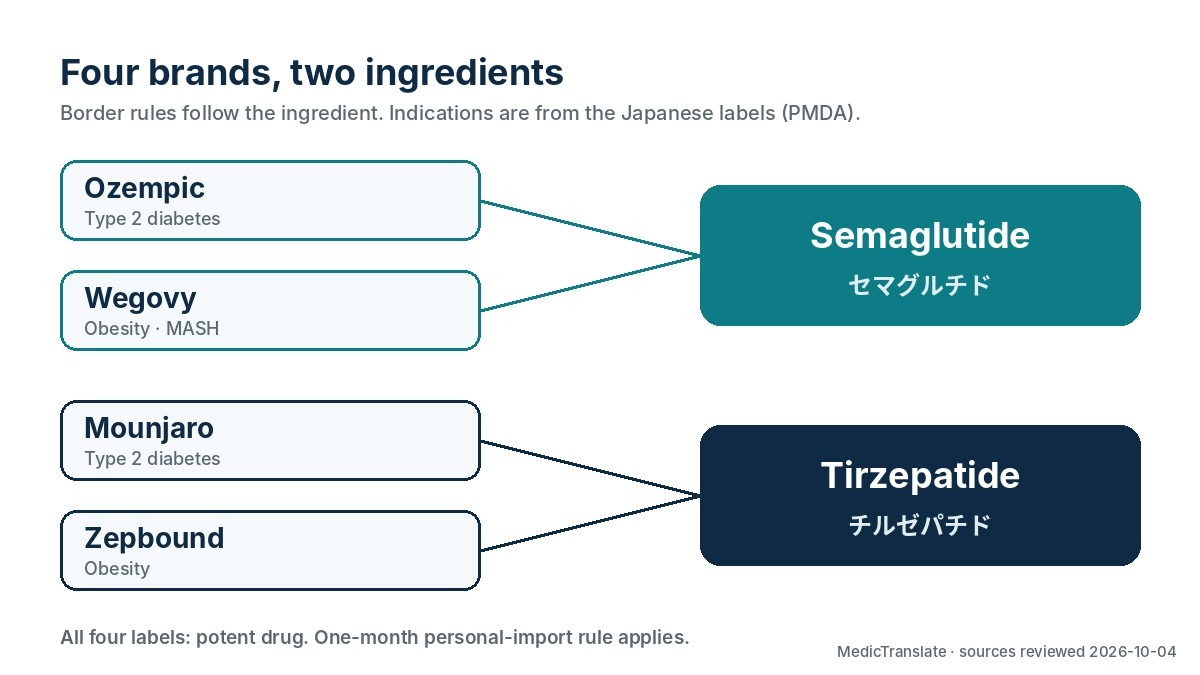
The indication matters for treatment in Japan, not for how much you may carry. A product approved overseas for one purpose may be labelled differently in Japan, so do not assume a Japanese doctor can simply continue your current brand.
Continuing treatment in Japan: obesity prescribing is restricted
For obesity, Wegovy and Zepbound are covered by MHLW and PMDA 最適使用推進ガイドライン (optimal-use guidelines). The Wegovy guideline and the tirzepatide guideline set requirements for the prescribing facility and doctor, and criteria for the patient. The patient criteria include a BMI at or above 27 kg/m² with two or more obesity-related health conditions, or a BMI of 35 or above, together with hypertension, dyslipidaemia or type 2 diabetes and insufficient response to diet and exercise therapy. Both guidelines also state that the medicine must not be used for cosmetic, slimming or diet purposes. Guidelines can be revised, so confirm the current text with the clinic.
MHLW and the Consumer Affairs Agency have also issued a notice on proper use of GLP-1 receptor agonists (December 2023) warning that safety and efficacy are unconfirmed outside the approved indications.
Do not stop or change your injectable medicine because of travel paperwork. Discuss any gap, change of brand or timing with your prescriber before you travel.
What to do if it can't come in
If your supply is more than one month, you cannot obtain Import Confirmation in time, or customs does not release it, you still have options. None of them is guaranteed, because a Japanese doctor decides what to prescribe.
- Ask MHLW first. Email the pharmaceutical inspector at your arrival airport with the product name, ingredient, format and quantity before you fly.
- Reduce what you carry. Bringing no more than one month's supply may avoid Import Confirmation altogether; confirm this with MHLW for your case.
- See a Japanese doctor. Look for a doctor who can communicate in English, or book an interpreter for the visit. Bring an English letter from your prescriber stating your diagnosis, the ingredient, the dose and how long you have taken it.
- Be cautious about online sellers. The MHLW personal-import page warns that import agents often disclaim responsibility, leaving the buyer liable, and that selling or giving imported medicine to others is not allowed.
- Telehealth from overseas. We have not verified Japanese rules on overseas online consultations or prescriptions, so do not assume a remote prescription will be accepted at the border.
For a wider overview, see our guide on how to bring medication to Japan.
Want your exact medicine and quantity checked?
We review the ingredient, strength, dosage form and total quantity against the current published MHLW guidance and explain the likely next step, including whether you should apply for Import Confirmation.
- Price confirmed before work begins
- Reply within 2–3 business days (or sooner)
- Secure document process
MedicTranslate is not a healthcare provider or customs authority. We do not give medical advice or guarantee customs approval.
Frequently asked questions
Can I bring Ozempic to Japan?
Yes, in most cases, if you carry it yourself for your own use. Ozempic contains semaglutide, an injectable prescription medicine that is also approved in Japan. MHLW allows prescription medicines for personal use without special procedures up to one month's supply by the dosage on the label. Self-injection pens carried together with their needles or syringes fall under the same one-month rule. For more than one month's supply, apply for Import Confirmation before you arrive.
Can I bring Wegovy or Mounjaro to Japan?
The rules follow the ingredient, not the brand. Wegovy contains semaglutide and Mounjaro contains tirzepatide. Both are injectable prescription medicines that are approved in Japan, so the same MHLW one-month rule and Import Confirmation process apply as for Ozempic. Zepbound, also tirzepatide, is handled the same way.
Are Ozempic and Wegovy controlled substances in Japan?
Not as far as the published guidance shows. The Narcotics Control Department's traveller guidance covers narcotics, psychotropics and stimulants' raw materials, and its examples do not include semaglutide or tirzepatide. Japanese labels for Wegovy, Ozempic, Mounjaro and Zepbound classify them as potent drugs (gekiyaku), a prescription category. Potent drugs and prescription medicines fall under MHLW's one-month personal-import rule.
Do I need Import Confirmation (yakkan shoumei) to carry injectable pens?
Not for up to one month's supply. The MHLW Q&A says self-injectable medicines carried together with syringes, such as insulin, under one month's supply do not need an Import Confirmation certificate. You do need one for more than one month's supply, and for syringes without the medicine, even a single piece.
Can I bring more than one month of Ozempic, Wegovy or Mounjaro?
Only with an Import Confirmation certificate obtained before you enter Japan. The MHLW Q&A says you apply online with a prescription or doctor's note showing the patient, the medicine and the doctor's name, plus an airline document showing your arrival date, airport, flight number and name. It says certificates are normally issued in a few business days when the application is complete.
Do I need a doctor's letter to bring a pen?
For up to one month's supply, the MHLW Q&A does not list a document you must show. We suggest carrying the original pharmacy-labelled packaging and a prescription copy anyway, because an officer may ask what the medicine is. For Import Confirmation, a prescription or doctor's note is required.
Can I post Ozempic or Wegovy to Japan or have someone carry it for me?
This guide covers medicine you carry yourself for your own treatment. MHLW says imported medicine may not be sold or given to other people, and its Q&A treats sending as a separate procedure with extra documents if customs stops a parcel. MHLW also warns that import-agent websites often disclaim responsibility, leaving the buyer liable.
Can I get Wegovy or Zepbound for weight loss in Japan?
Only through a Japanese doctor, and not for cosmetic or diet purposes. The Japanese labels carry obesity indications, and the MHLW and PMDA optimal-use guidelines set facility, physician and patient criteria, including a BMI and obesity-related health conditions. The guidelines state that these medicines must not be used for cosmetic, slimming or diet purposes outside the approved use. Whether a clinic can prescribe to you is for that clinic to decide.
Can MedicTranslate check whether my pens and quantity are within the limits?
Yes. Our from US$59 medication assessment reviews your ingredient, strength, dosage form and quantity against the published MHLW guidance and explains the likely next step. We do not give medical advice or guarantee customs approval; the final decision rests with the Japanese authorities.
This article provides general information reviewed on 4 October 2026. It is not medical, pharmaceutical or legal advice. Import rules, drug classifications and prescribing guidelines change. Confirm current requirements with MHLW before you travel, and do not stop or change an injectable medicine without advice from your doctor. MedicTranslate provides translation and coordination services.
- MHLW: Personal import of medicines (Japanese)
- MHLW: Q&A for those importing medicines into Japan (PDF)
- Narcotics Control Department: Procedures for import/export of controlled drugs by carrying
- PMDA: Wegovy subcutaneous injection SD package insert (revised June 2026)
- PMDA: Ozempic subcutaneous injection 2 mg package insert (revised July 2025)
- PMDA: Mounjaro subcutaneous injection package insert (revised May 2026)
- PMDA: Zepbound subcutaneous injection Ateos package insert (revised September 2026)
- PMDA: Optimal-use guideline, semaglutide (Wegovy) (PDF)
- PMDA: Optimal-use guideline, tirzepatide (Zepbound, Mounjaro) (PDF)
- MHLW and Consumer Affairs Agency: Proper use of GLP-1 receptor agonists, December 2023 (PDF)
- MHLW: Personal import of medicines, buyer guidance (Japanese)