
Leaving Japan With Medication: Leftover Medicine and Multi-Country Trips
Planning for leaving Japan with medication is easy to overlook. For example, if you needed paperwork to bring your medicine in, you may need a second document to take the leftovers out, and every other country on your route checks again. This guide covers the exit side and multi-country trips such as Korea, Japan and Taiwan or China.
Quick answer
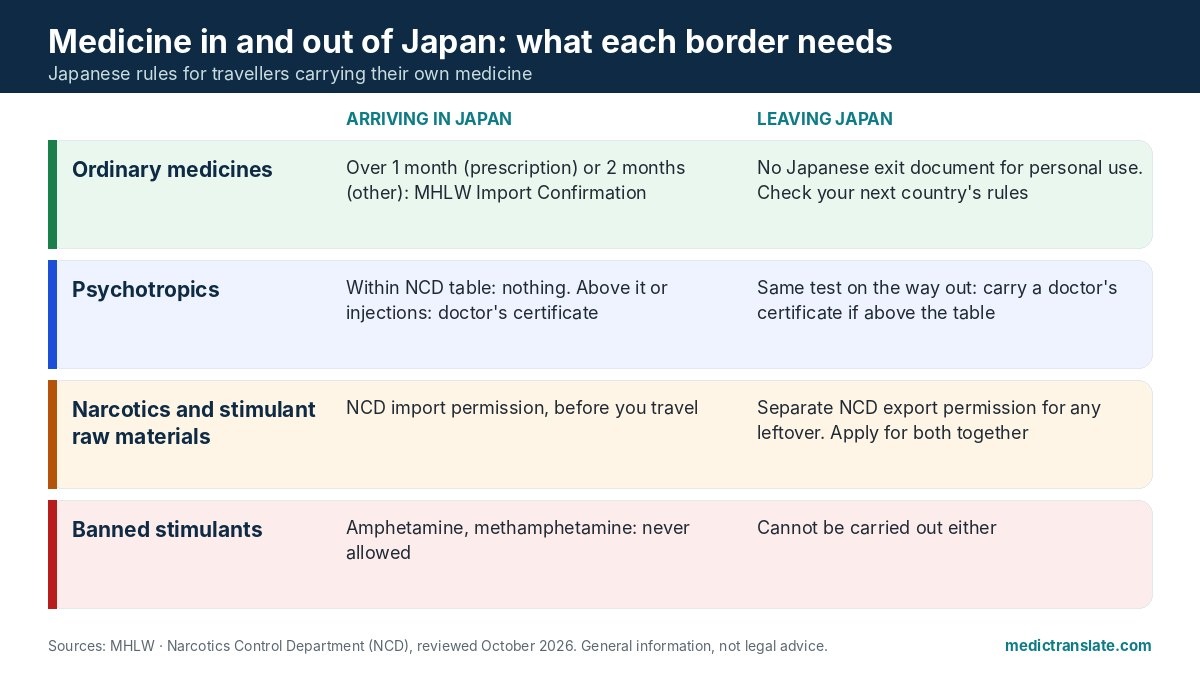
When leaving Japan with medication, ordinary medicines have no Japanese exit procedure; the Import Confirmation (Yunyu Kakunin-sho) is an arrival procedure only. Psychotropics follow the same Narcotics Control Department (NCD) quantity table on the way out. Narcotics and stimulant raw materials need a separate NCD export permission for any leftover, so apply for import and export together at least 14 days before travel. However, on a multi-country trip every border applies its own rules, so a Japanese permit does not cover Korea, Taiwan or China. New Year 2026–27: earlier deadlines apply. Entry 21 Dec to 4 Jan: documents by 7 Dec. Entry 5 to 11 Jan: by 14 Dec. Entry 12 to 18 Jan: by 21 Dec.
Travelling through more than one country? Check how Japan classifies each medicine before you book, so you know which entry and exit rules may apply.
Check my medicationOn this page
Leaving Japan with medication: do leftovers need paperwork?
Most people plan carefully for arrival but forget the return leg. However, when leaving Japan with medication, Japan checks controlled medicine in both directions, and the rules on the way out depend on the active ingredient, not on what you did at arrival.
Ordinary medicines
The Import Confirmation (Yunyu Kakunin-sho) is an entry procedure. It has no departure version, and Japanese guidance sets no exit procedure for ordinary medicines such as most blood pressure or diabetes tablets.
Even so, your next country may ask questions, so keep the prescription.
Psychotropics
NCD applies its quantity table to carrying medicine into or out of Japan. At or below the table amount (not injections): no permission or certificate. Above it, or any injection: carry a doctor’s certificate.
Examples: alprazolam, zolpidem, clonazepam, diazepam, methylphenidate.
Narcotics and stimulant raw materials
Permission to bring them in does not cover taking them out. NCD says that if you intend to leave with leftover medicine, you must also submit the export application.
Examples NCD lists: oxycodone, morphine, codeine (preparations above 1%; low-strength codeine products are treated differently), tapentadol; lisdexamfetamine (Vyvanse) and pseudoephedrine (preparations above 10%) as stimulant raw materials.
Some medicines can never be carried in or out. NCD lists heroin, opium powder, methamphetamine, amphetamine and methaqualone as off-limits to individual travellers, with or without a prescription.
Narcotics and stimulant raw materials: the export permission for leftovers
If you were given NCD permission to bring in a narcotic (such as oxycodone or tapentadol) or a stimulant raw material (such as lisdexamfetamine), plan the exit permission at the same time.
- Apply for import and export togetherNCD’s guide covers bringing narcotics in and taking the remainder out again: you send the doctor’s certificate with both the import form and the export form. Narcotics and stimulant raw materials need separate forms; they cannot share one.
- State the leftover as an upper limitIf you cannot know the exact amount left, NCD allows the export quantity to be written as “up to” a number of tablets or milligrams.
- Choose the right reason for leavingNCD asks for “To return home” or “To go to another country”. It warns that answers such as “For vacation” slow processing.
- Send it to the right office, 14 days aheadVisitors apply to the NCD office covering their arrival airport (even if they leave from a different airport). Residents apply to the office covering their home address, or their hospital if admitted. The deadline is two weeks before the entry or departure date.
- Show the permit at customs as you leaveApproved applicants receive a Japanese permit and an English certificate to show customs on entry and exit.
- Carry the medicine yourselfOnly the patient named on the permission may carry it. It cannot be posted, couriered or handed to someone else.
Already in Japan and missed the export form? Contact the NCD office that issued your import permission as early as possible. NCD asks you to call if time is short, but says contacting it does not guarantee your application can be handled, and the Tokyo office states it cannot accept last-minute applications for any reason.
If your doctor’s certificate is in German, French or Arabic, a medical document translation into English or Japanese keeps ingredient names, strengths and quantities identical across the import and export forms.
Leaving Japan with medication and coming back on the same trip
Side trips are common, for example Tokyo to Seoul for a weekend, or Osaka to Taipei and back. As a result, every time you return you are arriving in Japan again with medicine.
- Narcotics and stimulant raw materials: NCD’s guide also covers leaving with medicine and bringing the remainder back. Therefore, if you will leave Japan and come back, include both the export and the re-import in your application. If you cannot know the quantity you will bring back, NCD allows an upper limit such as “up to 20 tablets”.
- Ordinary medicines: the one-month (prescription) and two-month (other) personal allowances are judged on what you carry at each arrival. Japanese guidance does not spell out how an existing Import Confirmation applies to a second arrival, so ask the Regional Bureau of Health and Welfare before you go (per Japan Customs: Kanto-Shinetsu Bureau 048-740-0800 for arrivals under Hakodate, Tokyo or Yokohama Customs; Kinki Bureau 06-6942-4096 for arrivals under Nagoya Customs and further west).
- Psychotropics: apply the NCD quantity table again to the amount you carry back in.
Transit and stopovers: Japanese guidance does not address airside transit. If you pass through immigration and customs, for example on an overnight stopover or a self-transfer, you are entering Japan and the rules above apply.
Multi-country trips: leaving Japan with medication for Korea, Taiwan or China
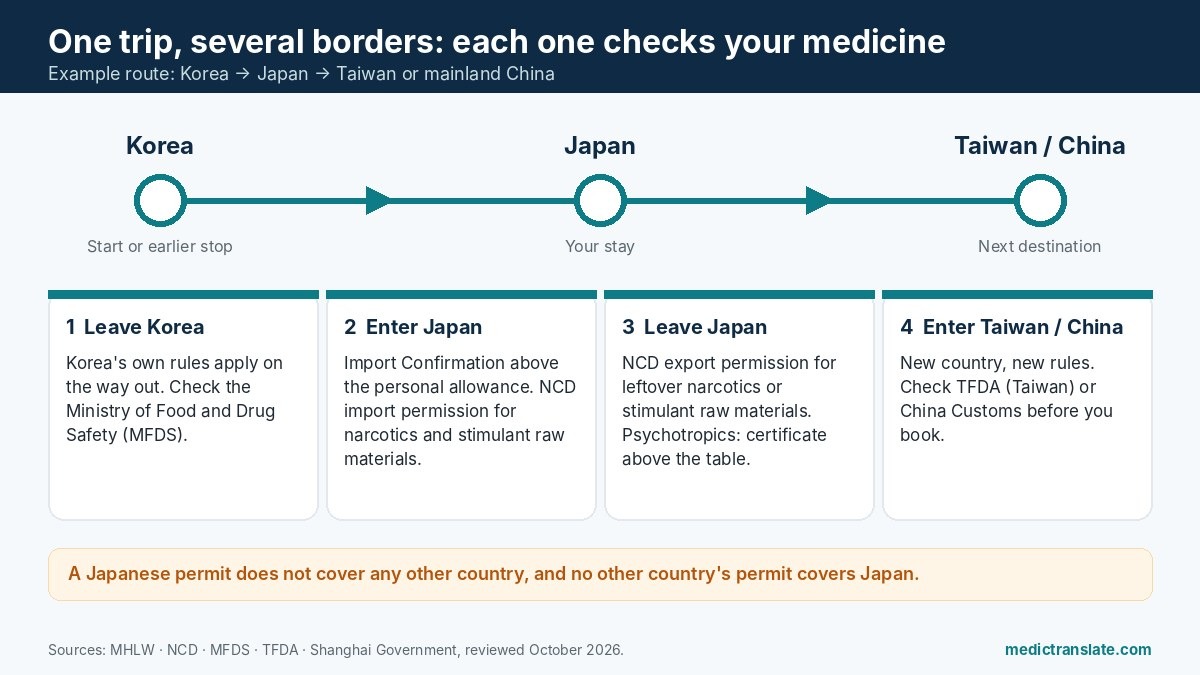
A popular route is Korea, then Japan, then Taiwan or mainland China. Each border is a separate legal check. NCD says plainly that a Japanese permission does not guarantee you can carry the medicine into another country. Equally, a permit from another country is not a Japanese permission.
| Border | What to check (official source) |
|---|---|
| Into Korea | Medicines containing narcotic or psychotropic substances need approval from Korea’s Ministry of Food and Drug Safety (MFDS) before entry. MFDS opened online applications on 27 December 2024. |
| Into Japan | Personal allowance or MHLW Import Confirmation; NCD import permission for narcotics and stimulant raw materials; NCD quantity table for psychotropics. |
| Out of Japan | NCD export permission for leftover narcotics and stimulant raw materials; doctor’s certificate for psychotropics above the table. |
| Into Taiwan | Taiwan FDA recommends carrying a prescription or diagnosis certificate. Controlled drugs must stay with you and cannot be posted or couriered. |
| Into mainland China | Shanghai’s official guidance: narcotics and Category I psychotropics are limited to the maximum amount of a single prescription, with a diagnosis certificate from a medical institution and photo ID such as your passport. Category II psychotropics must be declared to customs. |
Planning tips for a multi-country route
- Check the strictest country first. For example, a medicine allowed in Korea may be a narcotic or stimulant raw material in Japan, or banned outright. If Japan refuses it, it does not matter what Taiwan allows.
- Check the rules at each border. In addition, China’s single-prescription cap and Japan’s one-month allowance can be smaller than a long trip needs, so plan the paperwork or local prescriptions before you go.
- Use one consistent set of documents. The same ingredient names, strengths and daily doses on your prescription, doctor’s certificate and every application avoids questions at each border.
- Keep medicine in its original packaging and in your carry-on, with copies of each permit and certificate.
Before-you-book checklist
- List every medicine by active ingredientBrand names differ by country; the ingredient decides the category.
- Classify each ingredient in JapanOrdinary, psychotropic, narcotic, stimulant raw material or prohibited.
- Map every border on your routeWrite down each arrival and departure, including side trips and stopovers.
- Apply for entry and exit togetherFor narcotics and stimulant raw materials, send import and export forms in one go, at least 14 days ahead.
- Check each other country’s official rulesUse the regulator or customs authority, or the country’s embassy in Japan, as NCD suggests.
- Carry the documents with the medicinePermits, the English certificate, prescriptions and translated doctor’s letters, in your hand luggage.
Common mistakes
- Assuming the NCD import permission also covers leaving Japan with the leftovers.
- Writing “For vacation” as the reason for leaving, which NCD says slows processing.
- Planning to post leftover controlled medicine home instead of carrying it.
- Using a permit from Korea, Taiwan or your home country as proof for Japanese customs.
- Forgetting that a weekend trip out of Japan means a fresh arrival on the way back.
- Different doses or spellings across the prescription, the certificate and the forms.
Know what Japan requires before you book
MedicTranslate reviews the medicines you list against current published MHLW and Narcotics Control Department guidance and explains, medicine by medicine, which Japanese process is likely to apply.
- Medicine-by-medicine outcome for Japan
- Checked against current official guidance
- Doctor’s certificate translation available (quoted separately)
Price confirmed before you pay · Reply within 1–3 business days · MedicTranslate covers Japanese requirements only, does not issue permits, act as your agent or guarantee approval. Final decisions rest with the authorities of each country.
Frequently asked questions
Do I need a permit to leave Japan with leftover medicine?
It depends on the ingredient. Japanese guidance sets no exit procedure for ordinary medicines carried for personal use. Leftover narcotics and stimulant raw materials need a separate export permission from the Narcotics Control Department before you leave. Psychotropics need a doctor's certificate on the way out if the amount is above the NCD table or the medicine is an injection.
Is the Import Confirmation (Yunyu Kakunin-sho) also needed when I leave Japan?
No. The Import Confirmation is an entry procedure from MHLW for medicines above the personal-use allowance. It has no departure version. What matters on the way out is whether the medicine is a narcotic, stimulant raw material or psychotropic, and what your next country requires.
Can I apply for the narcotics import and export permissions at the same time?
Yes. NCD guidance covers the case of bringing narcotics in and taking the remainder out again: you submit the doctor's certificate with both the import and the export application forms. Apply at least 14 days before you travel.
What if I do not know how much medicine will be left when I leave?
NCD guidance allows the quantity on the export form to be written as an upper limit, for example up to a stated number of tablets. Base it on your prescription and travel dates, and do not take out more than the form allows.
Does my Japanese permit cover Korea, Taiwan or China?
No. NCD states that its permission does not guarantee you can carry the medicine into another country. Korea, Taiwan and mainland China each apply their own rules at their own border, and none of their permits covers Japan.
I am travelling Korea, then Japan, then Taiwan. What do I need?
Treat each border separately. Check Korea's rules for leaving, Japan's rules for arriving (Import Confirmation or NCD import permission), Japan's rules for leaving (NCD export permission for narcotics and stimulant raw materials), and Taiwan's rules for arriving. Plan the whole route before you book.
Can I post leftover medicine home from Japan?
Not controlled medicine. NCD states that narcotics, psychotropics and stimulant raw materials cannot be sent to or from Japan by post or courier, or handed to someone else to carry. You must carry them yourself with the right paperwork.
Does MedicTranslate apply for the permits for me?
No. MedicTranslate does not issue permits or lodge applications as your agent. It can assess your medicines against published guidance and translate your doctor's certificate, and you submit any application yourself.
This article provides general information based on published Japanese government guidance, and official Korean, Taiwanese and Chinese guidance, reviewed on 18 October 2026. It is not medical or legal advice and is not an official customs or controlled-substance determination. Rules change and product-specific facts matter, so confirm current requirements with MHLW, the Narcotics Control Department or the responsible Regional Bureau of Health and Welfare, and with the authorities or embassy of every other country on your route, before travel.
MedicTranslate provides translation, interpreting, information and healthcare coordination services. It does not issue Import Confirmation Certificates or NCD permissions, lodge applications as your agent, give legal or medical advice, advise on other countries’ requirements, or guarantee government approval or border clearance.
- Narcotics Control Department: Carrying medicines into or out of Japan (application guidance)
- Narcotics Control Department: Guide to carrying medical narcotics in and out of Japan (Japanese, PDF)
- Narcotics Control Department: Carrying narcotics, psychotropics and stimulant raw materials (Japanese)
- Narcotics Control Department: Psychotropics quantity table (PDF)
- Kinki Regional Bureau of Health and Welfare: Carrying medical narcotics abroad (Japanese)
- MHLW: Bringing medicines for personal use into Japan (quantity limits)
- MHLW: Import Confirmation Information System
- Japan Customs: Personal import of medicines (Customs Answer 1806, Japanese)
- Korea MFDS: Permit for bringing in narcotic and psychotropic medicines for self-treatment
- Taiwan FDA: Travellers carrying medicines
- Shanghai Municipal Government: Bringing personal medication into China