
Can You Bring Sudafed to Japan? Pseudoephedrine and Cold Medicine Rules for Travellers
Can you bring Sudafed to Japan? Not as casually as most travellers assume. Sudafed-type medicines contain pseudoephedrine (プソイドエフェドリン), which Japan treats as a stimulants' raw material (覚醒剤原料), so carrying a supply across the border is permission-based. Here is what the official pages say, and what to do if your medicine cannot come in.
Quick answer
Sudafed and other Sudafed-type decongestants contain pseudoephedrine, which the Narcotics Control Department (NCD) lists as a stimulants' raw material. For a medicine in that category, you need permission before you enter Japan: apply at least 14 days before travel, with a doctor's certificate issued within 3 months and photos of the packaging. The law excludes preparations with a content of 10% or less, but the NCD traveller pages do not say how that applies to Sudafed-type tablets, so confirm your exact product with the NCD first. The 2-month over-the-counter rule does not cover stimulants' raw materials, and they cannot be posted to Japan.
Not sure whether your cold medicine counts as a stimulants' raw material? Check the ingredient, strength and quantity before you travel.
Check my medicationOn this page
Can you bring Sudafed to Japan? Why pseudoephedrine is a stimulants' raw material
Sudafed is a brand name. Japan's border rules follow the active ingredient, and in Sudafed-type decongestants that ingredient is pseudoephedrine プソイドエフェドリン. The Narcotics Control Department (NCD) lists pseudoephedrine, together with lisdexamfetamine (Vyvanse), as a stimulants' raw material 覚醒剤原料.
For stimulants' raw materials, the NCD says you need permission before you enter or leave Japan. In addition, the Kanto-Shinetsu Regional Bureau of Health and Welfare states that a medicine that is a stimulants' raw material may be carried across the border only under that permission, for a person using it to treat their own illness.
The brand name does not decide the rule. A product is judged by what it contains and how much. A US or Australian cold tablet may combine pseudoephedrine with other ingredients, so read the full ingredient list before you pack it.
The 10% exclusion and why you should still check with the NCD
The law does not treat every pseudoephedrine product the same way. MHLW's handling guide for stimulants' raw materials, as republished by Miyagi Prefecture, lists 1-phenyl-2-methylaminopropanol-1 (ephedrine and pseudoephedrine) and states that preparations with a content of 10% or less are excluded from the category. Tokyo Metropolitan Government's list of stimulants' raw materials shows the same 10% exclusion for that entry.
However, the NCD traveller guide is less specific. Its guide to carrying stimulants' raw materials names the 10% exclusion for ephedrine and methylephedrine, and does not mention pseudoephedrine. The NCD pages we reviewed also do not describe a route for over-the-counter purchases.
What this means in practice. We cannot tell you from the brand name whether your tablet falls under the exclusion. Contact the NCD office for your area (the NCD office and email list) with the product name, ingredient list and quantity, and keep the answer in writing.
Step by step: bringing a pseudoephedrine medicine into Japan
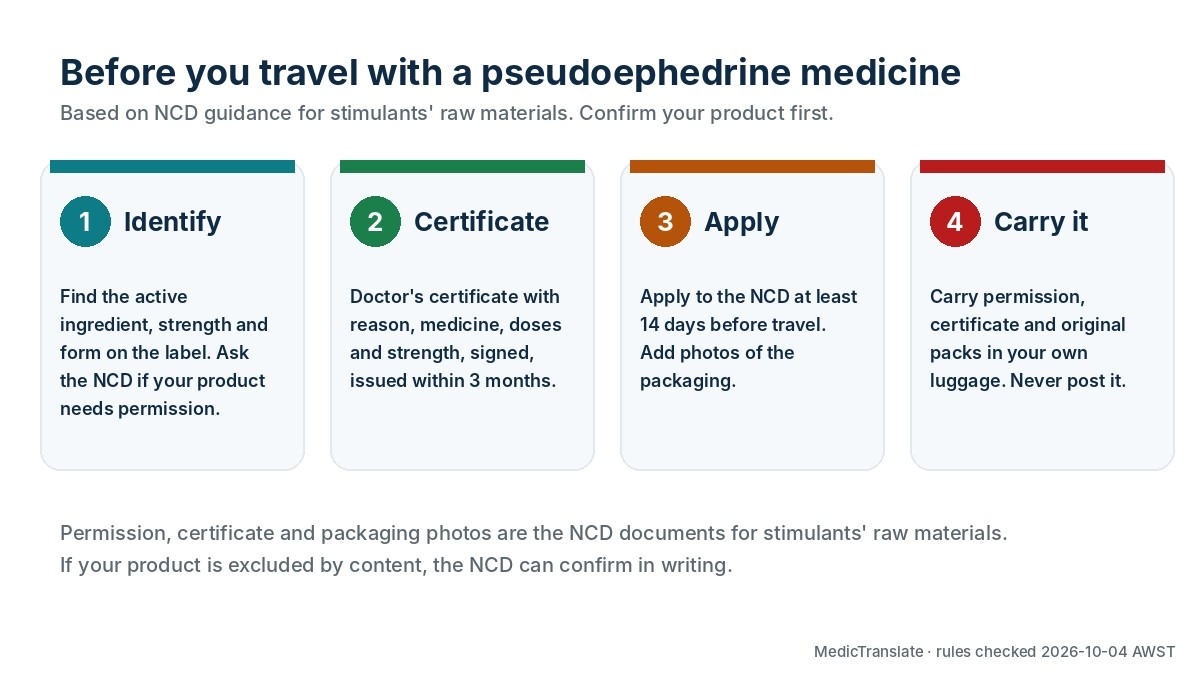
If your medicine counts as a stimulants' raw material, the NCD's English guidance sets out this process.
- Identify the active ingredient. Look for pseudoephedrine (or pseudoephedrine hydrochloride) on the label, and note the strength and form.
- Ask the NCD whether your product needs permission. Send the ingredient list and quantity to the regional office, as explained above.
- Get a doctor's certificate. It should show your name, current address, the reason you take the medicine, a list of the medicine with doses and strength, the doctor's signature, and an issue date within 3 months.
- Apply at least 14 days before travel. Use the import application form and send it to the Narcotics Control Department for your home area or your arrival airport, by email, fax or post. Add photos of the medicine's packaging.
- Carry the permission, certificate and original packaging in your own luggage. Do not post the medicine ahead of you.
The NCD guide does not state a numerical quantity limit. It asks you to state the quantity accurately in the application. Therefore, request only what your treatment needs for the trip, and keep the amount consistent across your certificate, application and luggage. Our guide to how to bring medication to Japan explains the wider process.
Is the 2-month over-the-counter rule a loophole? No
MHLW's personal import page allows medicines other than poisonous, powerful or prescription drugs up to 2 months' supply by the dosage on the label. Many travellers assume this covers a pack of Sudafed.
It does not settle the question. The same page says ordinary individuals are prohibited from importing medical narcotics, psychotropics and medicine-type stimulants' raw materials, except a person carrying a medicine prescribed to them by a doctor. In addition, MHLW's Q&A for people importing medicines states that stimulants' raw materials cannot be sent to Japan.
As a result, the 2-month rule is the wrong test for a pseudoephedrine product. Ingredient and content come first.
Combination cold and flu medicines: check every ingredient
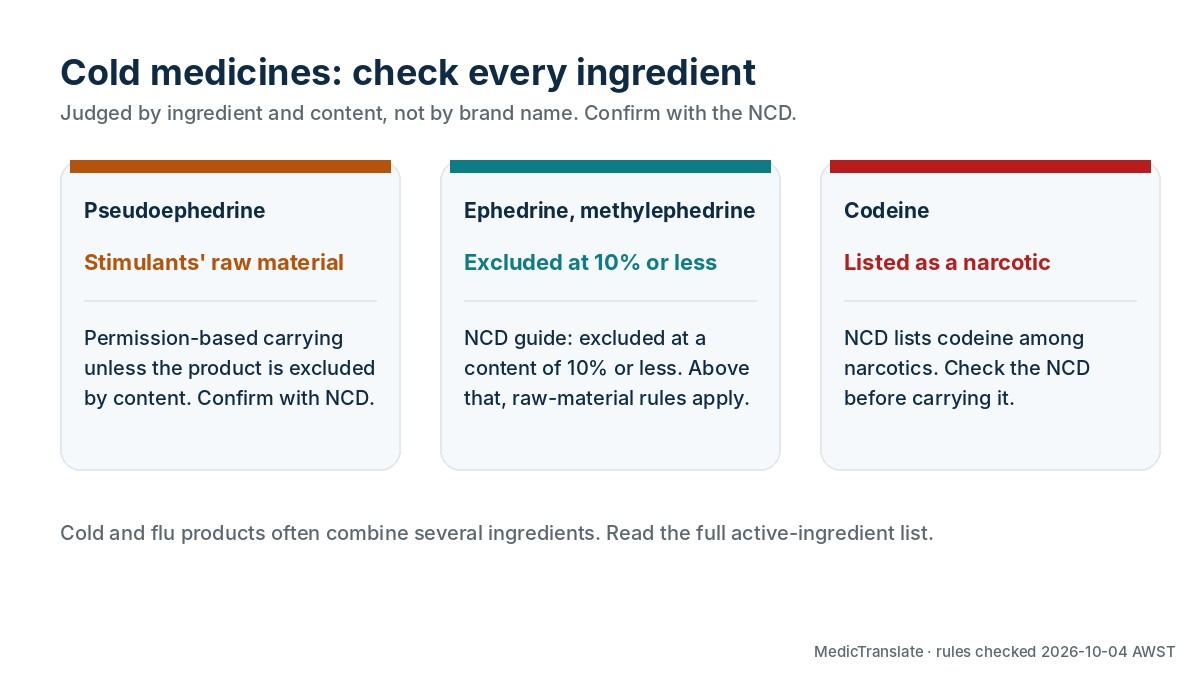
Many cold remedies mix several actives, and one of them can change the answer. Read the full list, not only the front of the pack.
Stimulants' raw material
Permission-based carrying under the NCD process above, unless the product is excluded by content. Confirm with the NCD.
Excluded at 10% or less
The NCD guide excludes these at a content of 10% or less. Above that, the stimulants' raw material rules apply.
Listed as a narcotic
The NCD lists codeine among narcotics. Check the NCD before carrying any product that contains it.
Our overview of controlled medicines in Japan explains how narcotics, psychotropics, stimulants and stimulants' raw materials differ.
What to do if Sudafed cannot come in
If your product is a stimulants' raw material and you do not have permission, do not carry it. Instead, take these steps.
- Ask the NCD first. The NCD or your regional bureau can confirm whether your product needs permission. Do this well before the flight, because the application is due at least 14 days before travel.
- Talk to your own doctor. Ask about options for congestion that do not rely on this ingredient. We cannot advise on treatment.
- Plan to buy a Japanese product after you arrive. Pharmacies and drugstores sell their own cold and nasal medicines. Show the staff your symptoms and your current medicines, and do not assume a Japanese product matches your usual ingredient. Our guide to finding an OTC medicine equivalent in Japan explains the classes sold in pharmacies and drugstores.
- Do not post it. Stimulants' raw materials cannot be sent to Japan.
Do not stop or change prescribed medicine because of travel paperwork. If a doctor prescribed a pseudoephedrine product for you, discuss timing and alternatives with your prescriber well before you travel.
Buying cold medicine in Japan: sales checks for pseudoephedrine
Pseudoephedrine is not unavailable in Japan, but it sits on a list of ingredients with extra sales rules. MHLW's list of over-the-counter medicines with abuse potential includes ephedrine, codeine, dihydrocodeine, bromvalerylurea, pseudoephedrine and methylephedrine. Since 1 April 2023, sellers must check the name and age of a young buyer, ask about purchases at other shops and the reason for purchase, and in principle limit sales to one package per person.
From 1 May 2026, MHLW's revised sales system covers these ingredients as designated abuse-prevention medicines. Pharmacists or registered sellers must sell them face to face or by video call, at pharmacies and drugstores alike. As a result, expect questions at the counter.
If you need help at the counter, an interpreter or a doctor who can communicate in English can help you describe your symptoms.
Want your exact cold medicine checked?
We review the ingredient, strength, dosage form and total quantity against the current published NCD and MHLW guidance and explain the likely next step, including whether you may need advance permission and a doctor certificate.
- Price confirmed before work begins
- Reply within 2–3 business days (or sooner)
- Secure document process
MedicTranslate is not a healthcare provider or customs authority. We do not give medical advice or guarantee customs approval.
Frequently asked questions
Can you bring Sudafed to Japan?
Only with care. Sudafed contains pseudoephedrine, which the Narcotics Control Department lists as a stimulants' raw material. For stimulants' raw materials, the NCD says you need permission before you enter Japan, applied for at least 14 days before travel, with a doctor's certificate issued within 3 months and photos of the packaging. The law excludes preparations with a content of 10% or less, but the NCD traveller pages do not say how that applies to Sudafed-type tablets, so confirm your exact product with the NCD before you pack it.
Is pseudoephedrine illegal in Japan?
No. Pseudoephedrine is not banned outright. Japanese pharmacies and drugstores sell cold medicines that can contain it, under extra sales checks. For travellers, however, the NCD lists pseudoephedrine as a stimulants' raw material, which is why carrying it across the border is controlled.
Do I need a prescription or doctor certificate to carry Sudafed into Japan?
For a product that counts as a stimulants' raw material, yes. The NCD asks for a medical certificate showing your name, address, the reason you take the medicine, a list of the medicine with doses and strength, the doctor's signature, and an issue date within 3 months. The NCD's traveller guidance is written for people using the medicine for their own treatment and does not describe a separate route for over-the-counter purchases.
Does the 2-month over-the-counter rule cover Sudafed?
Not for stimulants' raw materials. MHLW's personal import page gives a 2-month limit for medicines other than poisonous, powerful or prescription drugs, but it also says ordinary individuals may not import stimulants' raw materials, except a person carrying a doctor-prescribed medicine into Japan under the permission system.
Can I post or courier Sudafed to Japan?
No. MHLW guidance for people importing medicines states that psychotropics, narcotics and stimulants' raw materials cannot be sent to Japan. Do not mail a supply to yourself.
What if my Sudafed cannot come in?
Do not carry it without checking. Ask the NCD about your exact product, then consider buying a Japanese over-the-counter cold or nasal product after arrival. Japanese cold medicines can contain pseudoephedrine, ephedrine or methylephedrine, and MHLW lists these among ingredients sold with extra checks, so show the pharmacist your symptoms and your current medicines instead of asking for the same ingredient.
Are cold medicines with codeine or ephedrine also controlled?
They can be. The NCD lists codeine among narcotics, and the NCD guide excludes ephedrine and methylephedrine only at a content of 10% or less. Cold and flu products often combine several ingredients, so check every active ingredient on the label, not only the brand name.
Can MedicTranslate check my cold medicine before I travel?
Yes. Our from US$59 medication assessment reviews your ingredient, strength, dosage form and quantity against the published NCD and MHLW guidance and explains the likely next step. We do not give medical advice or guarantee customs approval; the final decision rests with the Japanese authorities.
This article provides general information reviewed on 4 October 2026. It is not medical, pharmaceutical or legal advice. Classifications, exclusions and import procedures change, and a product's status depends on its ingredients and content. Confirm current requirements with the Narcotics Control Department and MHLW before you travel, and do not stop or change prescribed medicine without advice from your doctor. MedicTranslate provides translation and coordination services.
- Narcotics Control Department: Procedures for import/export of controlled drugs by carrying
- Narcotics Control Department: Carrying narcotics, psychotropics and stimulants' raw materials (Japanese)
- Narcotics Control Department: Guide to carrying stimulants' raw materials (Japanese PDF)
- Kanto-Shinetsu Regional Bureau of Health and Welfare: Carrying narcotics, psychotropics and stimulants' raw materials (Japanese)
- MHLW: Personal import of medicines
- MHLW: Q&A for those importing medicines into Japan (PDF)
- MHLW handling guide for stimulants' raw materials, as republished by Miyagi Prefecture (PDF)
- Tokyo Metropolitan Government: List of stimulants' raw materials (PDF)
- MHLW Safety Information No. 400: Revision of OTC medicines with abuse potential (PDF)
- MHLW: Medicine sales system revision effective 1 May 2026