
Is CBD Legal in Japan? What Travellers Need to Know About CBD Oil and Products
Is CBD legal in Japan? Partly. Since 12 December 2024, Japan regulates cannabis products by their THC content, not by plant part, so a CBD product within the limits is not a narcotic. However, that does not make it safe to carry across the border, because official sources give no traveller allowance and customs treats narcotics and cannabis as prohibited imports.
Quick answer
CBD products are not banned as such in Japan, but a product whose delta-9-THC exceeds 10 ppm (oils and powders), 0.1 ppm (water-based liquids) or 1 ppm (other products) is a narcotic. Neither Japan Customs nor the Narcotics Control Department publishes a traveller allowance for CBD, and the use of cannabis and similar narcotics is now an offence. Our conservative advice is not to bring CBD products into Japan. CBN is a prohibited designated substance from 1 June 2026. For a prescribed cannabis-derived medicine, contact the Narcotics Control Department before you travel.
Carrying a cannabis-derived or prescribed medicine? Check the ingredient and product type before you travel.
Check my medicationOn this page
Is CBD legal in Japan? What changed on 12 December 2024
Japan amended the Cannabis Control Act and the Narcotics and Psychotropics Control Act, and MHLW states that the first stage took effect on 12 December 2024. A second stage on 1 March 2025 covers cannabis cultivation licences. The key change for products is that regulation moved from plant parts to components. MHLW explains that the old system regulated parts such as leaves and flower heads, while the new system regulates harmful components, mainly THC.
As a result, a CBD product is not a narcotic by name or by plant part. It becomes a narcotic when its delta-9-THC exceeds the residue limit for its product type. In addition, MHLW's reform briefing says that components that easily turn into THC, such as THCA, are treated as narcotics.
Legal inside Japan does not mean allowed through the border. The limits below decide whether a product is a narcotic. They are not a traveller allowance, and we found no official page that gives one.
The THC limits for CBD products in Japan
The Narcotics Control Department (NCD) lists three THC limits by product form, which MHLW also publishes on its cannabis law amendment page. The unit ppm is the same as mg per kg.
| Product form | Examples listed by the NCD | Delta-9-THC limit |
|---|---|---|
| Oils and fats, and powders | CBD oil, hemp seed oil, CBD powder | 10 ppm |
| Water-based solutions | Drinks, cosmetic water, alcohol-based liquids | 0.1 ppm |
| Other products | Gummies, creams, capsules, solid confectionery, e-cigarette liquids | 1 ppm |
The NCD handbook defines each form. For example, an oil is a product with at least 90% glycerin and fatty-acid compounds, and the water-based form is a liquid with viscosity below 100 mPa·s. Products that are over their limit are regulated as narcotics.
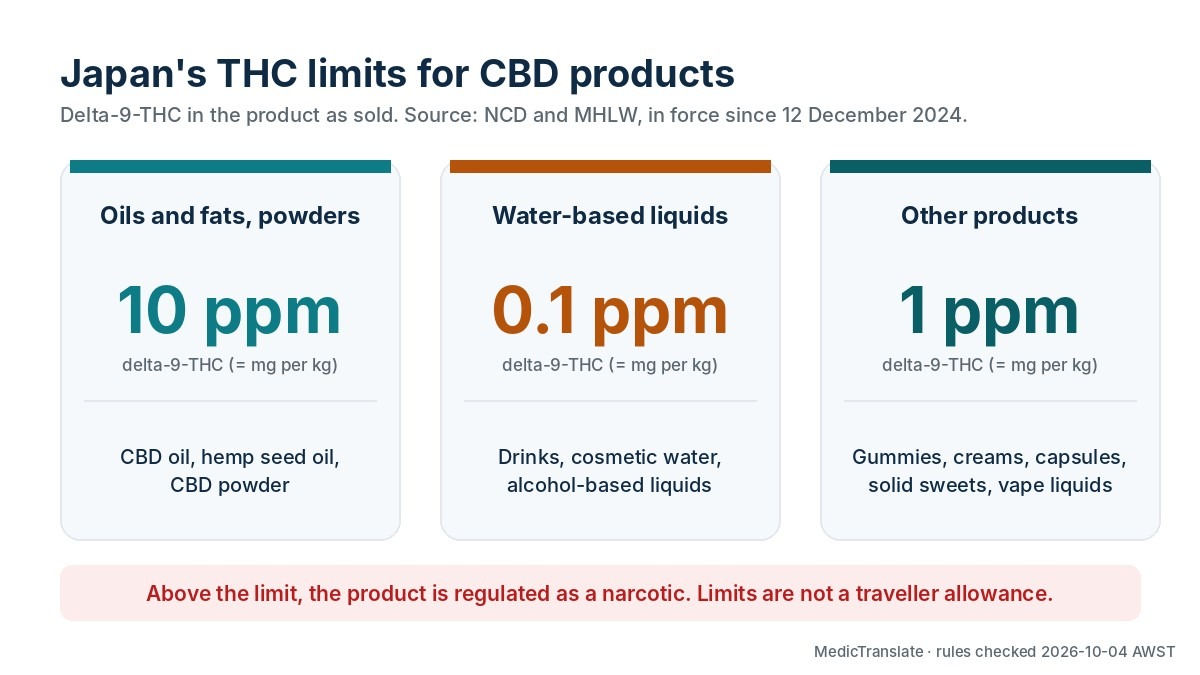
These limits are tiny, and a label is not proof. The NCD asks importers to supply a certificate of analysis with the method, limit of quantification and lot number, which most retail CBD products do not carry for the exact batch you hold.
Can you bring CBD to Japan? What the official sources say
Narcotics and cannabis are prohibited imports
Japan Customs lists narcotics and cannabis among the goods prohibited from import, with penalties under the Customs Act.
No traveller allowance for CBD
The NCD CBD page and handbook are written for importers and do not address personal luggage.
You cannot prove the THC level at the airport
A label is not proof of the batch you hold, and a product above its limit is a narcotic.
The NCD's CBD handbook says its pre-check is not a legally required step and that an answer from the NCD does not exempt a shipment from customs inspection. It adds that if a controlled substance is found, the importer may be punished for importing it. The pre-check is also performed by the importer, not a courier or agent.
Separately, the NCD's page on carrying medicines explains that narcotic medicines for your own treatment need advance permission, applied for two weeks before arrival or departure. That route concerns prescribed medicines. The NCD's English page lists cannabis as a category but gives no cannabis procedure, so it does not tell you how to carry a CBD product.
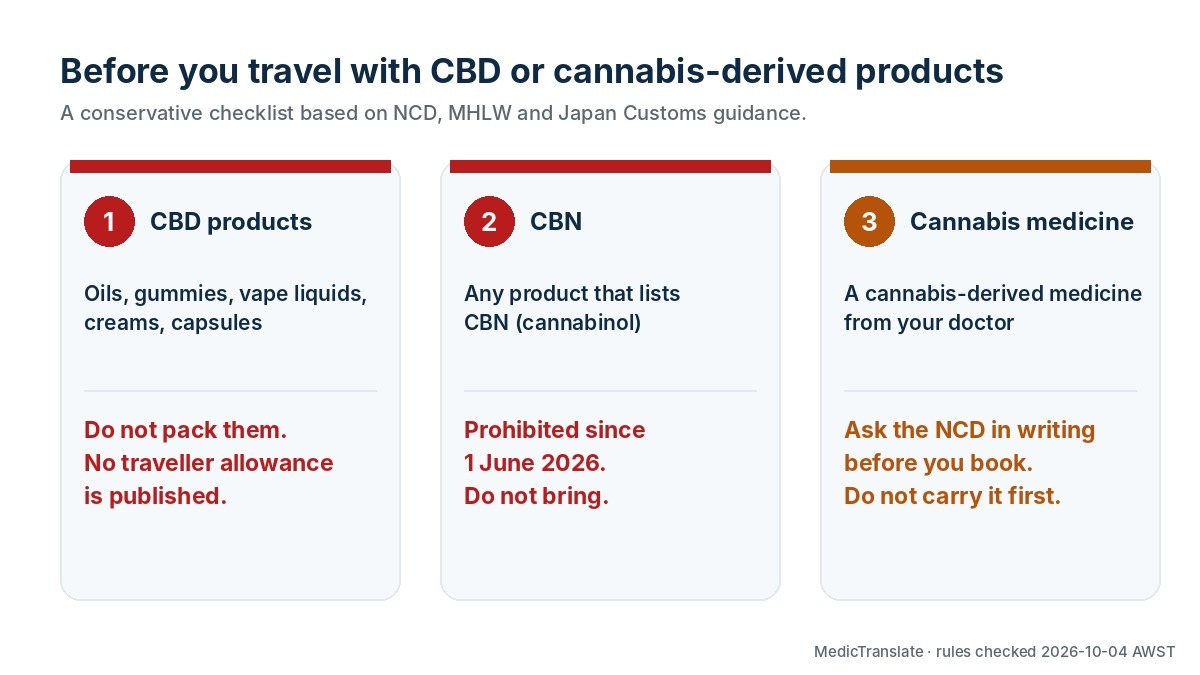
Our conservative advice: do not bring CBD products to Japan. This includes oils, gummies, vape liquids, creams and capsules, and it applies even if the label says "THC-free". Official sources give no allowance, and the consequence of being wrong is criminal.
CBN and "full-spectrum" products
MHLW states that CBN (cannabinol) became a designated substance on 1 June 2026, and that manufacture, import, sale, possession and use of CBN-containing products are prohibited. MHLW's announcement gives penalties of up to 3 years' imprisonment or a fine of up to 3 million yen for standard violations. The NCD's CBD page defines CBD-related products as those containing CBD or CBG and carries the same CBN notice.
Therefore, a product that lists CBN, or that does not disclose every cannabinoid, is a poor candidate for your luggage. Check the full ingredient list, and treat any missing information as a reason to leave the product at home.
The use ban and penalties
The amendment also created a use offence. MHLW states that unauthorised use of cannabis and similar narcotics now falls under the Narcotics and Psychotropics Control Act, and its summary of the reform gives up to 7 years' imprisonment for possession and for unauthorised use. Medical use is possible only under a doctor holding the relevant licence, as MHLW's guidance for patients explains.
We did not verify the penalty range for importing a narcotic on an official page fetched for this article, so we do not quote one. Customs lists penalties under the Customs Act for prohibited imports.
Cannabis-derived medicines such as Epidiolex
MHLW's reform briefing describes Epidiolex as a foreign-approved cannabis-derived medicine for treatment-resistant epilepsy and says the reform allows such medicines to be used under narcotics licensing. This is a policy statement. We could not confirm on an official page today whether any cannabis-derived medicine is approved, imported or prescribed in Japan, so we do not say that one is.
- Do not carry a cannabis-derived medicine until the NCD has told you the procedure in writing.
- Ask your prescriber for a letter that names the active ingredient, the dose and the diagnosis.
- MHLW has published guidance for patients using cannabinoid products, including patients in clinical research. Discuss this with your treating doctor.
Our guide to controlled medicines in Japan explains the other categories.
Step by step: what to do before you travel
- Decide whether you need it in Japan. Most travellers can leave CBD at home.
- Do not pack it. This includes oils, gummies, vape liquids, creams and capsules.
- Check the ingredient list for CBN. A product containing CBN is prohibited in Japan.
- If it is a prescribed cannabis-derived medicine, ask your prescriber for a letter and contact the Narcotics Control Department before you book.
- Allow time. The NCD says its CBD pre-check can take one to two months, and it does not cover customs inspection.
- Keep official guidance with you if you carry any prescribed medicine, and check the rules again close to departure.
What to do if it can't come in
- Leave it at home or give it away before you fly. Do not post it to yourself in Japan.
- If you use it for a medical reason, talk to your prescriber about alternatives for your trip. Do not stop a prescribed medicine because of travel paperwork.
- If you are already in Japan with a product, do not use or sell it, and ask the NCD or the prefectural pharmaceutical affairs division. In a 2022 case, MHLW asked people holding CBD products found to contain THC to hand them to the regional Narcotics Control Department, the prefectural pharmaceutical affairs division or a public health centre.
- If you need care in Japan, find a doctor who can communicate in English, or book an interpreter for the visit.
For other medicines, see our guide on how to bring medication to Japan, and our explanation of Import Confirmation (yakkan shoumei).
Want your medicine or product type checked?
We review the ingredient and product type against the current published NCD and MHLW guidance and explain the likely next step, including whether you should contact the Narcotics Control Department before you travel.
- Price confirmed before work begins
- Reply within 2–3 business days (or sooner)
- Secure document process
MedicTranslate is not a healthcare provider or customs authority. We do not test products, give medical advice or guarantee customs approval.
Frequently asked questions
Is CBD legal in Japan?
CBD products are not banned as such, but only if their THC stays within the limits set by the 2024 amendment: 10 ppm for oils and powders, 0.1 ppm for water-based liquids and 1 ppm for other products. A product above its limit is treated as a narcotic. MHLW publishes no allowance for travellers carrying CBD, so MedicTranslate's conservative advice is not to bring CBD products into Japan.
Can I bring CBD oil to Japan?
We advise against it. Japan Customs lists narcotics and cannabis among the goods prohibited from import, and the Narcotics Control Department says a product that tests above the THC limit can lead to punishment for importing a controlled substance. Neither body publishes a personal-use or traveller allowance for CBD products, so you cannot rely on a small quantity being tolerated.
What THC limits apply to CBD products in Japan?
The Narcotics Control Department lists three limits for delta-9-THC: 10 ppm (10 mg/kg) for oils and fats and for powders, 0.1 ppm for water-based solutions, and 1 ppm for everything else, such as gummies, creams, capsules and e-cigarette liquids. These limits apply to the product as sold, not to the CBD content.
Is CBD from hemp seeds or stalks allowed?
Japan's rule no longer turns on the plant part. MHLW explains that the old system regulated parts such as leaves and flower heads, and the amended system regulates harmful components, mainly THC. Hemp seed oil is listed by the Narcotics Control Department as an oil subject to the 10 ppm limit, so the product's THC level is what counts.
Is it a crime to use cannabis in Japan?
Yes. Since the amendment took effect on 12 December 2024, unauthorised use of cannabis and similar narcotics is an offence under the Narcotics and Psychotropics Control Act. MHLW's summary of the amendment gives up to 7 years' imprisonment for unauthorised use and for possession.
Is CBN banned in Japan?
Yes. CBN (cannabinol) was designated a designated substance (shitei yakubutsu) on 1 June 2026. MHLW states that manufacture, import, sale, possession and use of products containing CBN are prohibited, with penalties of up to 3 years' imprisonment or a fine of up to 3 million yen announced for standard violations. Do not bring any product that lists CBN.
Does the Narcotics Control Department's CBD pre-check make importing safe?
No. The pre-check is run by email for importers, is described by the Narcotics Control Department as not legally required, and does not exempt a shipment from customs inspection. If a controlled substance is found, the importer can still be punished. The page does not say it covers travellers' personal luggage.
Can I bring Epidiolex or another cannabis-based epilepsy medicine?
Do not carry it until the Narcotics Control Department has confirmed the procedure in writing. MHLW's reform briefing names Epidiolex as an example of a cannabis-derived medicine that the law would allow within narcotics licensing, but we could not verify on an official page whether any such medicine is approved or available in Japan. Ask your prescriber and the Narcotics Control Department before you travel.
Can MedicTranslate check my CBD or cannabis-derived medicine?
Yes, within limits. Our from US$59 medication assessment reviews your ingredient and product type against the published NCD and MHLW guidance and explains the likely next step. We do not test products, confirm THC content, give medical advice or guarantee customs approval; the final decision rests with the Japanese authorities.
This article provides general information reviewed on 4 October 2026. It is not medical, pharmaceutical or legal advice. Cannabis, narcotics and designated-substance rules change often. Confirm current requirements with the Narcotics Control Department, MHLW and Japan Customs before you travel, and do not stop or change a prescribed medicine without advice from your doctor. MedicTranslate provides translation and coordination services.
- MHLW: Cannabis Control Act and Narcotics Act amendment, THC residue limits and use offence (Japanese)
- Narcotics Control Department: Notice for those considering importing CBD products, 1 June 2026 (PDF, Japanese)
- Narcotics Control Department: Importing CBD-related products and CBN notice (Japanese)
- MHLW: Outline of the cannabis law reform, penalties and cannabis-derived medicines (PDF, Japanese)
- MHLW: Cannabis regulation by plant part and by component, THCA (PDF, Japanese)
- MHLW: Guidance for patients using cannabinoid products after 12 December 2024 (PDF, Japanese)
- MHLW: CBN designated as a designated substance from 1 June 2026 (Japanese)
- MHLW Pharmaceutical Safety: CBN designation announcement, 18 March 2026 (Japanese)
- Japan Customs: Goods prohibited from import (Japanese)
- Narcotics Control Department: Carrying narcotics, psychotropics and stimulants' raw materials (Japanese)
- Narcotics Control Department: Procedures for import/export of controlled drugs by carrying (English)
- Hyogo Prefecture: CBD products found to contain THC (Japanese)