
Medical Records Translation for Japan: When You Need It and What to Translate
Medical records translation for Japan comes up in two directions: overseas records that a Japanese doctor needs to read, and Japanese receipts and reports that an insurer needs to understand. This guide covers when translation is required, the official rules for health insurance claims, what to translate first, and what it costs.
Quick answer
Translate overseas records into Japanese when a Japanese doctor needs your history, test results or medication list. For Japanese public health insurance overseas medical expense claims (kaigai ryōyōhi), foreign-language documents need a Japanese translation that includes the translator’s name and address; some insurers also want a signature and phone number. Claims expire 2 years after you pay. Insurers abroad usually need Japanese receipts and medical certificates in English. Start with a one-page summary, the medication list and key results.
Have records to translate? Upload them and we will confirm a binding price before work begins.
Request a translation quoteOn this page
- When you need medical records translation for Japan
- What to include in medical records translation for Japan
- Medical records translation for Japan insurance claims (kaigai ryōyōhi)
- Translating Japanese records for an overseas insurer
- Cost and turnaround of medical records translation for Japan
- Frequently asked questions
When you need medical records translation for Japan
Most people need translation in one of these situations:
- Seeing a doctor in Japan with an existing condition, so the doctor can read your history, results and current medication.
- Continuing treatment or prescriptions started overseas, where the doctor needs to see the original prescriber’s details.
- Hospital admission or surgery, where past operations, allergies and anaesthesia history matter.
- Claiming on Japanese public health insurance for treatment you received abroad.
- Claiming on an overseas insurer for treatment you received in Japan.
In each case, the receiving doctor or insurer decides what it will accept. Therefore, ask them first which documents they need and in what form.
What to include in medical records translation for Japan
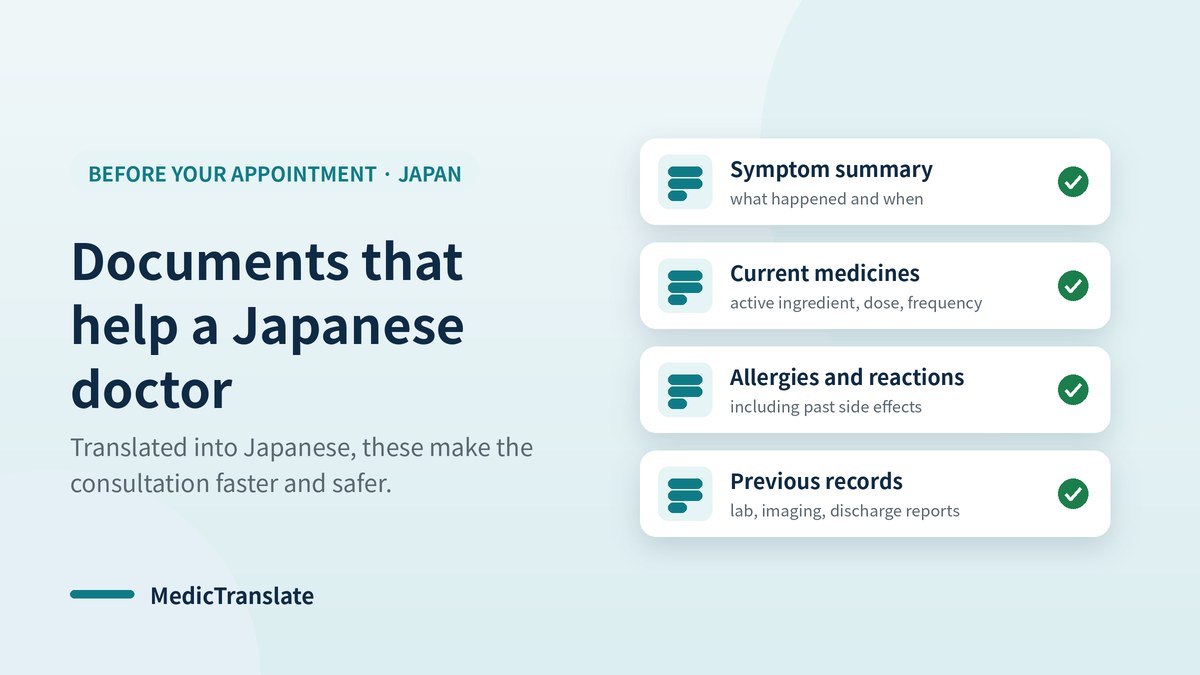
You rarely need every page translated. Instead, prioritise what a Japanese doctor reads first:
Summary and medication
Discharge or clinical summary, diagnosis list, current medicines with doses, and allergies.
Key results
Recent blood tests, imaging reports (not the images) and pathology reports.
Full notes
Long progress notes, nursing records and historic results. Ask the doctor before paying for these.
Ask your overseas doctor for a one or two-page summary letter before you leave. It is cheaper to translate and easier for a Japanese doctor to use than a full record.
Medical records translation for Japan insurance claims (kaigai ryōyōhi)
If you are covered by Japanese public health insurance and needed urgent treatment while travelling abroad, you may be able to claim overseas medical expenses (海外療養費, kaigai ryōyōhi). Official guidance sets clear translation rules:
| Rule | What the official source says |
|---|---|
| Translation required | Osaka City NHI: foreign-language documents need a Japanese translation that states the translator’s address and name. |
| Translator details | Japan Health Insurance Association (Kyokai Kenpo): the translator signs and states an address and phone number. |
| Time limit | Claims expire 2 years after the day after payment (Kyokai Kenpo) or treatment (Osaka City NHI). |
| Amount | Based on what the treatment would cost in Japan, or the amount paid if lower, minus your co-payment (Osaka City NHI). |
| Excluded | Trips made for the purpose of treatment, and treatment not covered in Japan, such as cosmetic surgery (Kyokai Kenpo). |
Each insurer publishes its own forms and rules. Check your insurer’s page before translating, so the translation matches the forms it expects.
Translating Japanese records for an overseas insurer
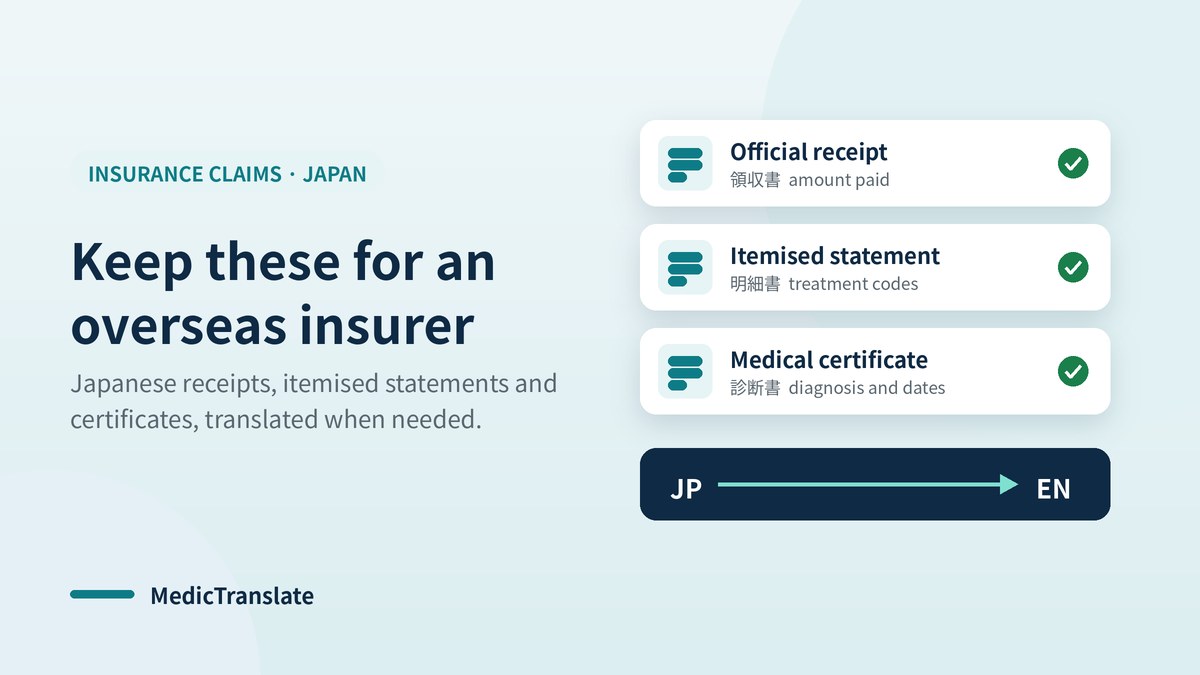
On the other hand, if you were treated in Japan and claim on travel or international health insurance, the insurer usually needs English versions of:
- receipts (領収書, ryōshūsho) and itemised statements (明細書, meisaisho);
- a medical certificate (診断書, shindansho) stating diagnosis and treatment dates;
- discharge summaries or referral letters, if requested.
In addition, some authorities or insurers require a specific type of certification, such as a translator declaration or notarisation. Ask the receiving organisation what it needs before ordering, because certification requirements differ by country.
Cost and turnaround of medical records translation for Japan
On our pricing page, as of 5 October 2026:
| Item | Price |
|---|---|
| Medical document translation | US$120 per source page (1 page = up to 200 source words) |
| Standard delivery | From 72 hours |
| Priority (48 hours) | Standard price +50% |
| Same-day or 24-hour | Quotation required |
| Notarisation | Available as an add-on; see pricing page |
As a result, a two-page summary letter costs far less than a full hospital file. The binding price is confirmed from your actual documents before payment.
Get your records ready for a Japanese doctor or insurer
Human-validated medical translation between Japanese and English and other languages, with the translator details insurers ask for. Upload your documents for a binding quote.
- Price confirmed before work begins
- Standard delivery from 72 hours
- Priority 48-hour option
- Secure document process
We translate documents; we do not assess claims, decide insurance eligibility or give medical advice.
Frequently asked questions
Do Japanese doctors need my medical records translated?
Not always, but it helps. A translated summary, medication list and key results let a Japanese doctor understand your history quickly. Ask the clinic what it needs before translating a full record.
What translation does a kaigai ryoyohi claim need?
Foreign-language documents need a Japanese translation. Osaka City NHI asks for the translator’s address and name, and the Japan Health Insurance Association asks the translator to sign and give an address and phone number. Check your own insurer’s rules.
How long do I have to claim overseas medical expenses?
Two years. Osaka City NHI counts from the day after treatment, and the Japan Health Insurance Association counts from the day after you paid. After that, the claim expires.
Can I claim if I travelled abroad for treatment?
No. The Japan Health Insurance Association states that treatment received on a trip made for the purpose of treatment is not covered, and neither is treatment not covered in Japan, such as cosmetic surgery.
How much does medical records translation cost?
MedicTranslate charges US$120 per source page, where one page is up to 200 source words. Priority 48-hour delivery adds 50%. The binding price is confirmed from your documents before payment.
Should I translate scans and X-ray images?
Usually not. Doctors read the radiologist’s report, so translate the report and bring the images on disc or as files in their original form.
This article provides general information reviewed on 5 October 2026. It is not medical, insurance or legal advice. Claim rules, forms and time limits differ between insurers and municipalities, so confirm them with your insurer before submitting. MedicTranslate translates documents and can include translator details on request; it does not assess claims, decide eligibility or guarantee acceptance.