
Prescription Translation for Japan: When It Helps and What It Must Show
Prescription translation for Japan turns your overseas prescription or medication list into clear Japanese that a doctor, pharmacist or official can read. This guide explains when a translation helps, what it must show, and why it cannot replace a Japanese prescription.
Quick answer
A translated prescription is information, not permission. It helps a Japanese doctor understand your treatment, helps you answer questions about the medicine you carry, and helps a pharmacist see your full list. It must show the generic name, strength, dosage form, dose and timing, and the prescriber. A Japanese pharmacy dispenses against a prescription from a doctor licensed in Japan, so to get more medicine locally you need to see a Japanese doctor.
Need your prescription or medication list in Japanese? Send it for a quote. The price is confirmed before work begins.
Request a translation quoteOn this page
Why prescription translation for Japan matters
Japanese clinics, hospitals and pharmacies work in Japanese. Many staff read some English, but a prescription is dense: abbreviations, brand names and dose instructions vary from country to country. A brand name used at home may not exist in Japan, or may belong to a different product.
A clear Japanese translation puts the important details where a Japanese reader expects them. It reduces the risk of misunderstanding about which medicine you take, how strong it is and how often you take it. It also saves time at the first appointment, when the doctor is trying to understand your history quickly.
When a translated prescription helps
Questions about medicine you carry
MHLW allows up to one month’s supply of prescription medicine for personal use without special procedures. More than that needs an Import Confirmation (輸入確認証) before you leave home, and the application includes a copy of your prescription. Carrying a copy, with a Japanese version, makes questions easier to answer.
Continuing care with a Japanese doctor
If you stay longer than your supply lasts, a Japanese doctor needs to understand your current treatment. A translated medication list and treatment summary give the doctor the facts to start from.
Pharmacies and the medicine notebook
When you fill a Japanese prescription, the pharmacist asks what else you take. A Japanese list of your other medicines helps, and you can keep it with your okusuri techō.
A translation does not change what is allowed. Some medicines are prohibited in Japan, and others need separate permission. Check the prohibited medication list and our guide on how to bring medication to Japan before you travel.
Can a Japanese pharmacy fill a foreign prescription?
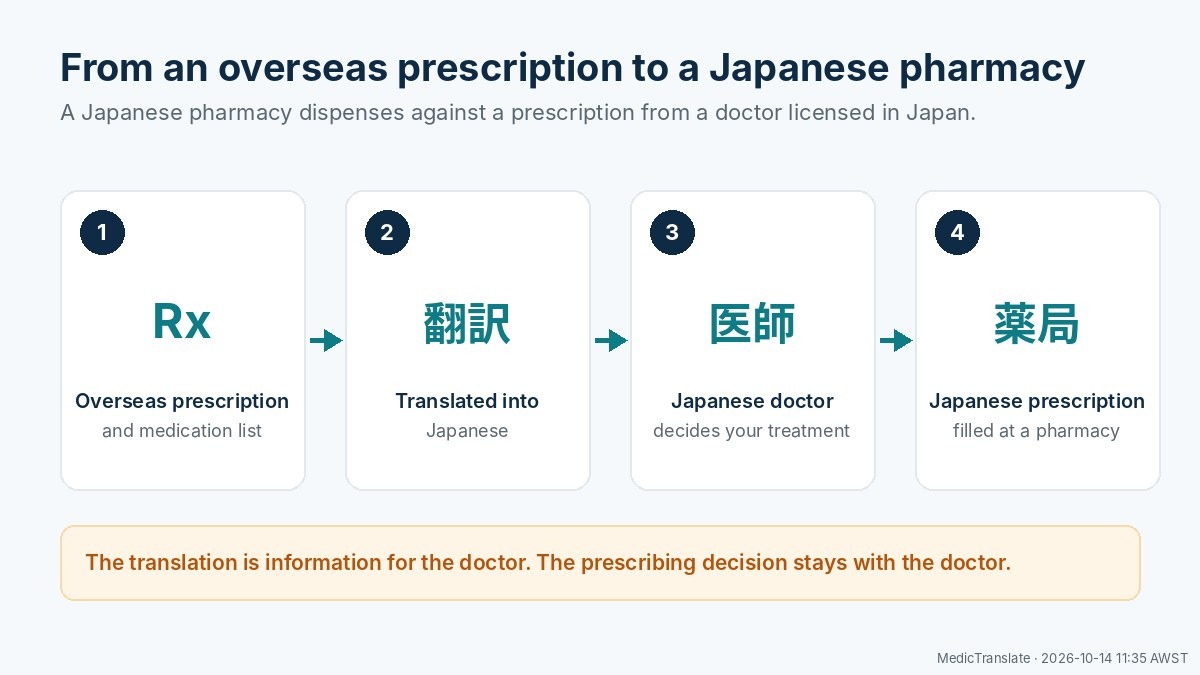
In practice, no. Under Article 23 of Japan’s Pharmacists Act, a pharmacist may only dispense against a prescription from a doctor, dentist or veterinarian. Under the Medical Practitioners Act, a doctor in Japan must hold a licence from the Minister of Health, Labour and Welfare, and only a doctor may practise medicine. So a prescription from an overseas doctor, translated or not, is not something a Japanese pharmacy can fill.
What your overseas prescription can do is show a Japanese doctor what you take and why. The doctor then makes their own decision and, if appropriate, writes a Japanese prescription (処方箋). Some medicines need a registered pharmacy or other checks, so confirm that the dispensing pharmacy can supply the exact medicine. Our guide to continuing an overseas prescription in Japan walks through that process.
What a prescription translation for Japan must show
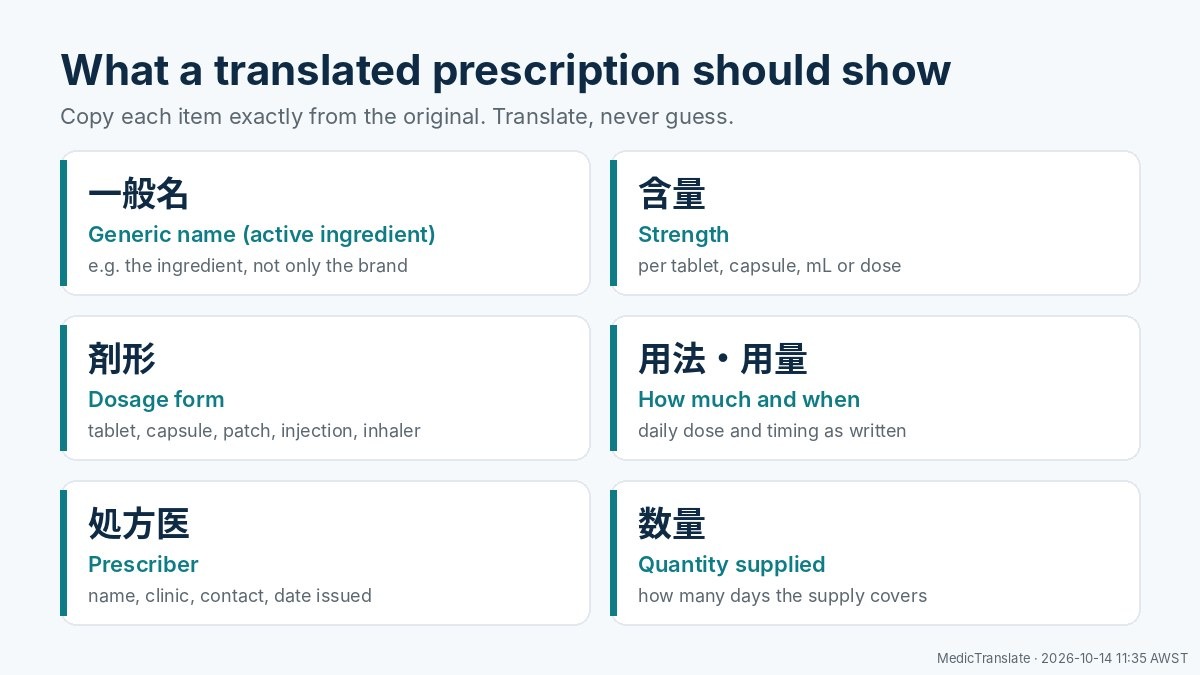
A useful translation copies each detail exactly from the original. It does not round numbers, guess missing details or swap a brand for a Japanese product. Make sure each medicine shows the following.
| Detail | Japanese label | Why it matters |
|---|---|---|
| Generic name (active ingredient) | 一般名 | Brand names differ between countries. The active ingredient is what a Japanese doctor or pharmacist looks up. |
| Strength | 含量 | The amount per tablet, capsule, mL or dose. Strengths sold in Japan may differ from yours. |
| Dosage form | 剤形 | Tablet, extended-release tablet, capsule, patch, inhaler or injection. Release type matters as much as the ingredient. |
| Dose and timing | 用法・用量 | How much you take each day and when, exactly as your prescriber wrote it. |
| Prescriber | 処方医 | Name, clinic, contact details and date issued, so the source of the prescription is clear. |
| Quantity supplied | 数量 | How many days the supply covers. This links to the one-month personal-use allowance. |
It also helps to include the reason for each medicine if your prescriber has written it down, any allergies, and how long you have taken the medicine. Only include what is in your records; a translator should never add clinical details.
How to prepare your documents
- Collect the originals Gather current prescriptions, pharmacy labels and any letter from your doctor. Check that each medicine you take is on them.
- Ask your prescriber for a letter A short letter listing each medicine by generic name, strength, form and dose, and its purpose, is often clearer than separate prescriptions.
- Check import rules early If you carry more than one month’s supply or a controlled medicine, check the requirements before you book flights. See Import Confirmation applications.
- Get the Japanese translation Have it done from the originals, and keep the original and the translation together.
- Carry copies Keep a paper copy in your hand luggage and a photo on your phone, and bring both to your first Japanese appointment.
What a translation cannot do
A translated prescription does not authorise import, does not replace an Import Confirmation where one is needed, and does not replace a Japanese prescription. Whether a document is accepted is decided by the authority, clinic or pharmacy you show it to. A translation also does not tell you whether a medicine is right for you in Japan; that is a decision for a Japanese doctor.
MedicTranslate provides prescription and medical document translation, human-validated, with standard delivery from 72 hours. If you are unsure whether your medicine can come into Japan, our personal medication import assessment, from US$59, summarises the published guidance for your medicines and lists questions to raise with the authority. You complete and submit any government application yourself. MedicTranslate does not submit, represent, or guarantee outcomes.
Get your prescriptions ready for Japan
MedicTranslate translates prescriptions, medication lists and doctor letters into Japanese, and checks the import requirements for the medicines you plan to bring.
- Human-validated medical translation
- Standard delivery from 72 hours
- Medication import assessment from US$59
- Price confirmed before work begins
Reply within 1–3 business days. We do not give medical or legal advice, and we cannot guarantee import approval.
Frequently asked questions
Can I use my foreign prescription at a Japanese pharmacy?
In practice, no. Under the Pharmacists Act, pharmacists dispense against a prescription from a doctor, and a doctor in Japan must be licensed in Japan. Show your overseas prescription to a Japanese doctor, who decides whether to write a Japanese prescription.
Do I need a translated prescription to bring medicine into Japan?
MHLW allows up to one month's supply of prescription medicine for personal use without special procedures. More than that needs an Import Confirmation before you leave, and the application includes a copy of your prescription. A Japanese translation is not stated as a requirement, but carrying one can make questions easier to answer.
What should a translated prescription show?
Each medicine's generic name, strength, dosage form, daily dose and timing, the prescriber's name and contact details, the date issued and the quantity supplied. Every detail should be copied exactly from the original.
Why does the generic name matter?
Brand names differ between countries, and a brand you know may not exist in Japan. The generic name, also called the active ingredient, is what a Japanese doctor or pharmacist uses to identify the medicine.
Will a translated prescription be accepted?
Acceptance is decided by the authority, clinic or pharmacy you show it to, so no translator can promise it. A clear and complete translation reduces the risk of misunderstanding.
Can MedicTranslate summarise the import rules for my medicine?
Our personal medication import assessment, from US$59, summarises the published guidance for your medicines and lists questions to raise with the authority. It is not legal advice or an individual clearance decision. You complete and submit any government application yourself. MedicTranslate does not submit, represent, or guarantee outcomes. We do not give medical advice or recommend medicines.
This article provides general information reviewed on 14 October 2026. It is not medical, pharmaceutical or legal advice. Import rules, quantity limits and the handling of documents can change and depend on the medicine, so confirm them with MHLW, customs and your doctor or pharmacist. A translation does not guarantee that any authority, clinic or pharmacy will accept a document. Do not stop or change a medicine without consulting a qualified clinician. MedicTranslate provides translation, interpreting, coordination and medication import assessment services and is not a healthcare provider, law firm or customs authority.
- MHLW: Information for those who are bringing medicines for personal use into Japan
- MHLW: Q&A for those who are importing medicines into Japan, Q5 lists the documents (English, PDF)
- Pharmacists Act, Article 23: dispensing against prescriptions (Japanese)
- Medical Practitioners Act, Articles 2 and 17: medical licence (Japanese)
- Consular Office of Japan in Anchorage: Medications