
Bringing Supplements to Japan: Vitamins, Herbal and Homeopathic Products
Bringing supplements to Japan is usually simple, but not always. Japan does not sort products by what the bottle calls itself. Instead, it looks at the ingredients, the claims, the form and the dosing instructions, so a “health food” from home can count as a medicine at a Japanese airport. This guide explains how that test works and what to check before you pack.
Quick answer
When bringing supplements to Japan for your own use, ordinary vitamins and minerals are generally treated as food, and food imported for personal use does not need a food import notification. However, Japan treats a product as a medicine if it contains an ingredient used only as a medicine in Japan (melatonin is one), makes treatment claims, or has a medicine-like form or dosing. Medicines follow the personal-use allowances: up to a 2-month supply, or 1 month for prescription-only medicines. Above that, you need an Import Confirmation.
Not sure whether a product counts as a medicine in Japan? List your supplements and medicines and check them against Japanese guidance before you fly.
Check my medicationOn this page
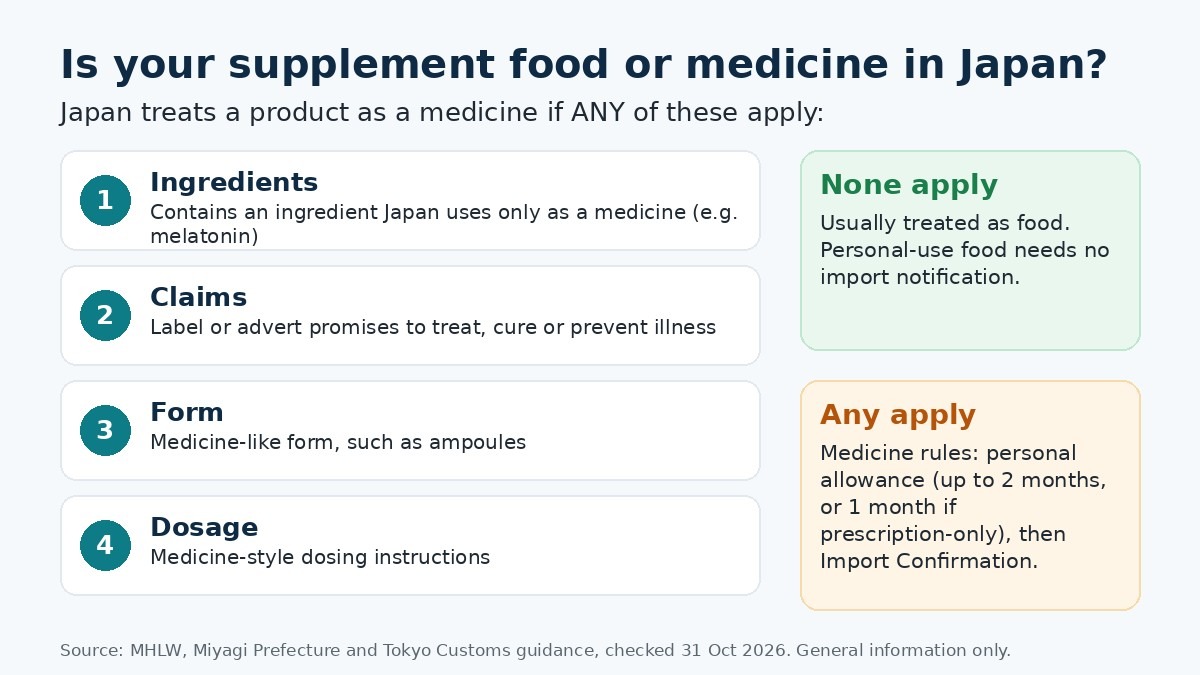
Bringing supplements to Japan: food or medicine?
In many countries, vitamins, fish oil and herbal capsules sit in a “supplement” category of their own. Japan has no such separate category for travellers. As a result, every product falls on one side of a line: it is either a food (often called a 健康食品, kenkō shokuhin, or health food) or a medicine (医薬品, iyakuhin).
Prefectural pharmaceutical guidance, based on the national standard, explains that a product is judged to be a medicine if any of these apply:
Ingredients
It contains a raw material that Japan uses exclusively as a medicine.
Claims
The label or advertising claims a medicinal effect, such as treating or preventing an illness.
Form
It has a medicine-like form, for example an ampoule.
Dosage
It sets medicine-style directions for use and dosage.
In other words, a product sold as a health food can still be treated as an unapproved medicine in Japan if it shows medicinal claims or contains a medicinal ingredient. That is why the brand name or the shop you bought it from does not settle the question.
Ingredients to check before bringing supplements to Japan
MHLW keeps a list of raw materials that are used exclusively as medicines in Japan, and prefectures note that it is revised from time to time. Therefore, the safest approach is to read the full ingredient panel of every product, not just the front label.
Melatonin is a medicine ingredient in Japan. MHLW states that melatonin is a raw material used exclusively as a medicine in Japan. For example, a melatonin sleep aid sold as a supplement in the United States is treated as a medicine when you bring it to Japan. See our melatonin guide for the details.
In addition, some ingredients raise separate legal issues. For instance, products made from cannabis, including some CBD products, can contain THC, which Japan controls strictly. Our CBD guide covers this. Similarly, if a product lists an ingredient you do not recognise, check it before you travel rather than at the airport.
Quantity limits for bringing supplements to Japan
The answer depends on which side of the food–medicine line your product falls.
| If the product is treated as… | What applies (official source) |
|---|---|
| Food (most ordinary vitamins and minerals) | Japan Customs explains that food imported for personal use does not need the food import notification to MHLW. No numeric personal limit for food is stated, and Customs suggests asking the quarantine station in advance if you are unsure whether an amount counts as personal use. |
| Medicine or quasi-drug (not prescription-only) | Up to a 2-month supply without an Import Confirmation (MHLW). |
| Prescription-only medicine | Up to a 1-month supply without an Import Confirmation (MHLW). |
| Topical products (not prescription-only) | Up to 24 items per product (MHLW). |
Consequently, if a supplement counts as a medicine and you need more than the allowance, for example for a long stay, you apply for an Import Confirmation before travel. Our Import Confirmation guide explains who needs one. In every case, the products must be for your own use; MHLW states that personally imported medicines may not be sold or given to other people.
Herbal, kampo and homeopathic remedies
We did not find any official Japanese traveller guidance that creates a separate category for herbal, kampo or homeopathic remedies. Instead, they are judged by the same four-point test as any other supplement.
- Labels with treatment claims: a remedy whose packaging says it treats a named condition is more likely to be treated as a medicine, because of the claims test.
- Herbal ingredients: Japan’s list of ingredients used only as medicines covers raw materials, not just synthetic substances, so check each herb by name.
- Remedies your doctor prescribed: keep the doctor’s letter or prescription with the product, and count the supply against the medicine allowances above.
Unsure about a specific remedy? Ask the Regional Bureau of Health and Welfare that covers your arrival airport before you travel. For Narita and Haneda that is the Kanto-Shinetsu Bureau; for Kansai and Chubu Centrair it is the Kinki Bureau (MHLW).
Ordering supplements online to Japan
Bringing supplements to Japan in your luggage and ordering them to a Japanese address are both personal imports. However, MHLW warns about the health risks of medicines and supplements bought online from overseas, and it publishes reports of overseas products found to contain undeclared medicine ingredients. As a result, a product that looks like a harmless supplement can still be stopped as a medicine.
Before you order, therefore, check the full ingredient list, buy only what you will use yourself, and keep the order and packaging. MHLW runs a consultation line for personal imports of medicines (03-5542-1865, Monday, Wednesday and Friday, 9:30–16:00, Japanese).
Packing checklist for bringing supplements to Japan
- Read every ingredientCheck the full ingredient panel, not only the brand name or the front label.
- Flag medicine-only ingredientsMelatonin is one example. If in doubt, check it before you travel.
- Keep original packagingLabelled bottles make it easy to show what the product is and how much you carry.
- Bring only what you will usePersonal imports are for your own use, not for friends, family or resale.
- Check the amount against the allowanceIf a product counts as a medicine, stay within the 2-month (or 1-month prescription) supply, or apply for an Import Confirmation.
- Leave cannabis-derived products at homeProducts containing THC are strictly controlled in Japan.
- Carry your doctor’s letterIf a doctor told you to take the product, a letter in English or Japanese helps explain it.
If your doctor’s letter or prescription is in German, French or Arabic, a medical document translation into English or Japanese keeps the ingredient names and doses clear.
Check your supplements and medicines before you fly
MedicTranslate reviews the products and medicines you list against current published MHLW guidance and explains, item by item, which Japanese process is likely to apply.
- Item-by-item outcome for Japan
- Checked against current official guidance
- Doctor’s letter translation available (quoted separately)
Price confirmed before you pay · Reply within 1–3 business days · MedicTranslate does not issue Import Confirmations, act as your agent or guarantee customs clearance.
Frequently asked questions
Can I bring vitamins and supplements to Japan?
Usually, yes, if they are for your own use. Ordinary vitamins and minerals are generally treated as food, and food imported for personal use does not need a food import notification. However, a product that contains an ingredient Japan treats as a medicine, or that makes treatment claims, is handled under the medicine rules instead.
How does Japan decide if a supplement is a medicine?
Japan looks at four things: the ingredients, any medicinal claims on the label or in advertising, a medicine-like form such as an ampoule, and medicine-style dosing instructions. If any one of these applies, the product is treated as a medicine, even if it is sold as a health food.
Is melatonin a supplement or a medicine in Japan?
A medicine. MHLW states that melatonin is a raw material used exclusively as a medicine in Japan, so melatonin products follow the medicine rules for personal import, even if they are sold as supplements elsewhere.
How much of a supplement can I bring if it counts as a medicine?
Without an Import Confirmation, MHLW allows up to a 2-month supply of medicines that are not prescription-only, and up to a 1-month supply of prescription-only medicines. Above that, you need to apply for an Import Confirmation before you travel.
Are homeopathic or herbal remedies allowed in Japan?
We found no separate traveller category for them in official Japanese guidance. They are judged by the same test as other supplements, so check each ingredient and any treatment claims on the label. If you are unsure, ask the Regional Bureau of Health and Welfare for your arrival airport before you travel.
Can I bring supplements for my family or to sell in Japan?
No. Personal imports are for your own use. MHLW states that medicines imported personally may not be sold or given to other people, and food brought in for sale or business use needs a food import notification.
Does MedicTranslate decide whether my supplement is allowed?
No. Only the Japanese authorities make that decision. MedicTranslate can review the products you list against published guidance and translate your doctor's letter, and you remain responsible for what you carry.
This article provides general information based on published Japanese government guidance reviewed on 31 October 2026. It is not medical or legal advice and is not an official customs or product-classification decision. Whether a specific product is treated as food or medicine depends on its ingredients, labelling and form, and rules change, so confirm current requirements with MHLW, the responsible Regional Bureau of Health and Welfare or the quarantine station before travel.
MedicTranslate provides translation, interpreting, information and healthcare coordination services. It does not issue Import Confirmations, classify products on behalf of the authorities, act as your agent, or guarantee customs clearance.
- MHLW: Bringing medicines for personal use into Japan (quantity limits)
- MHLW: Health food found to contain the medicine ingredient melatonin (Japanese)
- MHLW: Personal import of medicines (Japanese)
- Miyagi Prefecture: Health foods and the medicine classification criteria (Japanese)
- Tokyo Customs: Food Sanitation Act import notification and personal use (Japanese)