
Can You Bring an EpiPen to Japan? Adrenaline Auto-Injector Rules and Allergy Tips
Yes, you can bring an EpiPen to Japan. Adrenaline (epinephrine) is not a controlled substance in Japan, and auto-injectors count as self-injection kits under the personal-use rules. This guide covers how many pens you can carry, what to do if you need a replacement in Japan, and how to manage a food allergy day to day.
Quick answer
Carry your auto-injectors (EpiPen, Auvi-Q, Jext, Emerade or similar) in your hand luggage with a prescription or doctor’s letter. Japan allows prescription medicines in self-injection kits up to one month’s supply without an Import Confirmation; MHLW’s Q&A (Q50) also allows up to two adrenaline auto-injectors, including a spare, without Import Confirmation. Loose needles or syringes are different and need an Import Confirmation. In an emergency, use the pen as instructed and call 119.
Travelling with a severe allergy? Get an allergy card or doctor’s letter translated into Japanese before you go.
Request a translation quoteOn this page
Can you bring an EpiPen to Japan? The import rules
Before you bring an EpiPen to Japan, it helps to know how it is classed. Adrenaline auto-injectors are prescription medicines. They are not narcotics, psychotropics or stimulants in Japan, so no Narcotics Control Department permit is needed. Instead, the Ministry of Health, Labour and Welfare (MHLW) personal-use rules apply.
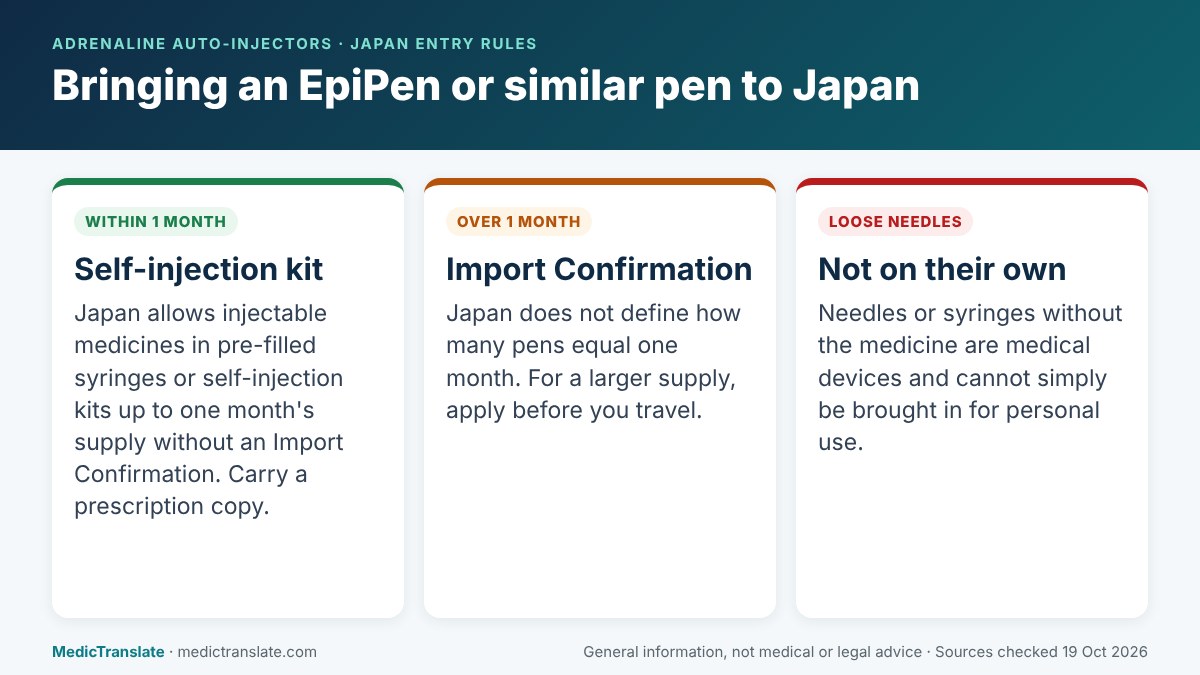
Up to one month’s supply
MHLW allows injectable medicines in pre-filled syringes or self-injection kits up to one month’s supply for personal use. Auto-injectors fit this rule.
A larger supply
MHLW allows up to two adrenaline auto-injectors, including a spare, without Import Confirmation. If your prescriber recommends carrying more, ask the Regional Bureau about Import Confirmation before you travel. Do not reduce your prescribed emergency supply without consulting your clinician.
Loose needles or syringes
MHLW treats syringes on their own as medical devices that need an Import Confirmation, even for one piece.
If you are unsure, MHLW suggests emailing the pharmaceutical inspector at your arrival airport with the product name, ingredient, strength, form and quantity.
How to bring an EpiPen to Japan: packing and documents
- Hand luggage, always. The pens need to be with you during the flight and on arrival, not in a checked bag.
- Keep them in the original box with the pharmacy label, so customs can match the label to your documents.
- Carry a prescription or doctor’s letter naming the medicine (adrenaline/epinephrine), the strength (for example 0.3 mg or 0.15 mg), the allergy and the number of pens.
- Check the expiry date before you go. Replacing a pen in Japan takes a doctor’s visit (see below).
- Bring a written allergy action plan and, ideally, a Japanese translation of it and of your allergy list.
Airlines set their own rules for medical items in the cabin, so check your airline’s policy as well.
Forgot or used it? When you cannot bring an EpiPen to Japan
EpiPen is approved in Japan in 0.15 mg and 0.3 mg strengths エピペン注射液, marketed by Viatris. It is prescription-only. In addition, Japan’s approval conditions limit prescribing to doctors who have completed the manufacturer’s training, so not every clinic can prescribe one. Call ahead and ask.
| Product | Status in Japan |
|---|---|
| EpiPen 0.15 mg / 0.3 mg | Approved, prescription-only, trained prescribers only |
| neffy nasal adrenaline 1 mg / 2 mg ネフィー点鼻液 | Approved 19 September 2025, on sale from February 2026; prescription-only, same trained-prescriber condition |
| Auvi-Q, Jext, Emerade, Anapen | Not found in Japan’s approved-medicine database. You can bring your own within the personal-use rules, but a Japanese doctor would prescribe a Japanese product. |
If you cannot bring an EpiPen to Japan for your whole stay, plan the replacement early. Our guides to booking a doctor appointment in Japan and continuing an overseas prescription explain how.
If an allergic emergency happens in Japan
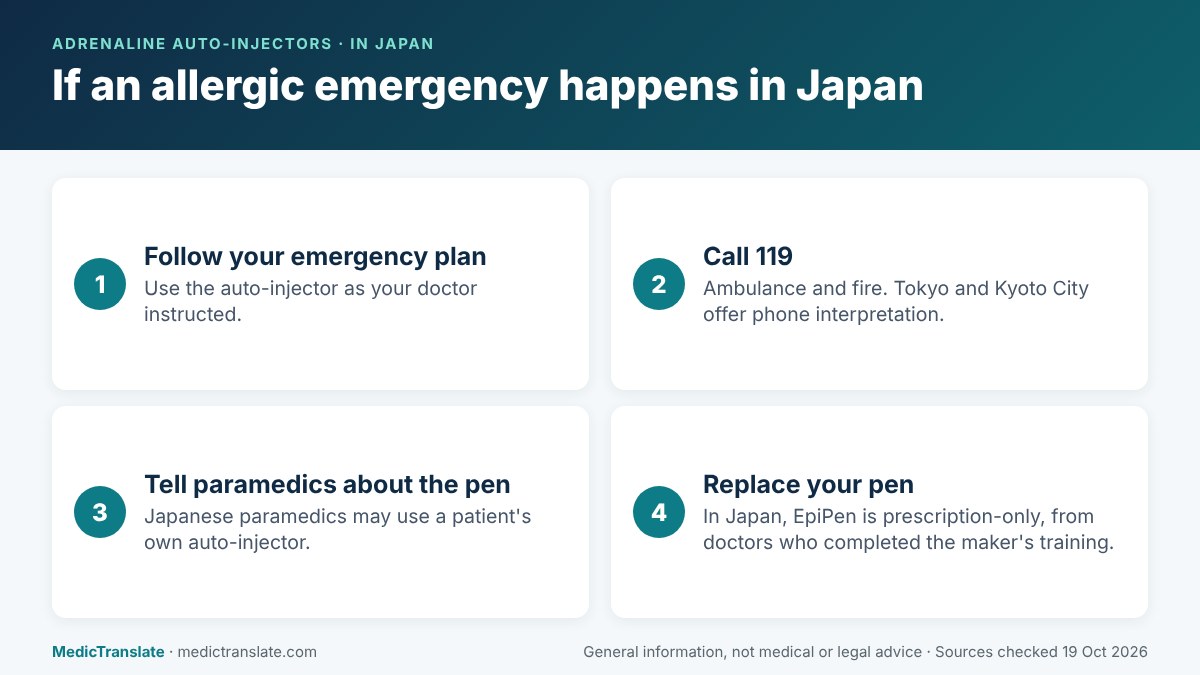
- Follow your emergency planUse the auto-injector as your doctor instructed.
- Call 119119 is the number for an ambulance or fire engine. The dispatcher asks for the address first. Many fire departments, including Tokyo’s and Kyoto City’s, can add a phone interpreter to a 119 call; say your language clearly.
- Tell the paramedics about the penUnder a 2009 MHLW notice, Japanese emergency life-saving technicians may give adrenaline using a patient’s own auto-injector.
- Replace the penAfter treatment, ask the hospital about a replacement, or see a trained prescriber.
For less urgent questions, the #7119 advice line runs in some areas, and #8000 is the children’s advice line in every prefecture. Read our full guide to calling 119 in Japan.
Children at school in Japan: MHLW has stated that a teacher who injects a child’s own EpiPen in an emergency, when the child cannot, does not breach the Medical Practitioners Act. An April 2026 notice describes a similar emergency exception for neffy when all four of its conditions are met. Check the school’s protocol with the school and the prescriber. Talk to the school before the first day.
Food allergies in Japan: what labels must show
Packaged food in Japan must declare nine allergens, called tokutei genzairyo 特定原材料. Cashew became mandatory in April 2026, with a transition until 31 March 2028, so older packaging may not list it; if in doubt, ask the manufacturer. Look for them on the label in Japanese:
| Allergen | Japanese | Allergen | Japanese |
|---|---|---|---|
| Shrimp | えび | Egg | 卵 |
| Crab | かに | Milk | 乳 |
| Walnut | くるみ | Peanut | 落花生 |
| Cashew nut | カシューナッツ | Buckwheat (soba) | そば |
| Wheat | 小麦 |
Cashew was added on 1 April 2026, with a transition period until 31 March 2028, so some older stock may not show it yet. A further 20 items, including almond, sesame, soybean and pistachio, are only recommended, so a label may not list them.
Restaurants and takeaway food are not covered by these labelling rules. Ask staff directly and carry a clear allergy card in Japanese.
Carry your allergy plan in Japanese
MedicTranslate translates allergy action plans, doctor’s letters and prescriptions into Japanese, with drug names, doses and allergens checked by a human translator.
- Allergy card and action plan in Japanese
- Doctor’s letter for customs and clinics
- Medication check for the rest of your list
Price confirmed before work begins · Reply within 1–3 business days · MedicTranslate does not give medical advice or guarantee customs clearance.
Frequently asked questions
Can I bring an EpiPen to Japan?
Yes. Adrenaline auto-injectors are not controlled in Japan. Self-injection kits up to one month's supply can be brought for personal use without an Import Confirmation. Carry them in your hand luggage with a prescription or doctor's letter.
How many EpiPens can I bring to Japan?
MHLW allows up to two adrenaline auto-injectors, including a spare, without Import Confirmation. If your prescriber recommends carrying more, ask the Regional Bureau about Import Confirmation before you travel.
Can I buy an EpiPen in Japan?
Only with a prescription. EpiPen is approved in Japan in 0.15 mg and 0.3 mg strengths, but it can only be prescribed by doctors who have completed the manufacturer's training, so call clinics ahead.
Is neffy nasal spray available in Japan?
Yes. neffy was approved in Japan on 19 September 2025 and went on sale in February 2026. It is prescription-only, with the same trained-prescriber condition as EpiPen.
Can Japanese paramedics use my EpiPen?
Yes. Under a 2009 MHLW notice, emergency life-saving technicians may give adrenaline using a patient's own auto-injector. Call 119 and tell them you have one.
Do Japanese food labels show allergens?
Packaged food must declare nine allergens: shrimp, crab, walnut, cashew, wheat, buckwheat, egg, milk and peanut. Cashew was added in April 2026, with a transition until 31 March 2028; during the transition, ask the manufacturer to confirm cashew content if the package does not identify it. Twenty more are only recommended, and restaurants are not covered, so always ask staff.
This article provides general information based on published Japanese government guidance reviewed on 19 October 2026. It is not medical or legal advice. Follow your own doctor’s allergy action plan, and in an emergency call 119. Rules change and product-specific facts matter, so confirm current import requirements with MHLW or the responsible Regional Bureau of Health and Welfare before travel.
MedicTranslate provides translation, information and administrative coordination services. It is not a healthcare provider, does not give medical or legal advice, and does not guarantee customs clearance or that a clinic can prescribe a particular product.
- MHLW: Bringing medicines into Japan for personal use (English)
- MHLW: Q&A for those who are importing medicines into Japan (English, PDF)
- MHLW: Japanese Q&A on personal import, Q50 on adrenaline auto-injectors (Japanese, PDF)
- Japan Customs: Personal import of medicines (Customs Answer 1806, Japanese)
- PMDA: EpiPen package insert and approval conditions (Japanese)
- PMDA: neffy nasal adrenaline listing (Japanese)
- MHLW: Notice on paramedics using a patient's own adrenaline auto-injector, 2009 (Japanese, PDF)
- MEXT: Food allergy and anaphylaxis at school (Japanese)
- Consumer Affairs Agency: Allergen labelling (Japanese)
- Fire and Disaster Management Agency: Ambulance guide for foreign visitors (English, PDF)
- Tokyo Metropolitan Government: Emergency calls with interpretation (English)