
Vaccinations in Japan: Travel Vaccines and Child Schedule
Vaccinations in Japan work differently from what many visitors and new residents expect. This guide covers which vaccines travellers should consider, how Japan's routine vaccination schedule works for resident children, and what you pay.
Quick answer
Japan does not require any vaccination to enter the country. Travellers should be up to date with routine vaccines such as measles, mumps and rubella (MMR) and diphtheria, tetanus and polio. Hepatitis B and Japanese encephalitis are advised for some travellers depending on the trip. For resident children, Japan's routine vaccinations are paid for by your city or ward when given within the set age period; outside that period, you usually pay yourself.
Moving to Japan with children? A Japanese translation of their vaccination record helps the city office and paediatrician see which doses are already done.
Request a translation quoteOn this page
Are vaccinations in Japan required for entry?
No vaccination certificate is required to enter Japan, including for yellow fever. The COVID-19 vaccination and testing rules for arrivals ended in 2023. Entry rules can change, so check the current position with your airline and your government's travel advice before you fly.
Vaccinations in Japan for travellers
However, national travel health services still give the same core advice before any trip. See a doctor or travel clinic at least 8 weeks before you leave.
Routine vaccines
Make sure your routine vaccines and boosters are up to date, especially MMR and diphtheria, tetanus, pertussis and polio.
Hepatitis B and Japanese encephalitis
Advised for some travellers depending on how long you stay, where you go, what you do and your health. A doctor should assess this.
Seasonal flu and others
Seasonal influenza and meningococcal vaccines may be suggested for some travellers. Tick-borne encephalitis has been found in Japan, but there is no general vaccine recommendation for it.
Travelling with a vaccine or other injectable medicine? Some injectables need an import certificate. Our guide on how to bring medication to Japan explains the rules.
Routine vaccinations in Japan for children
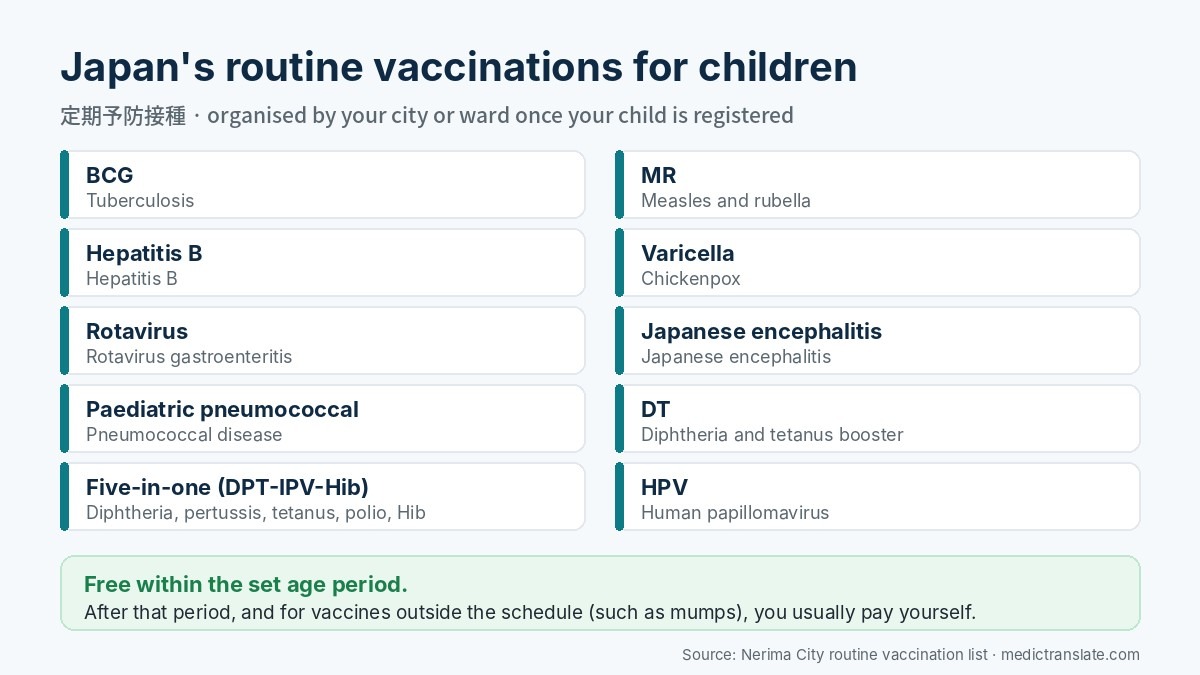
Japan's routine vaccinations (定期予防接種) are set under the Immunization Act and organised by each city or ward. When your child is registered as a resident, the local office sends a schedule and vouchers (予診票) to use at a participating clinic.
| Routine vaccine | Protects against |
|---|---|
| BCG | Tuberculosis |
| Hepatitis B | Hepatitis B |
| Rotavirus | Rotavirus gastroenteritis |
| Paediatric pneumococcal | Pneumococcal disease |
| Five-in-one (DPT-IPV-Hib) | Diphtheria, pertussis, tetanus, polio and Hib |
| MR | Measles and rubella |
| Varicella | Chickenpox |
| Japanese encephalitis | Japanese encephalitis |
| DT | Diphtheria and tetanus booster |
| HPV | Human papillomavirus (cervical cancer) |
Note that mumps is not part of the routine programme; the MR vaccine covers measles and rubella only. Many parents choose a mumps vaccine separately at their own cost. Each vaccine has its own age window, so follow the schedule your city or ward sends you.
In addition, for older adults, influenza and pneumococcal vaccines are also part of the routine programme, with eligibility set by age.

Who pays for vaccinations in Japan
Routine vaccinations are funded by your city or ward when given in the set age period. If a routine vaccination is given after that period, you usually pay the full cost yourself, so keep track of the dates.
By contrast, vaccines outside the routine programme, such as most travel vaccines and the mumps vaccine, are not covered by Japanese health insurance. You pay the clinic's price, which varies. See what Japanese health insurance does not cover for other common exclusions.
Bringing vaccination records from overseas
For example, if your child started vaccinations in another country, the paediatrician needs to see which doses were given and when. Japanese clinics and city offices work in Japanese, so a clear translated record helps the doctor decide which doses are still needed.
- Bring the original record and any booster certificates.
- Ask your city or ward office how they handle doses given overseas.
- Keep the record with your child's health record book (母子健康手帳).
Make your vaccination history clear to Japanese doctors
MedicTranslate translates overseas vaccination records and medical summaries into Japanese, and provides medical interpreters for paediatric and clinic appointments.
- Vaccination records translated for clinics and city offices
- Interpreters for paediatric appointments
- Help finding foreign-friendly clinics
- Support with city or ward office procedures
Price confirmed before work begins. Reply within 1–3 business days. We do not give medical advice.
Frequently asked questions
Do I need any vaccines to travel to Japan?
No vaccination is required to enter Japan. Travellers should be up to date with routine vaccines, and hepatitis B or Japanese encephalitis may be advised for some trips. Ask a doctor or travel clinic at least 8 weeks before travel.
What is Japan's vaccination schedule for children?
Japan's routine schedule includes BCG, hepatitis B, rotavirus, paediatric pneumococcal, the five-in-one DPT-IPV-Hib vaccine, MR, varicella, Japanese encephalitis, DT and HPV. Your city or ward sends the schedule and vouchers once your child is registered.
Are vaccinations free in Japan?
Routine vaccinations are paid for by your city or ward when given in the set age period. Outside that period, and for vaccines outside the routine programme, you usually pay yourself.
Is the mumps vaccine part of Japan's routine schedule?
No. Japan uses the MR vaccine for measles and rubella. The mumps vaccine is optional and usually paid for by the family.
Will a Japanese clinic accept my child's overseas vaccination record?
Clinics use your child's vaccination history to plan the remaining doses. A translated record makes this easier. Ask your city or ward office how doses given overseas are recorded.
This article provides general information reviewed on 13 October 2026. Vaccine recommendations, the routine schedule, age periods and costs can change and vary by city or ward. Ask your doctor, travel clinic or local office for advice on your situation. This page is not medical advice.