
Vaccination Record Translation for Japan: A Family Guide
Moving to Japan with children, or coming to study or work? A clear vaccination record translation helps Japanese city and ward offices, schools, nurseries and clinics see which doses have already been given. This guide explains what a good translation shows, how Japan records vaccination history, and what to ask your local office.
Quick answer
Japanese city offices, schools and clinics work in Japanese. When a child moves in, the city or ward office checks past vaccination history from the original documents before issuing the forms for the remaining routine vaccinations. A Japanese translation that lists each vaccine name and the diseases it covers, the date, the dose number and the lot number makes that check easier and reduces the risk of a dose being missed or repeated. Each office sets its own procedure, so ask yours how it handles doses given abroad.
Have an overseas vaccination record? Send it to us for a quote on a human-validated Japanese translation, laid out dose by dose.
Request a translation quoteOn this page
Who needs a vaccination record translation in Japan?
Most requests come from three groups. Each one shows the record to a different reader in Japan, but all of those readers work in Japanese.
Children moving to Japan
The city or ward office uses your child's history to work out which routine vaccinations are still due, and the paediatrician uses it to plan the next doses.
Enrolment health forms
Nurseries, kindergartens and schools may ask about vaccination history on their health forms. A translation helps staff read your record correctly.
Adults starting in Japan
Universities, employers and clinics may ask to see your vaccination history. Ask the requesting organisation exactly what it needs and in which language.
How Japan records vaccination history
In Japan, children's routine vaccinations (定期予防接種) are organised by each city or ward. The clinic that gives a vaccine writes it into the child's Maternal and Child Health Handbook (母子健康手帳, boshi kenkō techō). That handbook becomes the main vaccination history (予防接種歴) that Japanese offices and doctors look at.
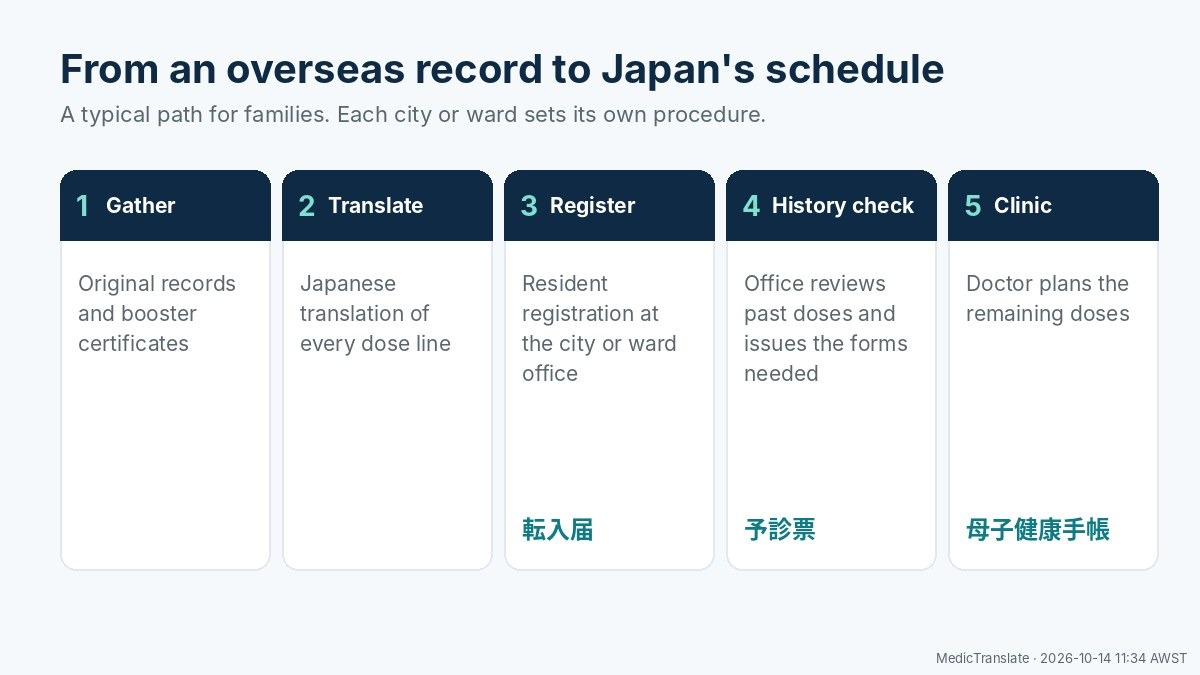
When a child moves into a city or ward, the office does not simply post every form. Yokohama's Tsuzuki Ward, for example, asks families who do not have the forms because of a move to bring the original documents showing past vaccinations, such as the handbook. Staff check the history and then issue the pre-vaccination forms (予診票, yoshinhyō) that are still needed.
Timing matters too. Routine vaccinations are free when given within the set age period, but if a dose is given after that period, you usually pay the full cost yourself. For the full routine list, see our guide to vaccinations in Japan.
A Japanese city office can usually only certify vaccinations it organised. Itabashi City, for example, lists vaccinations received overseas among those it cannot issue a certificate for. Your overseas record therefore stays the main proof of doses given abroad, so keep the original safe.
What a good vaccination record translation shows
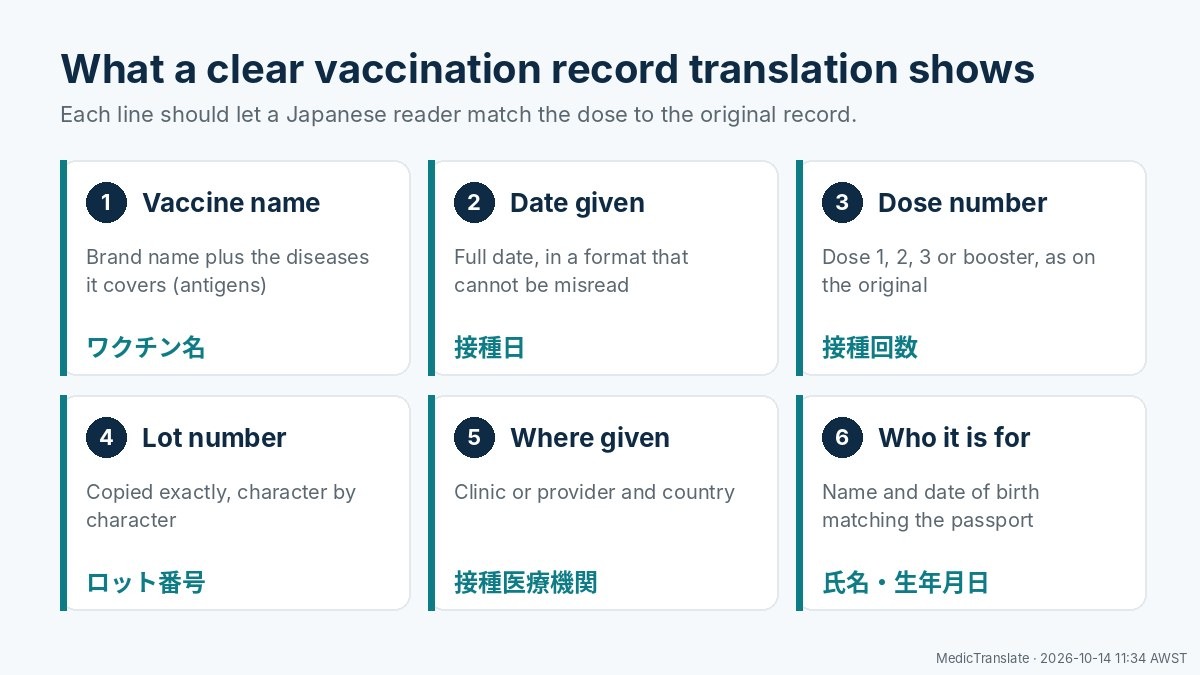
A vaccination record translation is only useful if a Japanese reader can match each line to the original. These are the details to check.
| Detail | Why it matters |
|---|---|
| Vaccine name ワクチン名 | Brand names differ by country. The translation should also give the diseases covered (the antigens), so a combined vaccine such as MMR or DTaP is understood correctly. |
| Date given 接種日 | Day-month and month-day formats are easy to confuse. A full, unambiguous date keeps the intervals between doses clear. |
| Dose number 接種回数 | Shows whether each entry is a first dose, a later dose or a booster, as written on the original. |
| Lot number ロット番号 | Copied exactly as written, so the entry can be traced back to the original if a question comes up. |
| Where given 接種医療機関 | The clinic or provider and the country. |
| Who it is for 氏名・生年月日 | Name and date of birth spelt the same way as the passport and residence documents. |
Combined vaccines need particular care. An MMR dose given abroad covers measles, mumps and rubella, while Japan's routine MR vaccine covers measles and rubella only, and mumps is outside the routine programme. A translation that names each disease, rather than only the brand, lets the office and doctor see exactly what was given.
A translator records what the original says. Deciding which doses still count or which vaccines your child needs next is for the city office and the doctor. MedicTranslate does not give medical advice.
How Japanese offices handle doses given abroad
There is no single national form for overseas records, and procedures vary between cities and wards. In practice, the office reviews your child's past vaccination history from the documents you bring, then issues the forms for the routine vaccinations that remain. Ask these questions at the health centre (保健センター) or the vaccination section of your city or ward office:
- How are doses given overseas recorded?Ask whether staff note them in the handbook or keep a separate record.
- Do you need a Japanese translation?Ask in advance, especially if your records are in a language other than English or Japanese.
- Which forms will we receive, and when?Some forms are posted at set ages, and Suginami City notes they may not arrive, depending on when you move in.
- Are any age deadlines close?Free routine doses must be given within the set period, so check the deadlines early.
How to prepare your records before you move
- Collect every record: the main immunisation card, booster certificates, school or nursery records and any clinic print-outs.
- Ask your current doctor for a complete, printed immunisation history if your records are spread across several clinics.
- Bring the originals to Japan in your hand luggage, and keep a scan.
- Get the translation done before your first visit to the city office, so the history check can happen in one trip.
- Keep the translation with your child's Maternal and Child Health Handbook once you receive it.
If your child also has ongoing conditions or other medical history, our guide to medical records translation in Japan covers what to translate beyond vaccinations. If you would rather have support at the office or the clinic, a medical interpreter can attend with you.
Get your vaccination record translated into Japanese
MedicTranslate translates overseas vaccination records and medical summaries into Japanese, with human-validated translation and standard delivery from 72 hours.
- Dose-by-dose layout that follows your original
- Vaccine names with the diseases they cover
- Dates, dose numbers and lot numbers carried over
- Interpreters for city office and paediatric visits
Price confirmed before work begins. Reply within 1–3 business days. We do not give medical advice, and acceptance of any document is decided by the receiving office.
Frequently asked questions
Do I need to translate my child's vaccination record for Japan?
It depends on the office, school or clinic. Many work only in Japanese, and the city or ward office checks past vaccination history before issuing the forms for the remaining routine vaccinations. A Japanese translation makes that check easier. Ask your local office what it needs.
What should a vaccination record translation include?
Each line should show the vaccine name and the diseases it covers, the date given, the dose number, the lot number, where it was given, and the name and date of birth of the person vaccinated, matching the original record.
Will the city office count doses my child received abroad?
Each city or ward sets its own procedure. Offices review past vaccination history from the documents you bring before issuing forms for the remaining doses. Ask your health centre how doses given overseas are recorded.
Can a Japanese city office certify vaccinations given overseas?
Usually not. Offices generally certify only the vaccinations they organised, and some, such as Itabashi City, state that they cannot certify vaccinations received overseas. Keep your original overseas record as proof of those doses.
Where is vaccination history recorded in Japan?
For children, the clinic writes each vaccination into the Maternal and Child Health Handbook, called boshi kenko techo. Keep your translated overseas record with the handbook.
Does MedicTranslate advise which vaccines my child still needs?
No. We translate what the original record says. Which doses still count and which vaccines come next are decided by your city office and your doctor.
This article provides general information reviewed on 14 October 2026. Vaccination procedures, forms, age periods and document requirements are set by each city or ward and can change. Whether a translated record is accepted, and how overseas doses are counted, is decided by the receiving office, school or clinic. MedicTranslate translates documents; it does not give medical or legal advice or recommend vaccinations. Ask your city office and doctor about your situation.
- Yokohama City, Tsuzuki Ward: Vaccinations, forms after moving in and the past-history check (Japanese)
- Itabashi City: Vaccination certificates, including vaccinations that cannot be certified (Japanese)
- Kashiwa City: Vaccination records and the Maternal and Child Health Handbook (Japanese)
- Suginami City: Issuing and reissuing children's routine vaccination forms (Japanese)
- Nerima City: Routine childhood vaccinations and self-payment outside the set period (Japanese)