
MRI and CT Scans in Japan: How to Bring Previous Imaging to a Japanese Doctor
Planning to use previous MRI and CT scans in Japan? If you had scans overseas, the images and reports can help a Japanese doctor understand your history. This guide covers image formats, translated radiology reports, referral letters, and what to check with the hospital before you go.
Quick answer
Bring the images themselves in DICOM format (usually on a CD-R or DVD), the radiology report and a referral letter from your doctor. Japanese hospitals work in Japanese, so a translated report and letter help the doctor read them. Rules on accepted media differ between hospitals, so ask first. Whether new scans are needed is the Japanese doctor’s decision.
Radiology reports or a referral letter in English? We translate them into Japanese for your appointment.
Request a translation quoteOn this page
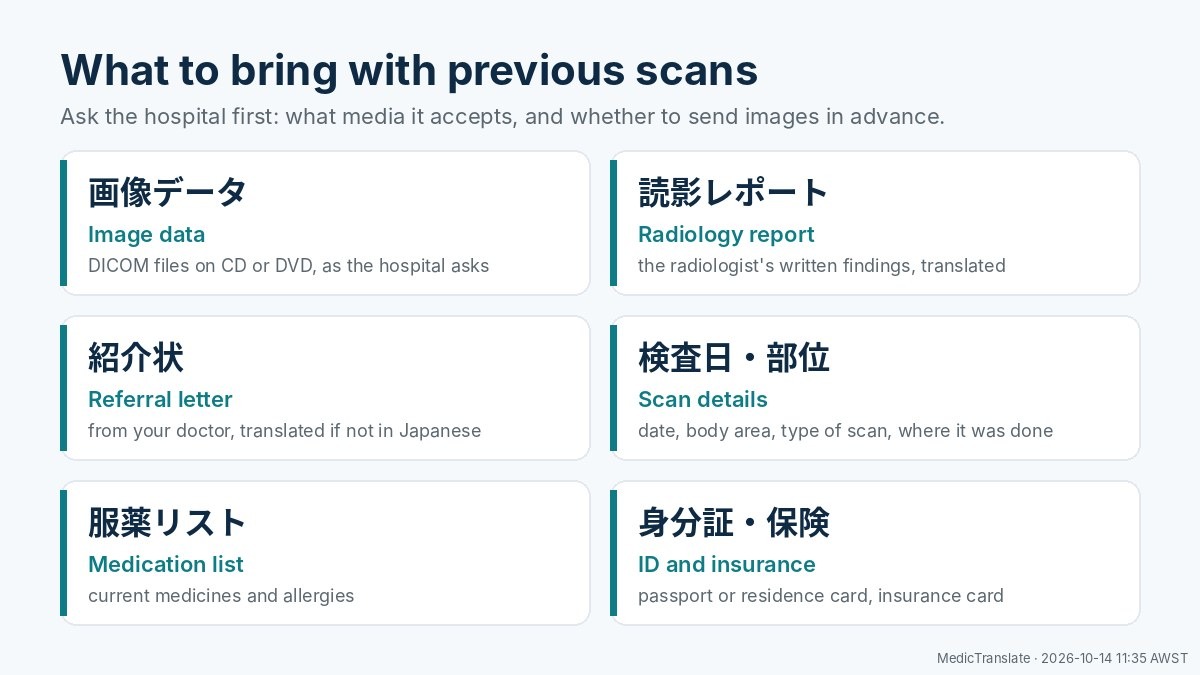
Why previous MRI and CT scans in Japan help
A Japanese doctor seeing you for the first time does not have your history. Earlier scans can show what was found before, when, and how things have changed. That context can save time at the first appointment.
Your previous imaging is information for the doctor, not a substitute for their assessment. The Japanese doctor decides what the images mean for your care today and whether any further tests are needed. MedicTranslate does not read or interpret scans; we translate the written documents that go with them.
Getting your images in the right format
Hospitals store MRI and CT images in a standard format called DICOM. A Japanese hospital usually wants the DICOM files themselves, not screenshots or a PDF of selected pictures. Ask the hospital or imaging centre that did your scans for a copy before you leave, because it can take time to arrange.
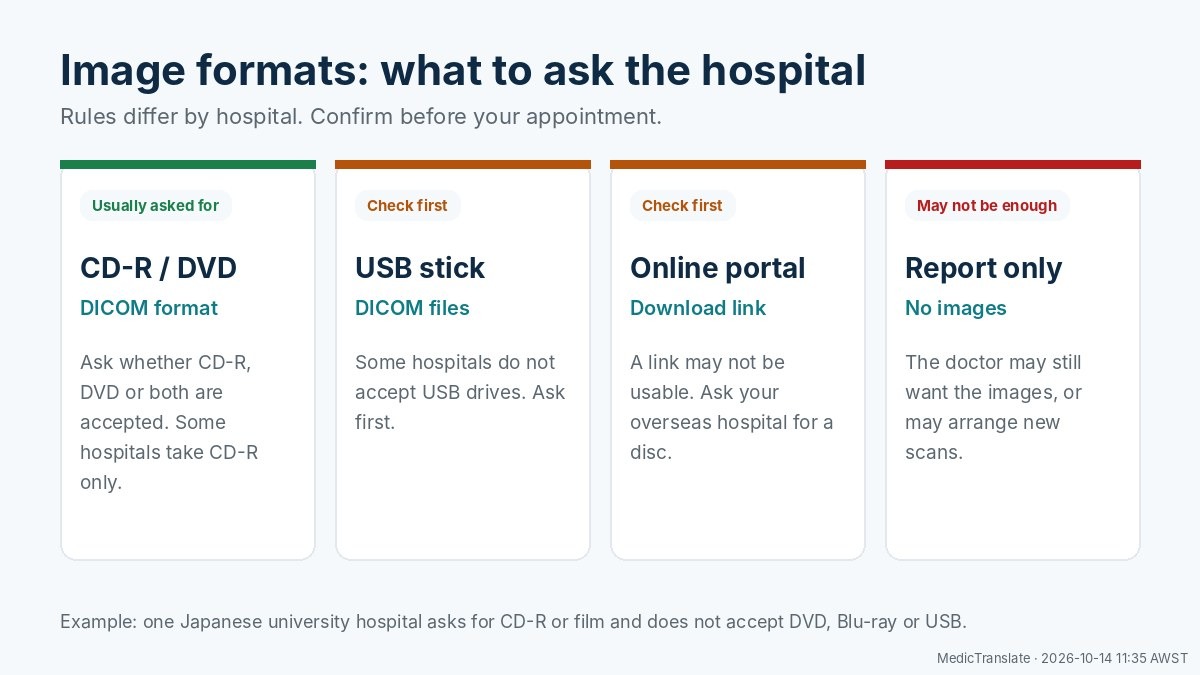
CD-R or DVD with DICOM files
The usual way to carry scans. Some hospitals accept CD-R only, so check before you copy to DVD.
USB drive
Some hospitals do not accept USB drives. Do not rely on one without asking.
Online portal link
A download link from your overseas hospital may expire or need a login. Ask for a disc as well.
For example, Dokkyo Medical University Hospital published a notice in 2011 asking for CD-R or X-ray film, declining DVD, Blu-ray and USB, and saying that discs are generally not returned. Keio University Hospital asks referred patients to send image CD-Rs in advance by registered mail so they arrive three clinic days before the appointment, and to bring film on the day. These are examples only. Each hospital sets its own rules, so check the one you are visiting.
Label each disc with your name, date of birth, the scan type, body area and scan date. Keep a second copy, because discs may not be returned.
The radiology report
The radiology report is the written summary of what the radiologist found. Images without a report leave the Japanese doctor to start from scratch, so bring the report for every scan you bring.
Japanese hospitals work in Japanese. Some doctors read English medical reports, but you cannot count on it, and other staff may also need the information. A Japanese translation of the report reduces the risk of misunderstanding. Our medical records translation guide explains which documents are worth translating.
Referral letters
A referral letter (紹介状, formally 診療情報提供書) passes your clinical information to the next doctor. In Japan it also matters for cost: at specified large hospitals, a first visit without a referral carries an extra charge of at least ¥7,000 for medical care, under a national framework in place since October 2022.
Whether an overseas referral letter counts for that charge is up to the hospital. Ask before you attend. Our guide to referral letters and the large-hospital fee explains how it works and how to get a referral from a Japanese clinic.
Repeat scans and charges
Bringing previous scans does not mean the hospital will not scan you again. The Japanese doctor decides whether new imaging is needed for your care. If you have questions about a repeat scan, ask the doctor directly; an interpreter can help with that conversation.
Charges also vary. A hospital may charge for handling or reviewing images taken elsewhere, and you usually pay for copies of any Japanese scans you want to take away. For example, one National Hospital Organization hospital in Osaka lists ¥1,100 including tax per CD-R for copies of X-ray images and similar records. Ask the hospital what applies before your visit.
Checklist before you go
- Request your images early Ask your overseas hospital or imaging centre for DICOM copies on disc, with the reports.
- Ask the Japanese hospital about media Check which media it accepts and whether images should be sent before the appointment.
- Get a referral letter From your overseas doctor, or from a Japanese clinic if you are going to a large hospital.
- Translate the written documents Radiology reports and referral letters are the priority. Keep originals and translations together.
- Bring the rest ID, insurance card if you have one, your medication list and allergies. See what to bring to a doctor, clinic or hospital in Japan.
If you are worried about discussing results in Japanese, read why a hospital may ask you to bring an interpreter.
Make your imaging reports readable in Japan
MedicTranslate translates radiology reports, referral letters and medical summaries into Japanese, so the doctor can read your history before deciding what comes next.
- Human-validated medical translation
- Standard delivery from 72 hours
- Radiology reports, referral letters and summaries
- Price confirmed before work begins
Reply within 1–3 business days. We translate documents; we do not read scans or give medical advice.
Frequently asked questions
Should I bring my previous MRI and CT scans to a doctor in Japan?
Previous scans and their reports give a Japanese doctor useful history. Bring the images in DICOM format, the radiology reports and a referral letter, and ask the hospital beforehand what it accepts.
What format should the images be in?
Bring the DICOM image files, usually on a CD-R or DVD. Some accept CD-R only and some do not accept USB drives, so check with the hospital you are visiting.
Do I need the radiology report translated into Japanese?
It is not always required, but Japanese hospitals work in Japanese. A translated report helps the doctor and staff read it and reduces the risk of misunderstanding.
Will a Japanese hospital repeat my scans?
It may. The Japanese doctor decides whether new imaging is needed for your care. Ask the doctor if you have questions about a repeat scan.
Is there a fee for bringing outside images?
It depends on the hospital. Some charge for handling or reviewing outside images, and specified large hospitals charge at least 7,000 yen extra for a first visit without a referral. Ask the hospital before you go.
Can MedicTranslate explain my scan results?
No. MedicTranslate is not a healthcare provider and does not read or interpret scans. We translate written documents such as radiology reports and referral letters, and we can arrange an interpreter for your appointment.
This article provides general information reviewed on 14 October 2026. It is not medical advice. Hospital rules on image media, referrals and charges differ and change, and the hospital examples given are for illustration only, so confirm the current policy with the hospital you are visiting. Whether new tests are needed is a decision for your doctor. A translation does not guarantee that a hospital will accept a document. MedicTranslate provides translation, interpreting and coordination services, is not a healthcare provider and does not interpret medical images.
- MHLW: charges for first visits without a referral at specified hospitals (Japanese)
- Keio University Hospital: guidance for referred patients, sending image CD-Rs (example, Japanese)
- Dokkyo Medical University Hospital: accepted media for outside images (example, 2011, Japanese)
- National Cancer Center Hospital: second-opinion documents and images (example, Japanese)
- NHO Osaka Minami Medical Center: self-pay fees from July 2026, CD-R copies (example, Japanese)