
How to Book a Doctor Appointment in Japan
Need to book a doctor appointment in Japan but not sure whether to walk in, phone ahead or go to a hospital? This guide explains clinics versus hospitals, how reservations (予約) work, what to say on the phone, the extra fee large hospitals charge without a referral letter, and how to find English-speaking care.
Quick answer
For most everyday problems, start at a local clinic (クリニック・医院). Many clinics take walk-ins during reception hours, while others work by reservation, by phone, online or through a queue ticket. Large hospitals expect a referral letter (紹介状): without one, designated hospitals with 200 or more general beds must charge an extra fee of at least ¥7,000 on top of the normal bill, except in emergencies. In an emergency, call 119.
Not confident booking in Japanese? We can contact the clinic or hospital for you and arrange an interpreter for the visit.
Arrange healthcare supportOn this page
Clinic or hospital: where to book a doctor appointment in Japan
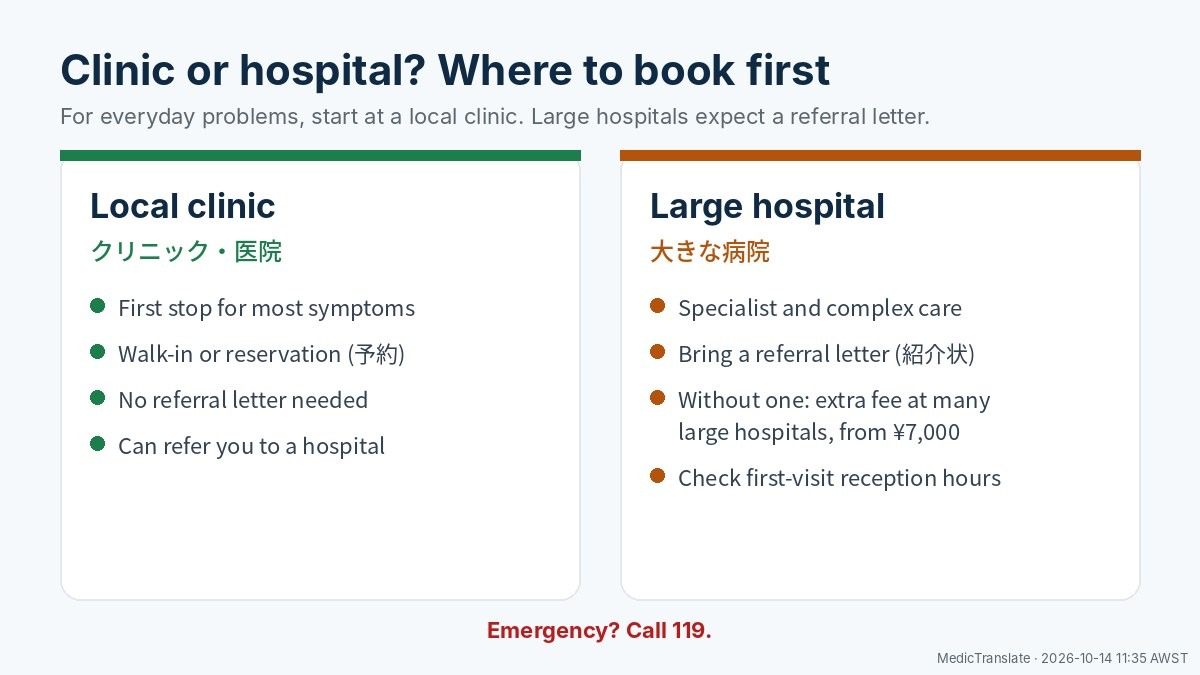
In Japan you can usually choose where to go yourself. The most important choice is between a local clinic and a large hospital.
Local clinic クリニック・医院・診療所
Small, often single-doctor practices for common problems: colds, fevers, skin, stomach, minor injuries, repeat prescriptions. Each clinic usually covers one or a few departments, such as internal medicine (内科) or dermatology (皮膚科). No referral letter is needed.
Large hospital 病院
University and general hospitals focus on specialist care, tests and admissions. They expect new outpatients to bring a referral letter from a clinic. Without one, many large hospitals charge an extra fee (see below).
If you are unsure which department you need, a local internal medicine clinic is usually the first step. The doctor can refer you to a hospital or specialist if needed.
Walk-in or reservation (予約)?
Booking rules vary from clinic to clinic, so check the clinic's website or call before you go. You will usually meet one of these systems:
- Walk-in during reception hoursMany clinics see patients in arrival order. You fill in a form at reception and wait. Arrive well before reception closes.
- Reservation onlySome clinics only see patients with an appointment.
- Online booking or queue ticketSome clinics take bookings through their website or an app, or let you take a numbered place in the queue online (順番予約) and come in when your turn is near.
- Hospital first visitsLarge hospitals often have separate reception hours for new patients (初診受付), and some require a booking made by the referring clinic. Check the hospital's website.
Reception hours are not consultation hours. Japanese clinics list reception times (受付時間), which can end before consultations do and often vary by day of the week. If you arrive after reception closes, you may not be seen that day.
Bring your health insurance card or My Number card, any medicines you take, and your medicine notebook if you have one. See what to bring to a doctor, clinic or hospital in Japan for a full checklist.
What to say when you book a doctor appointment in Japan by phone
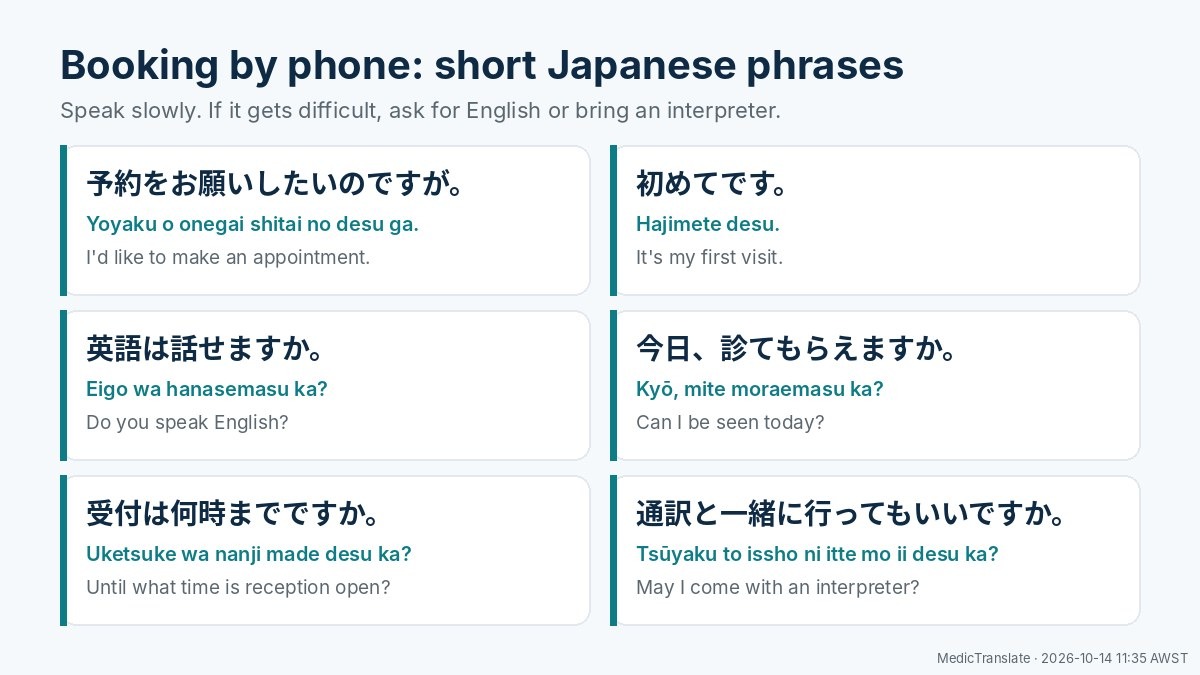
Reception staff are used to short, simple requests. Speak slowly, say your name and that it is your first visit, and ask about the time.
| Japanese | Romaji | Meaning |
|---|---|---|
| 予約をお願いしたいのですが。 | Yoyaku o onegai shitai no desu ga. | I'd like to make an appointment. |
| 初めてです。 | Hajimete desu. | It's my first visit. |
| 日本語があまり話せません。 | Nihongo ga amari hanasemasen. | I don't speak much Japanese. |
| 英語は話せますか。 | Eigo wa hanasemasu ka? | Do you speak English? |
| 今日、診てもらえますか。 | Kyō, mite moraemasu ka? | Can I be seen today? |
| 予約なしでも大丈夫ですか。 | Yoyaku nashi demo daijōbu desu ka? | Is it OK to come without an appointment? |
| 受付は何時までですか。 | Uketsuke wa nanji made desu ka? | Until what time is reception open? |
| 通訳と一緒に行ってもいいですか。 | Tsūyaku to issho ni itte mo ii desu ka? | May I come with an interpreter? |
Keep the call to booking details. Describing symptoms in detail by phone is hard in a second language, and the doctor will ask about them at the visit. If you would rather not make the call yourself, our medical interpreters can help.
Large hospitals and the referral letter fee
Japan steers first visits to clinics so that large hospitals can focus on specialist care. Since 1 October 2022, the following hospitals must charge an extra fee (特別の料金) to first-visit outpatients who come without a referral letter:
- special functioning hospitals (特定機能病院), such as many university hospitals;
- regional medical support hospitals with 200 or more general beds;
- referral-focused hospitals (紹介受診重点医療機関) with 200 or more general beds.
The national minimum is ¥7,000 for a first medical visit and ¥5,000 for dental, charged on top of your normal share of the bill and not covered by insurance. A ¥3,000 minimum (¥1,900 dental) applies to return visits when the hospital has already referred you back to another facility. Hospitals can set a higher amount; Kobe University Hospital, for example, charges ¥13,200 for a first visit without a referral. Emergency patients must not be charged the fee.
Our guide to referral letters (shōkaijō) and the hospital fee explains how to get a letter from a clinic.
Finding English-speaking clinics
The Japan National Tourism Organization (JNTO) runs a free medical institution search for visitors. You can filter by area, language (English, Chinese, Korean, Portuguese, Spanish and others), medical department, emergency room and JMIP certification. JNTO notes that language support can vary, and advises contacting each facility before you visit.
JNTO also runs the Japan Visitor Hotline (050-3816-2787), 24 hours a day, in English, Chinese and Korean. For more options, read how to find an English-speaking doctor or clinic in Japan or browse our list of foreign-friendly clinics.
"English-speaking" often means the doctor speaks some English, not that reception or the pharmacy does. For complex conditions, tests or results, a medical interpreter reduces the risk of misunderstanding.
Urgent cases: 119 and #7119
In an emergency, call 119 for an ambulance. Do not wait to book an appointment. See our guide to calling 119 in Japan.
If you are unsure whether you need an ambulance or which hospital to go to, many areas run #7119, a phone advice line staffed by doctors, nurses or paramedics. According to the Fire and Disaster Management Agency, #7119 runs in 42 areas, including Tokyo, Osaka, Kyoto and Hyogo. It is not yet nationwide, some areas use a different number, and in many areas #7119 is for people aged about 15 and over, with children directed to #8000. Check your prefecture's website for the number that applies where you are.
Let us handle the booking call
MedicTranslate contacts Japanese clinics and hospitals on your behalf, helps you prepare for the visit, and provides medical interpreters in person across Kansai and beyond and by video or phone Japan-wide. Interpreting is US$360 for the first 3 hours and US$60 for each extra hour.
- Help contacting clinics and hospitals
- Interpreters for the appointment
- Help finding foreign-friendly clinics
- Translation of referral letters and records
Reply within 1–3 business days. Appointment times depend on the clinic or hospital and cannot be guaranteed. We do not give medical advice.
Frequently asked questions
Do I need an appointment to see a doctor in Japan?
Not always. Many local clinics see walk-in patients during reception hours, while others work by reservation only. Large hospitals usually expect a referral letter and may require a booking. Check the clinic website or call before you go.
How do I book a doctor appointment in Japan in English?
Use the JNTO medical institution search to find clinics that list English support, then call or book online. JNTO advises contacting each facility before visiting. If you need help, MedicTranslate can contact the clinic for you and arrange an interpreter.
Can I go straight to a large hospital without a referral?
You can, but designated hospitals with 200 or more general beds must charge an extra fee of at least 7,000 yen for a first visit without a referral letter, on top of the normal bill. Emergency patients are not charged this fee.
What should I say on the phone to book?
Say Yoyaku o onegai shitai no desu ga (I would like to make an appointment) and Hajimete desu (it is my first visit). You can ask Eigo wa hanasemasu ka (do you speak English?) and Uketsuke wa nanji made desu ka (until what time is reception open?).
What is #7119?
#7119 is a phone advice line where doctors, nurses or paramedics help you decide whether to call an ambulance or go to hospital. It runs in 42 areas, including Tokyo, Osaka, Kyoto and Hyogo, but not everywhere. In an emergency, call 119.
Can MedicTranslate book my appointment?
Yes, our healthcare coordination service can contact clinics and hospitals for you and arrange an interpreter for the visit. Appointment times depend on the clinic or hospital, so we cannot guarantee a booking.
This article provides general information reviewed on 14 October 2026. Booking systems, reception hours, referral fees and phone advice services vary by clinic, hospital and area, and can change. Check with the clinic, hospital or your local government. MedicTranslate is not a healthcare provider and does not give medical advice. If you think you need emergency care, call 119.
- MHLW: Extra fee for large-hospital visits without a referral letter, from 1 October 2022 (Japanese)
- Kobe University Hospital: First-visit fee without a referral letter (Japanese)
- JNTO: Guide for when you are feeling ill, medical institution search and Japan Visitor Hotline
- Fire and Disaster Management Agency: #7119 emergency advice line and areas covered (Japanese)