
Controlled Medicines in Japan: Narcotics, Psychotropics, Stimulants and Stimulant Raw Materials
Controlled medicines in Japan follow strict rules, so a medicine routinely prescribed overseas may be regulated very differently here. Narcotics, psychotropics, stimulants and stimulant raw materials are each subject to different import rules. Some may be carried with advance permission, some within defined limits, and certain stimulant substances cannot be imported by an individual traveller even when prescribed overseas. Before travelling, check the active ingredient, its Japanese legal category, the quantity you will carry and whether advance permission or supporting documentation is required.
Quick Answer
Japan does not apply one rule to all controlled medicines. Check by active ingredient, not brand name. Narcotics, psychotropics, stimulants and stimulant raw materials are treated differently. Some may be carried with advance permission, some within defined limits, and certain stimulant substances cannot be imported by an individual traveller even when prescribed overseas.
⚕️ Not sure which rule applies to your medicine? MedicTranslate can review your medication list against current MHLW and NCD classifications and explain the likely requirement.
Start Medication Assessment — from US$59📋 On This Page
Start with the Active Ingredient, Not the Brand Name
Japanese authorities classify medicines by their ingredients and legal status, not simply by the overseas brand printed on the box. This is particularly important for ADHD medicines, strong pain medicines, sleep medicines, anxiety medicines and combination cold or sinus products.
For an ordinary prescription medicine that is not otherwise prohibited or specially controlled, MHLW's current personal-import guidance generally permits up to a one-month supply without an Import Confirmation. However, different rules apply to controlled substances.
One-month exemption applies to ordinary medicines only. This exemption does not override separate rules for prohibited or controlled substances. Always check the active ingredient first.
The Four Categories of Controlled Medicines in Japan
Each category has its own procedure. Therefore, find your medicine's active ingredient below, then read the matching card.
Advance Permission Required
Examples: morphine, fentanyl, oxycodone
If your medicine is classified as a narcotic, you must obtain advance permission from the appropriate Regional Bureau of Health and Welfare before entering Japan. Supporting medical documentation is required, and the authorised patient must carry the medicine personally.
Check Quantity Thresholds
Examples: methylphenidate, zolpidem, alprazolam, clonazepam, diazepam
Requirements depend on the specific substance, total quantity and dosage form. Japan publishes substance-specific quantity thresholds, so check the total amount of active ingredient rather than relying on the number of days supplied.
Cannot be Imported by Travellers
Examples: amphetamine, methamphetamine
Japan's Narcotics Control Department identifies amphetamine and methamphetamine as prohibited for individual travellers. A foreign prescription does not make an amphetamine-based ADHD medicine permissible. The NCD specifically states that Adderall cannot be brought into Japan for personal treatment.
Advance Permission Required
Examples: lisdexamfetamine (Vyvanse); some pseudoephedrine preparations
A separate legal category. The NCD states that a person carrying lisdexamfetamine for their own treatment must obtain advance permission before entering Japan. Combination cold and sinus products should be checked by exact ingredient and product composition.
Methylphenidate is a psychotropic, not a stimulant raw material. Medicines containing methylphenidate or dexmethylphenidate are currently treated as psychotropics under Japanese guidance and should not be grouped with lisdexamfetamine.
At-a-Glance Comparison
| Category | Examples | Status | Traveller Requirement |
|---|---|---|---|
| Narcotics | Morphine, fentanyl, oxycodone | Permission | Advance permission from the relevant Regional Bureau of Health and Welfare |
| Psychotropics | Methylphenidate, zolpidem, alprazolam, clonazepam, diazepam | Check limits | Check the specific substance, total amount and dosage form against the official threshold guidance |
| Stimulants | Amphetamine, methamphetamine | Not permitted | Individual travellers cannot import these substances for personal treatment |
| Stimulant Raw Materials | Lisdexamfetamine; some pseudoephedrine preparations | Permission | Advance permission is required before entry |
Prohibited, Permission or Conditions? Sort Your Medicine
Controlled-medicine rules fall into three groups for travellers. Classify by the active ingredient, then read the guide for your medicine.
| Group | Examples (by ingredient) | What applies | Guides |
|---|---|---|---|
| Prohibited | Amphetamine (Adderall); CBD and other cannabis-derived products | Amphetamine cannot be imported, even with a prescription. For CBD, no traveller allowance is published and strict THC limits apply, so do not bring it. | Adderall CBD |
| Requires advance permission | Lisdexamfetamine (Vyvanse); pseudoephedrine (Sudafed); narcotics such as morphine and oxycodone | Apply to the Narcotics Control Department or the relevant Regional Bureau before you travel, at least 14 days ahead where the NCD requires it. Carry the medicine yourself; it cannot be posted. | Vyvanse Sudafed |
| Allowed under conditions | Methylphenidate (Concerta, Ritalin); other psychotropics such as alprazolam (Xanax); ordinary prescription medicines such as tramadol, trazodone, hydroxyzine and GLP-1 pens; melatonin | Psychotropics: no NCD application at or below the table amount, a doctor certificate above it. Ordinary prescription medicines: up to about one month for your own use, Import Confirmation above that. Check each guide for the exact conditions. | Concerta Xanax Tramadol Trazodone Hydroxyzine Ozempic, Wegovy, Mounjaro Melatonin |
Documents for Controlled Medicines in Japan
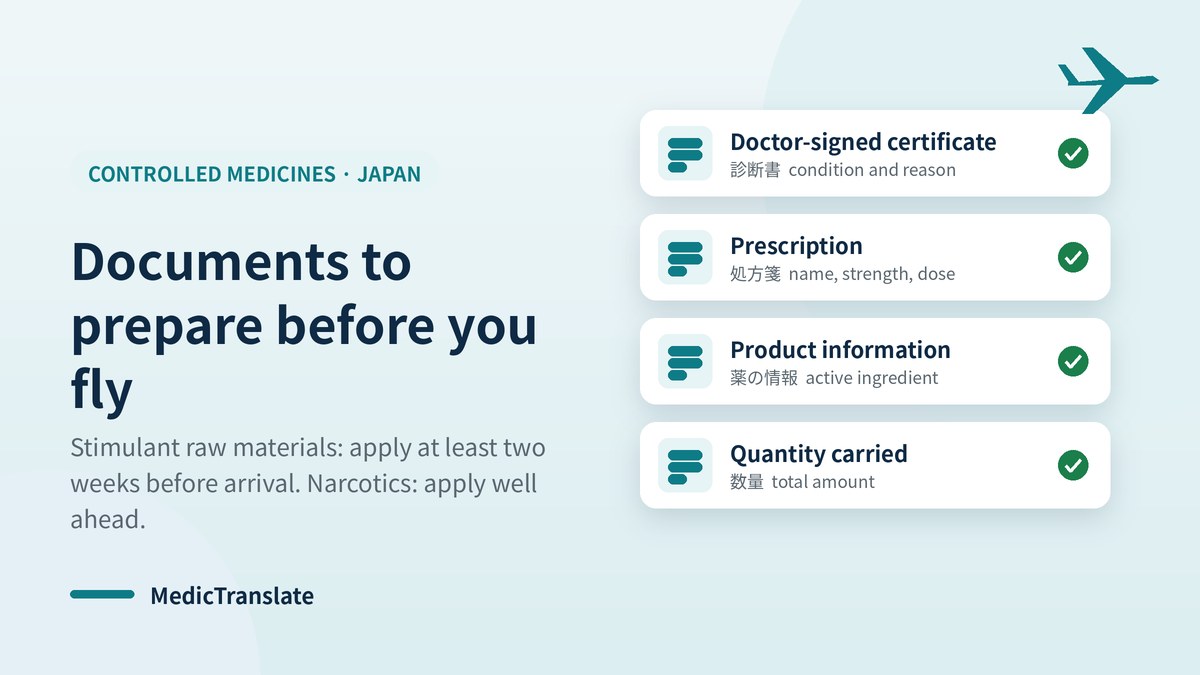
The required documents depend on the legal category. For narcotics and stimulant raw materials, official application guidance requires supporting medical information identifying the condition, the medicine and the prescribed quantity.
How Early Should You Apply?
⏱ Stimulant raw materials: Allow at least two weeks. Official NCD guidance states that approximately two weeks is necessary to process the application and asks applicants to submit documents at least two weeks before arrival or departure.
For narcotics: Apply well before departure and follow the instructions of the responsible Regional Bureau.
Plan ahead. Do not wait until close to your travel date to begin the application process. Processing times vary by jurisdiction, and last-minute requests may be declined.
Do Not Confuse NCD Permission with Import Confirmation
Japan also operates an Import Confirmation Certificate system for medicines imported outside the ordinary personal-use exemptions. That is separate from the advance permission required for narcotics and stimulant raw materials.
Advance Permission (NCD / Regional Bureau)
Required for narcotics and stimulant raw materials, regardless of quantity. Applies to the controlled-substance categories above.
Import Confirmation (MHLW)
For otherwise-permitted medicines, generally not required for:
- up to one month of a prescription medicine
- up to two months of other ordinary medicines or quasi-drugs
- up to 24 units per item for qualifying external-use products
- up to one month of an injectable medicine with its pre-filled syringe
These general exemptions do not override separate rules for prohibited or controlled substances.
Controlled Medicines in Japan: Checklist Before You Fly
- List every active ingredient. Write down the generic or active ingredient for every medicine you intend to carry.
- Check the controlled-substances guidance. See whether any ingredient appears on Japan's current controlled-substances lists.
- Identify the category. Ordinary medicine, narcotic, psychotropic, stimulant or stimulant raw material.
- Check quantity and dosage form. Use the exact total amount, not only the number of boxes.
- Complete required procedures before departure. Any advance permission or Import Confirmation must be finalised first.
- Pack with documents and labelled packaging. Carry the medicine with the required documents and original, clearly labelled packaging.
- Follow carriage rules for controlled medicines. Comply with official instructions about who may carry the medicine and how it must enter Japan.
Not Sure Which Rule Applies to Your Medicine?
We review the information you provide against current published MHLW and NCD classifications and give you the likely requirement and next step in plain English. Delivered within 3 business days, checked against current guidance.
Frequently Asked Questions
Can I bring Adderall to Japan if I have a prescription?
No. Adderall contains amphetamine, which Japan's Narcotics Control Department lists as prohibited for individual travellers. A foreign prescription does not override this restriction. Do not travel with Adderall to Japan.
Can I bring Vyvanse to Japan?
Vyvanse contains lisdexamfetamine, a stimulant raw material. You must obtain advance permission from the NCD before entering Japan. This is a separate application from general import procedures. Allow at least two weeks for processing.
Is methylphenidate treated the same way as Vyvanse?
No. Methylphenidate is classified as a psychotropic under Japanese law, not a stimulant raw material. Medicines containing methylphenidate (such as Ritalin or Concerta) are subject to different rules than Vyvanse. Check the specific quantity thresholds for the psychotropic category.
Does a doctor's letter automatically allow a controlled medicine into Japan?
No. A doctor's letter supports an application but does not guarantee clearance. The Japanese authorities make the final decision based on the medicine's classification, the quantity and the supporting medical documentation. Some controlled medicines cannot be imported at any quantity, regardless of a doctor's letter.
Can another person carry my controlled medicine into Japan for me?
For narcotics and stimulant raw materials, the official guidance states that the authorised patient must carry the medicine personally into Japan. Someone else carrying it on your behalf may not be acceptable and could result in the medicine being confiscated.
What if I don't have an English-language prescription to show?
Professional medical translation of your overseas prescription is recommended. This ensures that Japanese authorities can clearly understand the medicine name, active ingredient, strength, dose and medical reason for the prescription. MedicTranslate can translate prescriptions and doctor's letters to support your application.

Get Expert Help with Your Medication Assessment
MedicTranslate reviews the information you provide against current published MHLW and NCD classifications and gives you the likely requirement and next step in plain English.
→ Personalised Assessment · from US$59This page provides general information based on published Japanese government guidance reviewed on 28 September 2026. It is not medical or legal advice and is not an official border determination. Rules, classifications and procedures can change. Confirm the current requirements with MHLW, the Narcotics Control Department, the relevant Regional Bureau of Health and Welfare or another competent Japanese authority before travel. Do not stop, substitute or change prescribed treatment without consulting an appropriately qualified healthcare professional. MedicTranslate provides translation, information and administrative coordination services. Medical care and clinical decisions are provided by healthcare professionals. Final import, permit and customs decisions remain with Japanese authorities. Nothing on this page excludes any consumer right or liability that cannot lawfully be excluded.