
LGBTQ+ Healthcare in Japan: A Guide for Couples and Individuals
LGBTQ+ healthcare in Japan uses the same clinics, hospitals and insurance system as everyone else. A few practical points are worth knowing in advance: how hospitals treat partners, how insurance works for couples, and the rules for bringing HIV, PrEP and hormone medicines. This guide explains each one, based on official sources, so you can prepare.
Quick answer
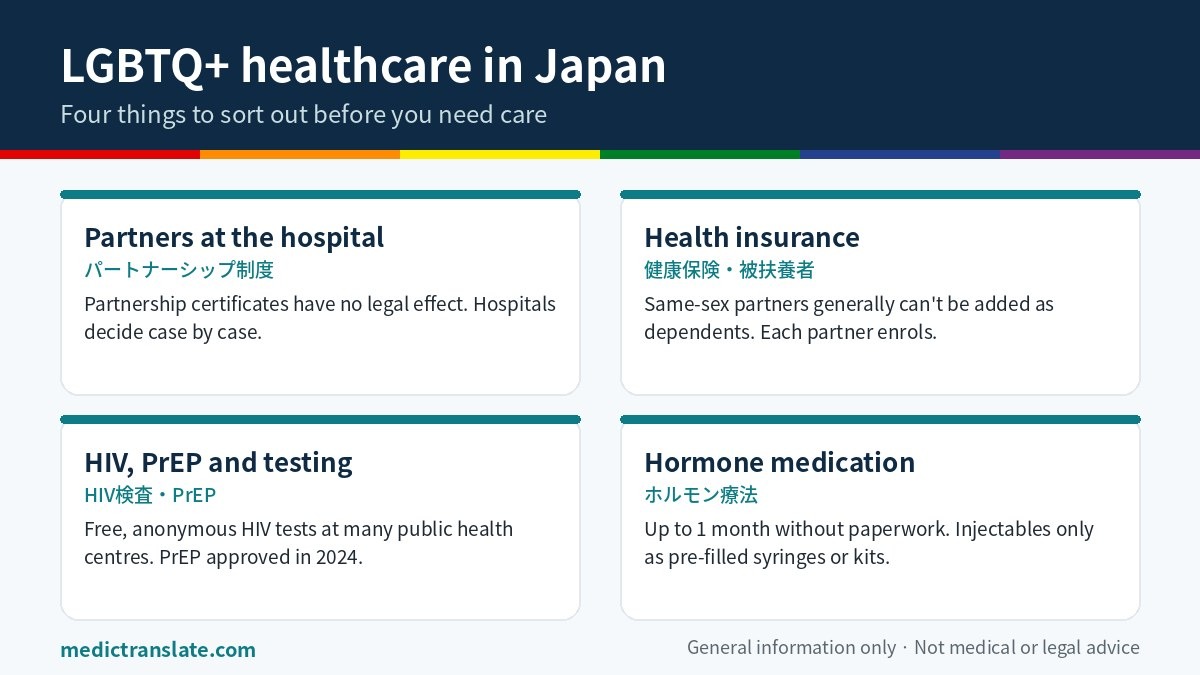
Japanese law does not currently provide for same-sex marriage. Most of the country is covered by local partnership certificate systems (パートナーシップ制度), but they have no legal effect, so each hospital decides what it shares with a partner. A same-sex partner generally cannot be added as a dependent on Japanese health insurance, so each partner enrols in their own right. You can bring HIV treatment, PrEP and hormone tablets for personal use up to a one-month supply without paperwork. Injectables qualify only as pre-filled syringes or self-injection kits. Many public health centres offer free, anonymous HIV tests.
Bringing HIV, PrEP or hormone medication? We check your medicines against Japan's import rules and explain what documents may be needed before you fly.
Check medication requirementsOn this page
Where the law stands for couples
Japanese law does not currently provide for same-sex marriage, and a local partnership certificate does not create marital status. Recognition of a same-sex partner depends on the law, institution and decision involved, so ask the hospital about its procedures and the insurer about eligibility. This guide describes the rules as they stand on the date shown above and takes no position on any legal or political question.
Many cities and prefectures run partnership certificate systems (パートナーシップ宣誓制度). A joint survey led by Shibuya City found these systems covered more than 90% of Japan's population as of 31 May 2025.
Kobe's version is the Kobe Life Partner System (神戸市ライフパートナー制度), started in December 2023. It is open to same-sex couples and unmarried opposite-sex couples, including foreign nationals with a Japanese resident record. Foreign applicants need a single-status certificate with a Japanese translation.
Partnership certificates have no legal effect. Kobe's own page says so plainly. Services such as city housing or municipal hospitals may accept the certificate, but each one applies its own rules. Rules and services also differ by city, so check your own municipality's page.
Partners at the hospital and in emergencies
Because a partner is not legal family, couples often ask whether a hospital will share information with their partner or involve them in decisions. The answer depends on the hospital and on the patient's own wishes.
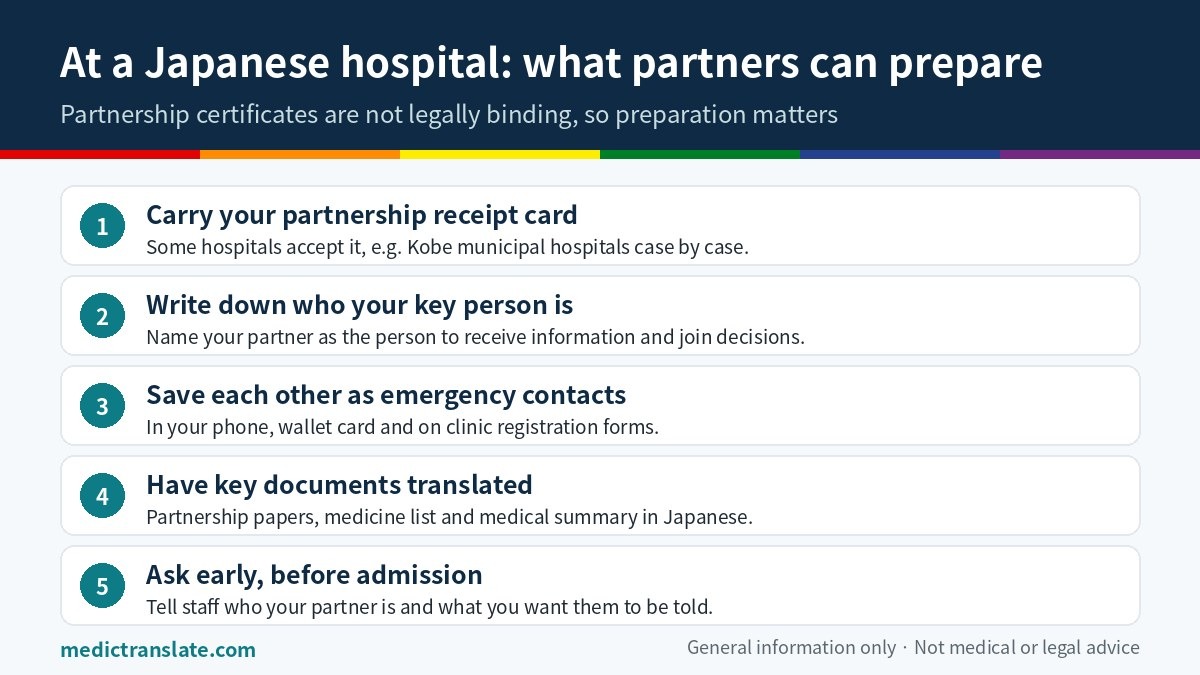
There is some official support for a wider view. In March 2018 the MHLW revised its guideline on decision-making for end-of-life care, widening the people involved from family to family and others close to the patient (家族等, including close friends). In Kobe, the city says its municipal hospitals can explain a patient's condition to a registered life partner, decided case by case after confirming the patient's wishes.
Each hospital sets its own procedures. These steps help make your wishes clear in advance.
- Register and carry your certificateIf your city has a partnership system, register and keep the wallet card with your insurance card.
- Put your wishes in writingA short note naming the person you want to receive information and be involved in decisions can help staff understand your wishes. It is not a legal document. For legally binding arrangements, consult a lawyer or notary.
- Save each other as emergency contactsIn your phone, in your wallet and on every clinic registration form.
- Translate key documents into JapaneseYour partnership certificate, your written wishes, your medicine list and any medical summary. Staff can act faster on a document they can read.
- Tell staff earlyAt admission or at the first visit, say who your partner is and what you want them to be told.
Health insurance for same-sex couples
Japanese residents must join public health insurance, either through an employer (健康保険) or through their city or ward (国民健康保険). Employer insurance lets you add a dependent spouse, including an unmarried opposite-sex partner in a de facto marriage.
For same-sex partners, the position is different. In September 2025 the Cabinet Secretariat published a review of which laws may treat same-sex partners like de facto spouses. The Health Insurance Act and the pension laws were not among them. At the time of writing, this generally means a same-sex partner cannot be added as a dependent, so each partner enrols in their own right. A partner without an employer plan usually joins National Health Insurance at their city or ward office. Your insurer makes the final decision, so confirm with them.
Some employers offer their own benefits for same-sex partners. Ask HR. If you are visiting rather than living in Japan, check how your travel insurance defines a partner or family member before you travel. Our guide to medical costs without Japanese insurance explains what visitors pay.
HIV, PrEP and sexual health
Testing
Many public health centres (保健所) offer free, anonymous HIV and STI tests, usually on set weekdays and often by appointment. Saitama Prefecture is one example. The MHLW-funded HIV検査相談マップ lists testing at public health centres and clinics across Japan, mostly in Japanese.
PrEP
Truvada was approved in Japan for HIV pre-exposure prophylaxis (PrEP) on 28 August 2024, according to PMDA’s approval record. PrEP needs a prescription and regular testing. Ask the clinic about cost before you start, as prevention is not always covered by insurance.
HIV treatment
If you live in Japan and are on HIV treatment, you may be eligible for a disability certificate for immune function (身体障害者手帳) and for public medical support (自立支援医療(更生医療)), which caps your monthly costs based on household income. Your city decides eligibility. Hiroshima City's page shows how it works. Ask your hospital's medical social worker or your city office.
Bringing HIV medication or PrEP
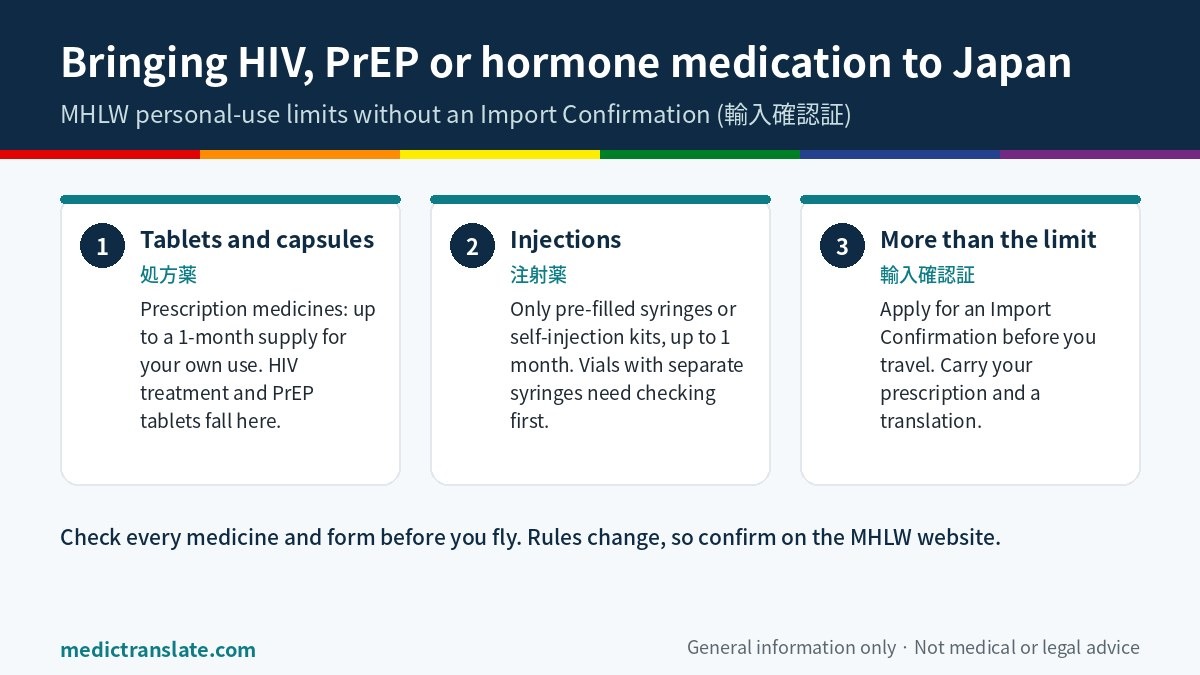
Under the MHLW's personal-use rules, you can bring up to a one-month supply of prescription medicines without extra paperwork. For more than that, you need an Import Confirmation (yakkan shoumei) before you travel. Carry your prescription, and a translation helps if you are asked about it.
Hormone therapy and gender-affirming care
Bringing hormone medication
Hormone medicines are prescription medicines, so the same one-month limit applies. Injections need extra care: the MHLW allowance covers injectables only as pre-filled syringes or self-injection kits, up to one month. Vials with separate syringes, or more than a month's supply, need checking first and may need an Import Confirmation.
Continuing treatment in Japan
If you live in Japan, you will need a Japanese doctor to keep prescribing. Bring your current prescription, recent blood test results and a doctor's summary, translated into Japanese. Our guide on continuing an overseas prescription in Japan explains the process.
Whether insurance covers a treatment depends on the treatment, the facility and your circumstances. Ask the clinic about costs and insurance before you start.
If the name on your insurance card differs from the name you use, you can mention it when you book and ask how the clinic can accommodate this.
Finding comfortable, English-speaking care
There is no official list of LGBTQ+-friendly clinics. The practical approach is to find clinics with English support, then ask a few questions before you book.
- Search by language and department. The JNTO medical institution search filters by area, language and department. See also our guide on how to find an English-speaking doctor or clinic in Japan.
- Ask before you book. Ask whether the clinic offers the care you need, for example PrEP or hormone therapy, and whether your partner can accompany you.
- Bring someone you trust. Ask the clinic whether you can bring your partner, a friend or an interpreter to your appointment.
- You decide what to share. Share the personal information that matters for your care, and ask the clinic how it handles your records if you have concerns.
- Mental health support. Our guide to mental health services in Japan covers psychiatry, counselling and English-speaking options.
How an interpreter or translation helps
Personal health conversations are easier in your own language. A professional interpreter or translated documents can help you explain your situation clearly without relying on friends or family to translate.
- A medical interpreter can join your appointment so you can speak in your own language, in person in Kansai and beyond or by video or phone anywhere in Japan.
- Translated documents such as partnership papers, your written wishes, prescriptions and medical summaries help staff understand your situation quickly. See our guide to prescription translation for Japan.
- A medication check tells you, before you fly, whether your medicines and their form are within the personal-use limits or need an Import Confirmation.
MedicTranslate provides language and access support only. We are not a healthcare provider or a law firm. We do not diagnose, recommend treatment, choose a clinic for you or give legal advice on partnership or family arrangements.
Get your medicines and documents ready for Japan
MedicTranslate checks your medicines against Japan's import rules, translates prescriptions, medical summaries and partnership documents into Japanese, and provides medical interpreters for appointments.
- Medication import requirements checked before you fly
- Human-validated translation, standard delivery from 72 hours
- Interpreters in person in Kansai and beyond, remote across Japan
- Price confirmed before work begins
Reply within 1–3 business days. We do not give medical or legal advice or guarantee customs approval.
Frequently asked questions
Is same-sex marriage legal in Japan?
Japanese law does not currently provide for same-sex marriage. Many municipalities offer partnership certificates, but these have no legal effect. Check your municipality for its current system.
Can my same-sex partner get information about me in a Japanese hospital?
It depends on the hospital. Partnership certificates are not legally binding, but some hospitals accept them. Kobe municipal hospitals, for example, can explain a patient's condition to a registered partner case by case. Carry your certificate, put your wishes in writing and tell staff early.
Can I add my same-sex partner to my Japanese health insurance?
Generally no. In a September 2025 government review, the Health Insurance Act was not among the laws that may treat same-sex partners like de facto spouses. Each partner usually enrols in their own right. Confirm with your insurer, and ask your employer about any partner benefits.
Can I bring HIV medication or PrEP to Japan?
Yes, for personal use. You can bring up to a one-month supply of prescription medicines without extra paperwork. For more, apply for an Import Confirmation before you travel. Carry your prescription.
Can I bring hormone therapy medication to Japan?
Hormone tablets, gels and patches on prescription can be brought up to a one-month supply. Injectables qualify only as pre-filled syringes or self-injection kits, up to one month. Vials with separate syringes or larger amounts need checking first and may need an Import Confirmation.
Where can I get an HIV test in Japan?
Many public health centres offer free, anonymous HIV and STI tests, usually on set days and often by appointment. The national HIV testing map, HIV検査相談マップ, lists testing sites across Japan.
Is PrEP available in Japan?
Yes. Truvada was approved in Japan for HIV pre-exposure prophylaxis in August 2024. It needs a prescription and regular testing. Ask the clinic about cost, as prevention is not always covered by insurance.
Can MedicTranslate recommend an LGBTQ+-friendly clinic?
No. We do not recommend or endorse specific clinics. We provide interpreting, translation, medication import checks and help arranging appointments with the provider you choose.
This article provides general information reviewed on 17 October 2026. It is not medical, legal or immigration advice, and it takes no position on any legal, political or social question. Partnership certificate systems have no legal effect, and what hospitals, insurers and employers accept depends on each organisation. Medicine import limits are set by the MHLW and can change, so confirm current rules before you travel. Insurance eligibility is decided by your insurer and municipality. MedicTranslate provides translation, interpreting, medication import checks and appointment support; it is not a healthcare provider or law firm and does not guarantee customs approval.
- City of Kobe: Kobe Life Partner System, eligibility and services (Japanese)
- Shibuya City: Nationwide joint survey of partnership systems (Japanese)
- Cabinet Secretariat: Treatment of same-sex partners in laws using de facto marriage wording, 30 September 2025 (Japanese)
- MHLW: End-of-life care materials, incl. the March 2018 guideline revision widening family to 家族等 (Japanese, PDF, p. 9)
- MHLW: Bringing medicines into Japan for personal use
- MHLW research group: HIV検査・相談マップ, HIV testing sites across Japan (Japanese)
- Saitama Prefecture: Free, anonymous HIV and STI testing at public health centres (Japanese)
- Hiroshima City: Public medical support (更生医療), including immune function impairment (Japanese)
- PMDA: Truvada approval record (PrEP indication)