
Mental Health Services in Japan: How to Find Care in English
Finding mental health services in Japan can feel hard when you are new to the system and the language. This guide explains the kinds of providers you will see listed, the official tools that help you find English-speaking care, what to expect when you book and attend a first visit, and where an interpreter or translated documents can help.
If you are struggling right now, you do not have to work this out alone. The Ministry of Health, Labour and Welfare keeps the current list of support services on its まもろうよ こころ support page (Japanese). In an emergency, call 119 (ambulance).
Quick answer
Mental health services in Japan are offered by psychiatry clinics and departments (精神科), psychosomatic medicine clinics (心療内科) and counsellors, including certified public psychologists (公認心理師). To find English-speaking care, search the JNTO medical institution search (filter by language and "Psychiatry") or the MHLW's 医療情報ネット (Navii), which has a foreign-language filter. Most clinics work by appointment, so contact them first and ask about language support. Public health insurance covers medical care, while counselling outside a medical setting is often self-pay.
Worried about explaining things in Japanese? A medical interpreter can join your appointment in person in Kansai and beyond, or by video or phone anywhere in Japan.
Book an interpreterOn this page
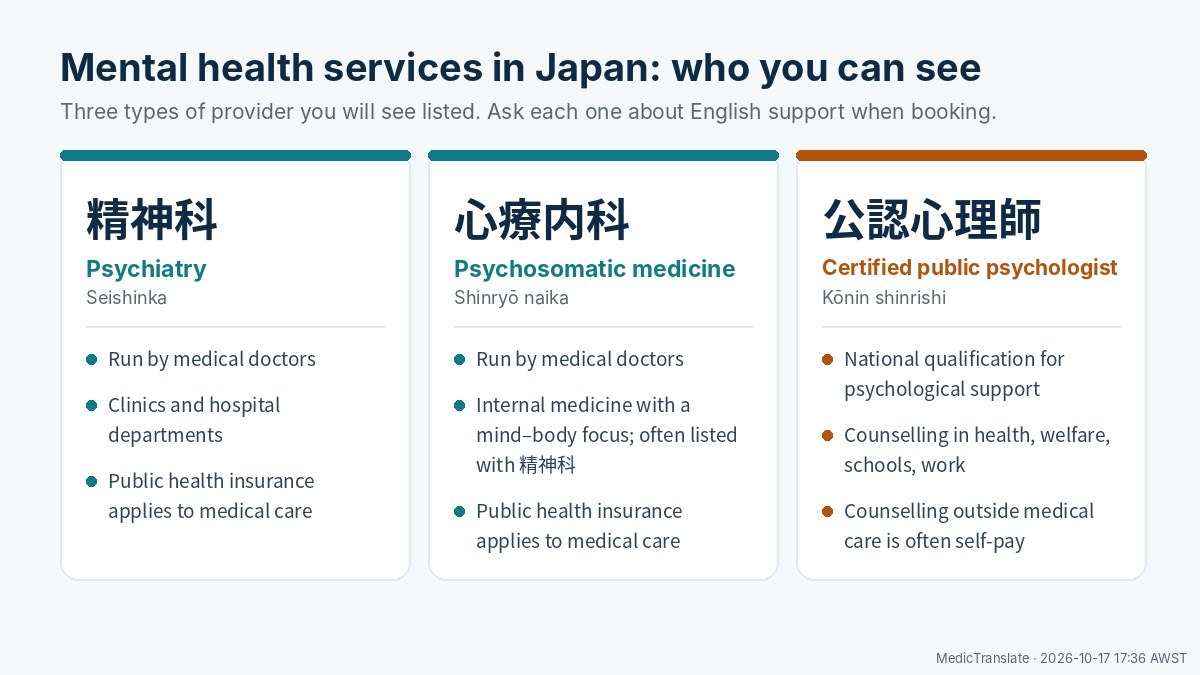
Types of mental health services in Japan
Clinic signs, websites and search tools in Japan use Japanese department names. Knowing the three main terms makes it much easier to search and to read what a clinic offers.
Psychiatry 精神科 (seishinka)
Psychiatry is an official clinic department name in Japan. It is run by medical doctors, at standalone clinics and in hospital departments, and public health insurance applies to the medical care given there.
Psychosomatic medicine 心療内科 (shinryō naika)
This department name combines internal medicine with a psychosomatic (mind and body) focus. It is also run by medical doctors, and many clinics list it alongside 精神科.
Counselling 公認心理師 (kōnin shinrishi)
Certified public psychologist is a national qualification set by law. These professionals give psychological support and counselling in health care, welfare, education and other settings. Counselling is also offered by other counsellors and organisations.
This guide does not tell you which type of provider is right for you. If you are unsure where to start, your local public health centre (保健所) or your prefecture's mental health and welfare centre (精神保健福祉センター) can talk through your options. The MHLW lists these local consultation windows on its consultation page (Japanese). Most of these services work in Japanese, so ask about language support when you contact them.
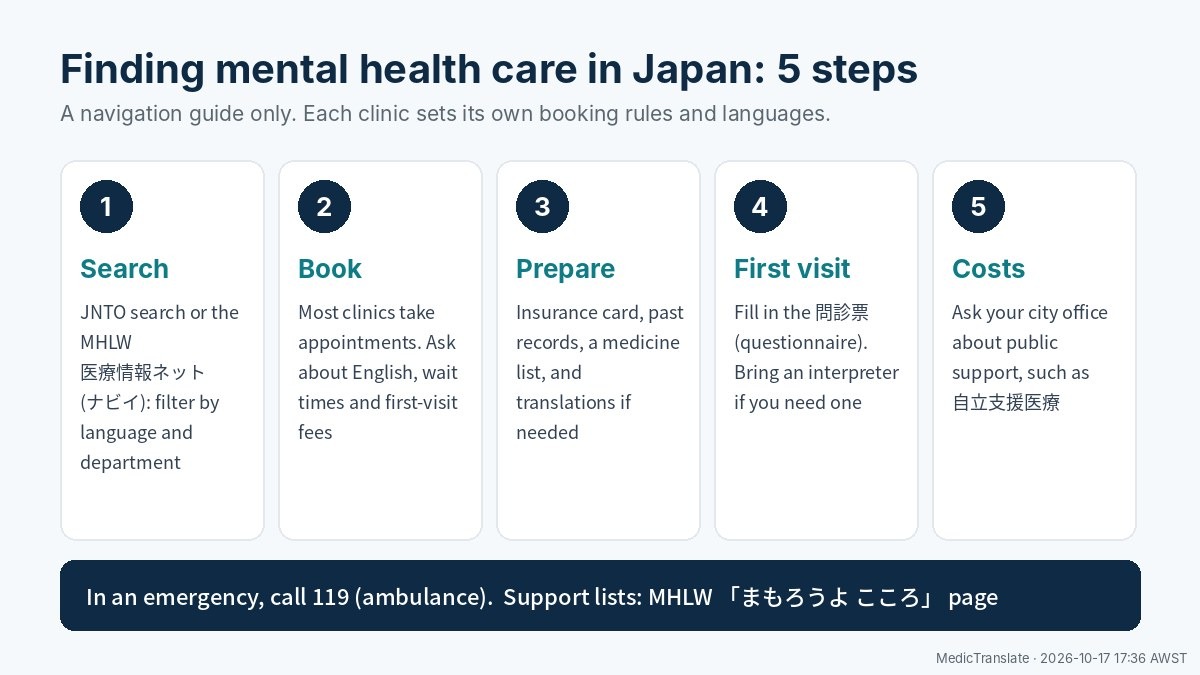
How to find English-speaking mental health services in Japan
There is no single list of English-speaking psychiatrists or counsellors, but several official tools let you filter by language. Use more than one, then contact the clinic to confirm.
- JNTO medical institution searchThe Japan National Tourism Organization's guide for when you are feeling ill includes a search by area, language and department. "Psychiatry" is one of the departments you can choose. It is written for visitors but useful for residents too.
- 医療情報ネット (Navii)The MHLW and prefectural governments run 医療情報ネット, a nationwide search of hospitals, clinics and pharmacies. Its detailed search includes a foreign-language option. The site is in Japanese, so a browser translation tool helps.
- MedicTranslate's regional clinic listsOur foreign-friendly clinics page has regional lists of clinics and hospitals used to seeing international patients. Check each clinic's departments, as not every listed clinic offers mental health care.
- Non-governmental servicesSome non-profits support the international community. TELL, for example, offers counselling and a lifeline service. Check their website for current details.
For more general tips on searching, see our guide on how to find an English-speaking doctor or clinic in Japan.
Booking tips
- Expect to book ahead. Many psychiatry and psychosomatic clinics work by appointment, and first-visit slots can be limited. Contact several clinics if the first one is full.
- Ask about language before you book. "English available" can mean a fully English consultation or only basic help at reception. Ask which applies, and whether you may bring an interpreter.
- Ask about fees. Check whether the clinic accepts Japanese public health insurance, and whether any counselling is charged separately.
- Check whether a referral letter is needed. Large hospitals often expect a referral letter (紹介状) from a clinic. Our guide to referral letters explains why.
- Use email or web forms if phone calls are hard. Some clinics accept bookings online. If not, a friend, colleague or interpreter can call for you.
What to expect at a first visit
Every clinic works a little differently, but first visits in Japan usually follow a similar pattern.
- Reception and registrationShow your health insurance details and fill in a registration form. Arrive early, as first visits involve paperwork.
- QuestionnaireMost clinics ask you to fill in a questionnaire (問診票, monshinhyō) before you see the doctor. It is normally in Japanese, so ask whether an English version exists or bring an interpreter.
- ConsultationA first consultation is often longer than later visits. You can usually bring a written summary of what you want to say, plus any past records.
- PaymentYou usually pay at reception after the visit. Keep the receipt.
What to bring
- Your health insurance details, or your passport and travel insurance details if you are visiting.
- Any past medical records or doctor's letters, with a translation if they are not in Japanese.
- A list of the medicines you currently take, and your medicine notebook (お薬手帳) if you have one.
- A short note of the questions you want to ask.
Our checklist on what to bring to a doctor, clinic or hospital in Japan has more detail. If you take medicine from home, read how to bring medication to Japan and bringing antidepressants to Japan before you travel.
Insurance and costs
If you are enrolled in Japanese public health insurance, it covers medical treatment at clinics and hospitals, including psychiatry and psychosomatic medicine, and you pay a share of the cost. Counselling offered outside a medical setting, such as at a private counselling room, is often self-pay. Fees vary, so ask before you book.
Visitors without Japanese public health insurance pay the full cost, so check what your travel insurance covers. Our guide on medical costs without Japanese insurance explains more.
Japan has a public scheme called 自立支援医療 (精神通院医療), which helps with the cost of ongoing outpatient psychiatric care. It is run by prefectures and designated cities, and eligibility is decided by them. The MHLW page on 精神通院医療 (Japanese) explains the scheme. Ask your doctor or your city or ward office whether it applies to you.
Workplace stress resources
If work stress is the concern, the MHLW runs こころの耳 (Kokoro no Mimi), a mental health portal for workers, their families and employers. It offers free, anonymous consultation by phone, social media and email, information on Japan's workplace stress check system (ストレスチェック制度), self-care courses and a short workplace stress self-check. The site is in Japanese.
Your employer may also offer its own support. Your HR team can tell you what is available.
How an interpreter or translated documents can help
In mental health care, the details of what you say matter. Working through a language barrier can make it harder to explain your situation and to understand what the doctor tells you.
- A medical interpreter can join your appointment so you can speak in your own language. This reduces the risk of misunderstanding during booking, the questionnaire and the consultation.
- Translated records, such as past doctor's letters or treatment summaries, help a Japanese doctor read your history without relying on you to explain it from memory.
- A translated medicine list helps the clinic and pharmacy see exactly what you have been prescribed abroad.
See our guide to medical records translation in Japan for what to translate, and medical interpreter costs in Japan for how interpreting is priced.
MedicTranslate provides language and access support only. We are not a healthcare provider, and we do not diagnose, recommend treatment or choose a clinic for you.
Get language support for your appointment
MedicTranslate provides medical interpreters, in person across Kansai and beyond and by video or phone anywhere in Japan, from US$360 for the first 3 hours. We also translate medical records and medicine lists into Japanese, with human-validated translation and standard delivery from 72 hours.
- Interpreters for booking calls and appointments
- Translation of past records and doctor's letters
- Help arranging healthcare appointments
- Price confirmed before work begins
Reply within 1–3 business days. We do not give medical advice, and clinic bookings depend on each clinic's availability.
Frequently asked questions
How do I find English-speaking mental health services in Japan?
Use the JNTO medical institution search, which lets you filter by language and choose Psychiatry as the department, or the MHLW 医療情報ネット (Navii), which has a foreign-language filter. Then contact the clinic to confirm what language support it offers.
What is the difference between 精神科 and 心療内科?
Both are clinic department names run by medical doctors. 精神科 is psychiatry. 心療内科 combines internal medicine with a psychosomatic, mind and body focus. Many clinics list both. The clinic can tell you what it treats.
Is counselling covered by health insurance in Japan?
Public health insurance covers medical treatment at clinics and hospitals. Counselling offered outside a medical setting is often self-pay. Ask the clinic or counsellor about fees before you book.
What is a 公認心理師?
A 公認心理師, or certified public psychologist, holds a national qualification set by law in Japan. They give psychological support and counselling in health care, welfare, education and other settings.
Do I need an appointment for a psychiatry clinic in Japan?
Many psychiatry and psychosomatic clinics work by appointment, and first-visit slots can be limited. Contact the clinic before you go and ask about language support and fees.
Where can I find support services or helplines in Japan?
The Ministry of Health, Labour and Welfare keeps the current list of phone and online support services on its まもろうよ こころ page. In an emergency, call 119 for an ambulance.
Can MedicTranslate recommend a psychiatrist or counsellor?
No. We do not recommend or endorse specific clinics or counsellors. We provide interpreting, translation and help arranging appointments with the provider you choose.
This article provides general navigation information reviewed on 17 October 2026. It is not medical advice and does not help you decide whether you need treatment. Clinic services, languages, fees and public support schemes can change, and eligibility for any scheme is decided by the relevant authority. MedicTranslate provides interpreting, translation and appointment support; it is not a healthcare provider and does not recommend specific clinics or counsellors. If you are struggling, the MHLW keeps the current list of support services on its まもろうよ こころ support page. In an emergency, call 119 (ambulance).
- JNTO: Guide for when you are feeling ill, with medical institution search by language and department
- MHLW and prefectures: 医療情報ネット (Navii), nationwide medical institution search (Japanese)
- MHLW: Certified public psychologists (公認心理師) (Japanese)
- MHLW: Medical Care Act Enforcement Order, permitted clinic department names (Japanese, PDF)
- MHLW: 自立支援医療 (精神通院医療) (Japanese)
- MHLW: Local mental health consultation windows (Japanese)
- MHLW: こころの耳, mental health portal for workers (Japanese)
- MHLW: まもろうよ こころ, list of support services (Japanese)