
Bringing Inhalers to Japan: Asthma and COPD Medicine Rules
Bringing inhalers to Japan is usually straightforward for asthma and COPD patients, as long as the amount fits Japan’s personal-use allowance. However, Japan’s official guidance does not name inhalers directly, so it helps to know which rule applies and where the grey areas are. This guide explains the quantity limits, the Import Confirmation, controlled ingredients, spacers and nebulisers, airport security and how to get a replacement in Japan.
Quick answer
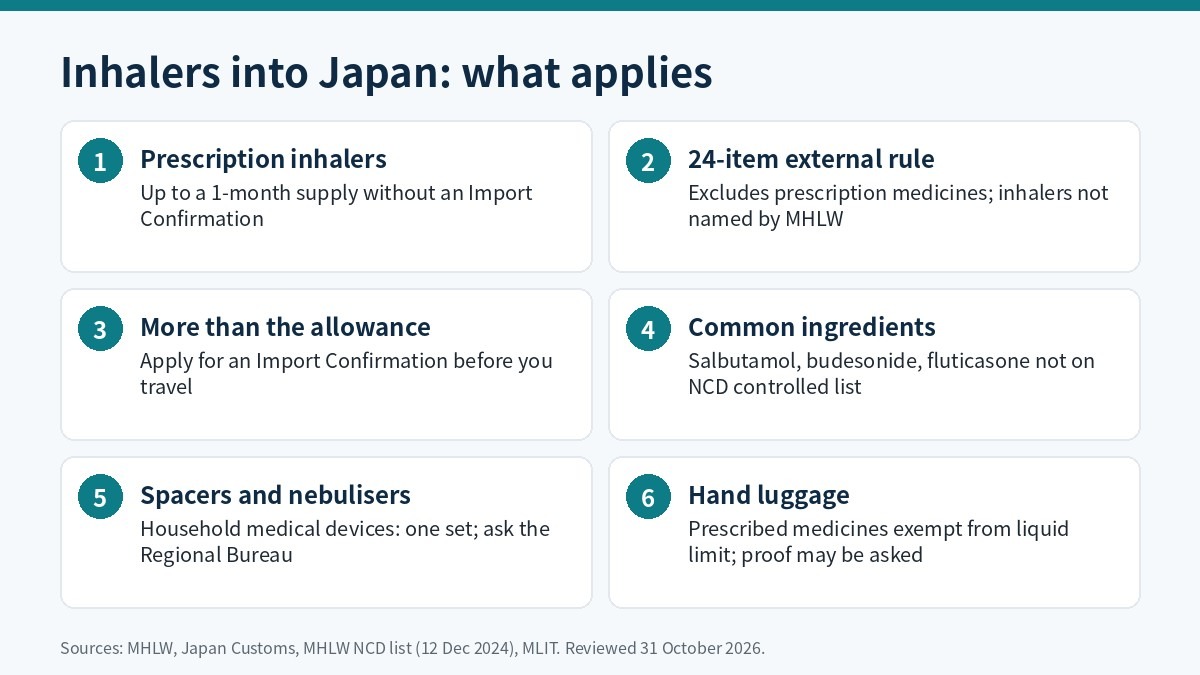
When bringing inhalers to Japan for your own use, MHLW allows up to a 1-month supply of prescription medicines without extra paperwork. The 24-item allowance for external medicines excludes prescription medicines, and MHLW does not say how inhalers are classed, so ask the Regional Bureau of Health and Welfare if you are unsure. For more than the allowance, you need an Import Confirmation before you travel. Common inhaler ingredients such as salbutamol, budesonide, fluticasone, formoterol, salmeterol and tiotropium do not appear on Japan’s controlled substances list that we checked.
Travelling with several inhalers or a long-stay supply? List your medicines and check them against Japanese guidance before you fly.
Check my medicationOn this page
Bringing inhalers to Japan: which rule applies?
Japan’s Ministry of Health, Labour and Welfare (MHLW) sets personal-use allowances for medicines that travellers carry. The allowance depends on the type of medicine, not on the brand. Therefore, the first step is to work out which category your inhaler falls into.
MHLW’s Japanese guidance describes external medicines (外用剤, gaiyōzai) as skin medicines such as ointments, and eye drops. Japan Customs uses the same wording. However, neither page mentions inhalers, inhalation aerosols or nasal sprays. In other words, official traveller guidance does not say whether an inhaler counts as an external medicine.
In practice, this gap matters less than it seems. The 24-item allowance for external medicines excludes prescription medicines. As a result, a prescription inhaler falls under the prescription-medicine rule either way. MHLW defines prescription medicines as medicines that need a doctor’s prescription for effective and safe use.
Not sure how your inhaler is classed? Ask the Regional Bureau of Health and Welfare for your arrival airport before you travel. MHLW lists the Kanto-Shinetsu Bureau for Narita and Haneda, and the Kinki Bureau for Kansai, Chubu Centrair, Fukuoka and Naha.
Quantity limits for bringing inhalers to Japan
The amounts below come from MHLW and Japan Customs.
| Type of medicine | Allowance without Import Confirmation (official source) |
|---|---|
| Prescription medicines (also poisons and powerful drugs) | Up to a 1-month supply, judged by the directions for use (MHLW, Japan Customs). |
| External medicines (not prescription-only) | Up to 24 standard-size units per item (MHLW, Japan Customs). |
| Other medicines and quasi-drugs | Up to a 2-month supply (MHLW, Japan Customs). |
| Household medical devices | One set (MHLW, Japan Customs). |
Most asthma and COPD inhalers are prescribed by a doctor. Consequently, the 1-month rule is the one most travellers should plan around. For example, a preventer inhaler used every day and a reliever inhaler used only when needed are both counted against a 1-month supply.
Reliever inhalers are a grey area. We found no official guidance on how to count a month’s supply for a medicine used only as needed. If you plan to carry several relievers, ask the Regional Bureau how they will count them, rather than guessing.
In every case, the medicines must be for your own use. MHLW states that personally imported medicines may not be sold or given to other people. Therefore, each traveller should carry their own inhalers.
When you need an Import Confirmation for inhalers
If you exceed the applicable allowance, obtain Import Confirmation (輸入確認証, yunyū kakunin-shō) before leaving home for Japan. Apply through MHLW’s electronic system or follow the relevant Regional Bureau’s alternative submission instructions. Show the confirmation to Customs on arrival.
- Count your supplyWork out how many inhalers you will use during your stay, and compare that with the 1-month allowance.
- Find your Regional BureauKanto-Shinetsu for Narita and Haneda; Kinki for Kansai, Chubu Centrair, Fukuoka and Naha (MHLW).
- Apply before travelUse MHLW’s Import Confirmation site or follow the relevant Regional Bureau’s alternative submission instructions.
- Carry the confirmationKeep it with your inhalers and show it to customs when you arrive.
Our Import Confirmation guide explains the process in more detail. In addition, our general guide on how to bring medication to Japan covers the rules for your other medicines.
Are common inhaler ingredients controlled in Japan?
Some medicines are restricted in Japan because they contain narcotics, psychotropics or stimulant raw materials. These follow separate rules, and some are banned outright. So it is worth checking each active ingredient before bringing inhalers to Japan.
We checked Japan’s Controlled Substances List, published by the Narcotics Control Department (NCD) of MHLW and dated 12 December 2024. None of the following common inhaler ingredients appear on it:
| Inhaler type | Common active ingredients | On the NCD list we checked? |
|---|---|---|
| Relievers | Salbutamol (albuterol), ipratropium | Not listed |
| Steroid preventers | Budesonide, fluticasone, beclomethasone | Not listed |
| Long-acting bronchodilators | Formoterol, salmeterol, vilanterol, tiotropium, umeclidinium | Not listed |
However, the same list does include ephedrine and methylephedrine as stimulant raw materials, with an exclusion for products containing 10% or less. These are not typical inhaler ingredients, but they can appear in some oral cold or asthma medicines. If you also carry those, read our guide to controlled medicines in Japan.
Lists change, so check the current NCD list for every ingredient on your label.
Spacers and nebulisers
MHLW treats medical devices separately from medicines. For household medical devices, the personal-use allowance is one set. MHLW’s Japanese page also describes a general restriction on individuals importing medical devices intended for professional use, with an Import Confirmation route where a documented medical need meets the requirements. Ask the Regional Bureau how your exact device is classified; for a professional-use device, it may require prescriber documentation and Import Confirmation.
The official pages we reviewed do not name spacers or nebulisers. As a result, we cannot confirm how each one is classed. If you travel with a nebuliser, or with more than one spacer, ask the Regional Bureau before you fly. In addition, check with your airline about any battery-powered device.
Liquid medicine for a nebuliser is a medicine, not a device. It counts against the medicine allowances above. For more on equipment, see our guide to bringing medical devices to Japan.
Bringing inhalers to Japan in your hand luggage
Japan’s Ministry of Land, Infrastructure, Transport and Tourism (MLIT) publishes a Q&A on the liquid rules for international flights.
- The basic rule: liquids go in containers of 100 ml or less, inside one clear resealable bag of 1 litre or less per passenger.
- Medicines are an exception: MLIT lists prescribed medicines, and liquids needed for diabetes or other medical reasons, as exempt on humanitarian grounds. Non-prescription medicines are also allowed, in the amount needed for the journey.
- Proof may be requested: MLIT says security staff may ask you to show that you need the item on board, for example a copy of the prescription, the pharmacy bag or a medical certificate.
Airlines can also have their own rules, especially for pressurised containers and batteries. Therefore, check your airline’s page as well before you pack.
Getting a replacement inhaler in Japan
If you lose an inhaler or run out, you cannot simply buy the same product at a Japanese drugstore. For example, PMDA’s official product page for Sultanol Inhaler 100µg, a salbutamol inhaler sold in Japan, classes it as a prescription medicine (処方箋医薬品), to be used on a doctor’s prescription.
In other words, you would normally need to see a doctor in Japan, who decides whether to prescribe and which product to use. Japanese brand names often differ from those at home. As a result, it helps to bring a list of your inhalers by active ingredient and strength, not only by brand. Our guide on lost or expired medications in Japan explains the next steps.

Breathing emergency? In Japan, call 119 for an ambulance. Our guide to calling 119 in Japan explains what to say.
Packing checklist for bringing inhalers to Japan
- Count your supplyStay within a 1-month supply of prescription inhalers, or apply for an Import Confirmation.
- Check every ingredientCompare the active ingredients on each label with the current NCD controlled substances list.
- Keep original packagingLabelled boxes show what the medicine is and how much you carry.
- Pack inhalers in hand luggageKeep them within reach and carry a prescription copy in case security asks.
- Bring a doctor’s letterA letter listing your inhalers by active ingredient helps at the border and at a Japanese clinic.
- Ask about devicesCheck with the Regional Bureau and your airline before travelling with a nebuliser.
If your doctor’s letter or prescription is in German, French or Arabic, a medical document translation into English or Japanese keeps the ingredient names clear.
Check your inhalers and other medicines before you fly
Our written medication assessment summarises published Japanese guidance and identifies questions to raise with the relevant authority. It is not an individual clearance decision. You complete and submit any government application yourself. MedicTranslate does not submit, represent, or guarantee outcomes.
- Item-by-item summary of published Japanese guidance
- Questions to raise with the relevant authority
- Doctor’s letter translation available (quoted separately)
Price confirmed before you pay · Reply within 1–3 business days · MedicTranslate does not provide medical care. You complete and submit any government application yourself. MedicTranslate does not submit, represent, or guarantee outcomes.
Frequently asked questions
Can I bring my asthma inhaler to Japan?
Yes, for your own use and within the personal-use allowance. MHLW allows up to a 1-month supply of prescription medicines without an Import Confirmation. If you need more, apply for an Import Confirmation before you travel.
Does an inhaler count as an external medicine with a 24-item limit?
Official guidance does not say. MHLW and Japan Customs describe external medicines as ointments, other skin medicines and eye drops, and do not mention inhalers. The 24-item allowance also excludes prescription medicines, so a prescription inhaler follows the 1-month rule. Ask the Regional Bureau of Health and Welfare if you are unsure.
Is salbutamol or albuterol controlled in Japan?
Salbutamol, also called albuterol, does not appear on the NCD Controlled Substances List dated 12 December 2024 that we checked. Neither do budesonide, fluticasone, formoterol, salmeterol or tiotropium. Check the current list for every ingredient on your label before you travel.
Can I take my inhaler in my hand luggage on a flight to Japan?
MLIT guidance exempts prescribed medicines from the liquid limit on international flights. Security staff may ask you to show that you need the item on board, for example with a copy of the prescription. Check your airline rules as well.
Can I bring a nebuliser or spacer to Japan?
MHLW allows one set of a household medical device for personal use, but the pages we reviewed do not name spacers or nebulisers. Ask the Regional Bureau of Health and Welfare for your arrival airport before you travel, and check battery rules with your airline.
Can I buy an asthma inhaler at a Japanese drugstore?
Generally not. The salbutamol inhaler sold in Japan is classed by PMDA as a prescription medicine, so you would normally need to see a doctor in Japan. Bring a list of your inhalers by active ingredient to help the doctor.
Does MedicTranslate decide whether my inhaler is allowed?
No. Only the Japanese authorities make that decision. MedicTranslate can review the medicines you list against published guidance and translate your doctor's letter, and you remain responsible for what you carry.
This article provides general information based on published Japanese government guidance reviewed on 31 October 2026. It is not medical or legal advice and is not an official customs or classification decision. Do not change how you use your inhalers without talking to your doctor. Rules change, so confirm current requirements with MHLW, the responsible Regional Bureau of Health and Welfare, Japan Customs and your airline before travel.
MedicTranslate provides translation, interpreting, information and healthcare coordination services. It does not provide medical care or prescriptions, submit applications, represent you, or guarantee outcomes. You complete and submit any government application yourself.
- MHLW: Bringing medicines for personal use into Japan (quantity limits)
- MHLW: Personal import of medicines and medical devices (Japanese)
- Japan Customs: Personal import of medicines and cosmetics (Japanese)
- MHLW Narcotics Control Department: Controlled Substances List (PDF)
- PMDA: Sultanol Inhaler 100µg product information (Japanese)
- MLIT: Liquid restrictions on international flights, Q&A (Japanese, PDF)