
Boshi Techo: Japan's Maternal and Child Health Handbook
The boshi techo (母子健康手帳, maternal and child health handbook) is the record book that follows a pregnancy and a child's early years in Japan. This guide explains how a foreign resident gets one, where to ask for a multilingual edition, how the prenatal checkup vouchers work, and how to keep the record useful if you move abroad.
Quick answer
You get a boshi techo by notifying your pregnancy (妊娠届) at the city or ward office where you are registered. The office gives you the handbook and, usually, vouchers for publicly subsidised prenatal checkups. Many cities offer bilingual editions (Japanese plus another language) on request. Bring the handbook to every checkup, the birth, and your child's health checks and vaccinations. If you move abroad, keep the original and have the key pages translated.
Moving abroad or seeing a doctor who does not read Japanese? We translate boshi techo pages, such as vaccination and checkup records, into English.
Request a translation quoteOn this page
What is the boshi techo?
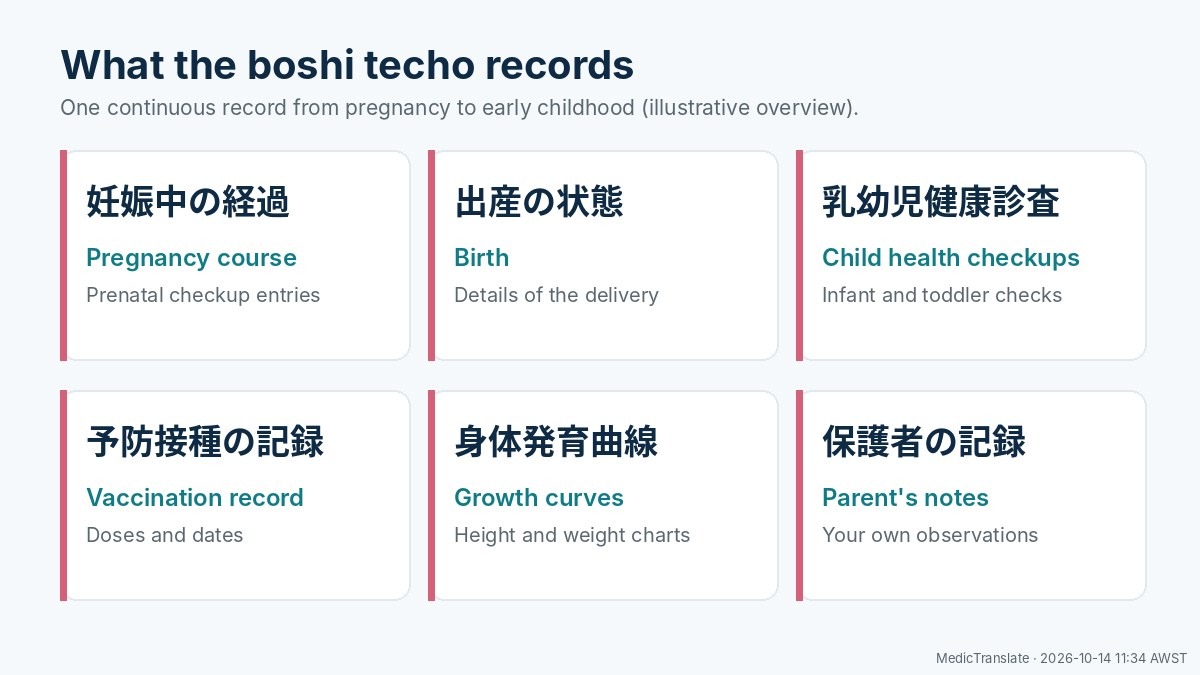
The 母子健康手帳 (boshi kenkō techō, usually shortened to boshi techo) is issued by your municipality under Articles 15 and 16 of the Maternal and Child Health Act. The Ministry of Health, Labour and Welfare (MHLW) describes it as one continuous health record covering pregnancy, birth and early childhood. It helps the mother keep track of her own health, becomes an important family record, and is used by health staff when they give checkups and guidance.
Part of the handbook follows a nationally uniform format set by ministerial ordinance. According to MHLW, this includes the record of the pregnancy, a vaccination record (予防接種の記録) and growth curves (身体発育曲線) for the child. The rest is information that each municipality chooses, such as local services and child-rearing tips.
How a foreign resident gets a boshi techo
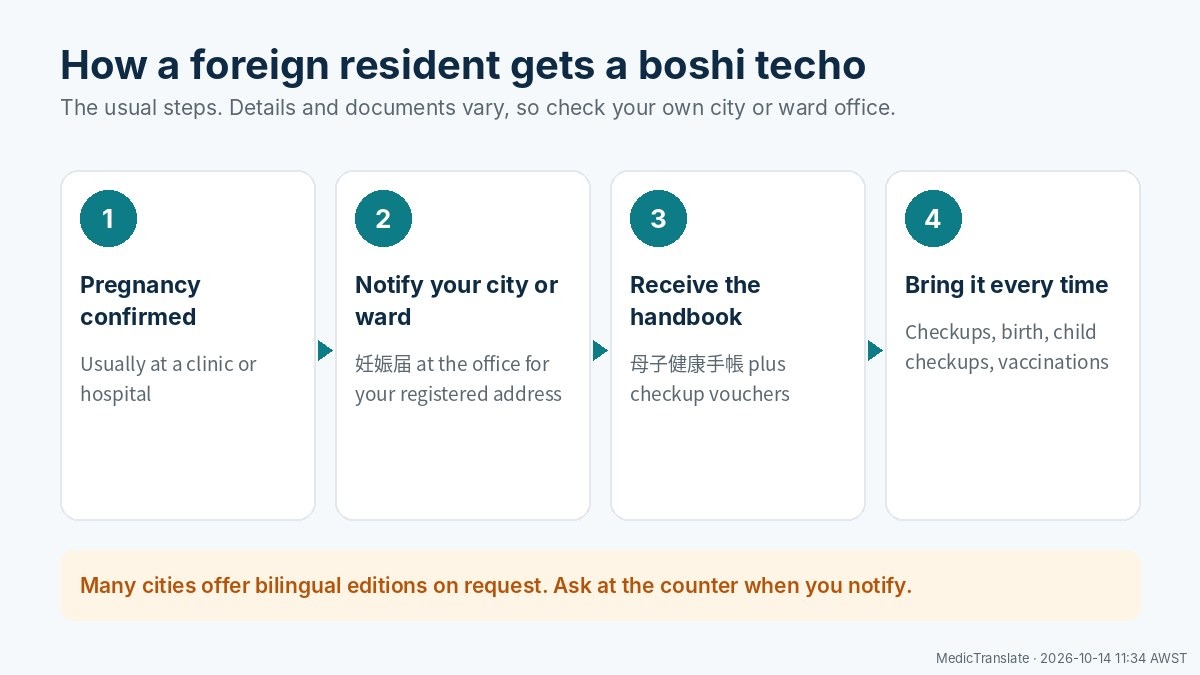
Foreign residents registered at a Japanese address follow the same process as Japanese residents. MHLW's guidance is to notify your city, town or village promptly once a pregnancy is confirmed. The municipality then issues the handbook.
- Confirm the pregnancyUsually at a clinic or hospital. Some municipalities, such as Kobe, do not ask for a medical certificate to issue the handbook, but check what your office needs.
- Submit the pregnancy notificationGo to the counter that handles maternal and child health at your city or ward office (妊娠届). In Kobe, you can apply at the health and welfare section of any ward office or branch office.
- Bring identificationKobe asks for your My Number card, or another ID plus proof of your My Number. A family member can apply for you with a power of attorney. Other cities may ask for different documents.
- Receive the handbook and vouchersStaff explain local services. In Kobe, the process takes about 30 to 60 minutes.
If you are not confident in Japanese, ask whether the office has interpreting support, or bring an interpreter. Our guide to interpreters at the ward office explains the options.
Multilingual boshi techo editions
Many municipalities stock foreign-language editions. These are usually bilingual, with Japanese alongside the other language, so Japanese doctors and midwives can still write in them and you can read them.
- A national multilingual edition. An MHLW-funded project (fiscal year 2019) produced the handbook in 10 languages: English, Chinese, Korean, Portuguese, Spanish, Indonesian, Vietnamese, Thai, Tagalog and Nepali. In the same study, about 78% of municipalities with foreign pregnant residents bought foreign-language handbooks and gave them out free.
- Yokohama City lists seven languages: English, Chinese, Korean, Spanish, Portuguese, Vietnamese and Nepali.
- Chiba Prefecture municipalities offer between one and eleven languages. Some give them out at notification, others only on request.
Availability, languages and stock differ by city, so ask for a foreign-language edition when you submit your notification. If your language is not available, a translation of key pages can help later.
Prenatal checkup vouchers (妊婦健康診査受診券)
When you notify your pregnancy, MHLW says you will also receive vouchers or subsidy tickets (受診券 or 補助券) that let you have prenatal checkups (妊婦健康診査) with public funding. The number of vouchers and the amounts depend on your municipality.
For example, Kobe City currently issues:
| Kobe City prenatal checkup rule | Detail |
|---|---|
| Basic checkup vouchers | 14 vouchers of ¥5,000 each, plus additional test vouchers |
| Total subsidy | Up to ¥120,000 for the standard set of vouchers |
| From 1 October 2026 | 2 extra basic vouchers (¥5,000) and 2 extra ultrasound vouchers (¥3,000) for a 15th or 16th checkup at 40 weeks or later |
| Where vouchers work | Only at medical facilities and midwife clinics contracted with Kobe City |
| Checkups outside Hyogo | Part of the cost can be reimbursed afterwards for facilities elsewhere in Japan, within a claim deadline |
| Moving out of Kobe | Kobe vouchers can no longer be used; apply to your new municipality |
Other cities have their own rules, so check your city's page or ask at the counter.
Using the boshi techo at appointments
Bring the handbook to every prenatal checkup, to the birth, and to your child's health checks and vaccinations. Clinics write in it, so it builds into one record over time. Japan's routine childhood vaccinations are recorded there too; see our guide to vaccinations in Japan for how the schedule works.
If you have records from another country, such as earlier vaccinations, keep them with the handbook and show them to the clinic. A Japanese translation makes it easier for staff to see what has already been done.
Keeping your boshi techo records if you move abroad
The handbook stays with your family. If you leave Japan, take the original with you. Doctors and schools overseas may not read Japanese, so plan ahead:
- Keep the original safeIt is often the only complete record of your pregnancy, the birth and your child's early checkups and vaccinations.
- Scan or photograph every written pageInclude stamps, handwritten notes and the vaccination pages.
- Translate the pages you will needVaccination records, birth details and child health checkups are the pages most often asked for. Ask the receiving clinic or school which records they need.
- Moving within JapanThe handbook moves with you, but checkup vouchers are tied to your municipality. Contact your new city or ward office about new vouchers.
Living abroad without a Japanese resident record? Kobe City notes that part of the handbook can be downloaded from the Children and Families Agency's information site for the maternal and child health handbook.
Translating your boshi techo
A translation turns the handwritten and printed entries into clear English (or Japanese, if you are bringing overseas records to Japan) for the clinic, school or doctor who needs them. It reduces the risk of misunderstanding, for example over which vaccine doses were given and when.
- Tell us which pages you need translated and who will receive them.
- Send clear scans of each page, including handwritten entries and stamps.
- Keep the original; you will not need to post it.
Whether a receiving organisation accepts a translation is up to that organisation, so check its requirements first. See medical records translation in Japan for more on how medical translation works.
Make your boshi techo readable wherever you go
MedicTranslate translates boshi techo pages and overseas child health records, and provides medical interpreters for prenatal checkups, paediatric appointments and city office procedures.
- Human-validated medical translation, standard delivery from 72 hours
- Vaccination and checkup pages translated
- Interpreters in person across Kansai and beyond, or by video or phone Japan-wide
- See current rates on our pricing page
Price confirmed before work begins. Reply within 1–3 business days. We do not give medical advice.
Frequently asked questions
What is a boshi techo?
A boshi techo (母子健康手帳) is Japan's maternal and child health handbook. Your municipality issues it after you notify your pregnancy, and it records the pregnancy, the birth and your child's early health checks and vaccinations in one place.
Can foreign residents get a boshi techo?
Yes. If you are registered at an address in Japan, you notify your pregnancy at your city or ward office in the same way as Japanese residents, and the office issues the handbook.
Is the boshi techo available in English?
Many municipalities stock bilingual editions, with Japanese alongside English or another language such as Chinese, Korean, Portuguese, Spanish, Vietnamese or Nepali. Ask for one when you submit your pregnancy notification, as availability varies by city.
How many prenatal checkups are subsidised?
It depends on your municipality. For example, Kobe City issues 14 basic checkup vouchers, or 16 from 1 October 2026 if your 15th and 16th checkups are at 40 weeks or later. Check your own city or ward for its rules.
What happens to my boshi techo if I move abroad?
The handbook stays with your family, so take the original with you. Scan every written page and have the pages you need, such as vaccination and checkup records, translated for doctors or schools abroad.
Can MedicTranslate translate my boshi techo?
Yes. We translate boshi techo pages, including handwritten entries, with human validation. Request a quote and tell us which pages you need and who will receive them. We do not give medical advice.
This article provides general information reviewed on 14 October 2026. Procedures, documents, available languages, voucher numbers and subsidy amounts are set by each municipality and can change. Check with your city or ward office for your situation. This page is not medical or legal advice; ask your doctor or midwife about your pregnancy and your child's health. Whether an organisation in Japan or abroad accepts a translated record is decided by that organisation.
- MHLW Birth Navi: Pregnancy notification, handbook and prenatal checkup vouchers (Japanese)
- MHLW: Maternal and child health handbook, Maternal and Child Health Act Articles 15 and 16 (Japanese)
- MHLW: Materials on the maternal and child health handbook format (Japanese, PDF)
- MHLW-funded study: Multilingual maternal and child health handbook, FY2019 (Japanese, PDF)
- Kobe City: Getting the maternal and child health handbook (Japanese)
- Kobe City: Prenatal checkup vouchers (Japanese)
- Yokohama City: Maternal and child health handbook, foreign-language editions (Japanese)
- Chiba Prefecture: Municipal multilingual services, including handbook editions (Japanese, PDF)