
Can You Bring Blood Thinners to Japan? Apixaban, Warfarin and Other Anticoagulants
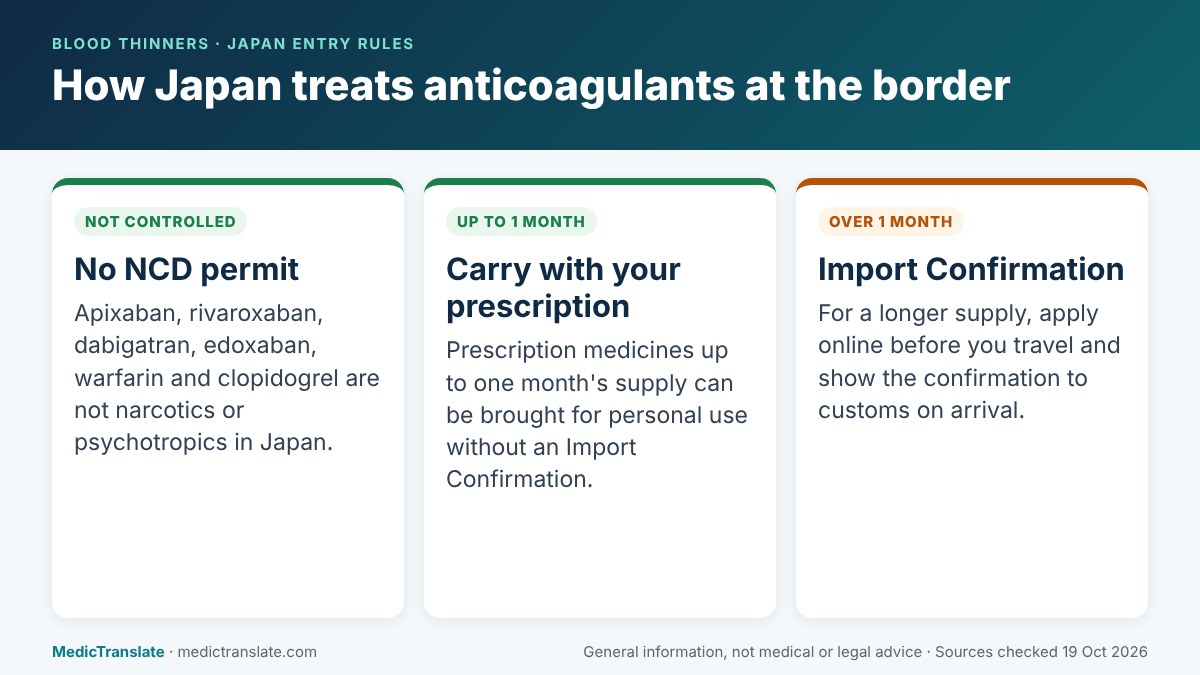
Yes, you can bring blood thinners to Japan for personal use. Apixaban (Eliquis), rivaroxaban (Xarelto), dabigatran, edoxaban, warfarin and clopidogrel are not controlled substances in Japan, so no Narcotics Control Department permit is needed. What matters is how much you bring and, for injections, what form they come in.
Quick answer
Anticoagulant and antiplatelet tablets are ordinary prescription medicines in Japan. You can carry up to one month’s supply for personal use without paperwork. For a longer supply, obtain Import Confirmation before leaving home for Japan. Enoxaparin (Clexane) may qualify for the personal-use exemption. Confirm your specific supply and injection equipment with the relevant Regional Bureau before travel. Syringes or needles carried on their own require Import Confirmation, even for a single piece. To continue treatment in Japan, you will need a Japanese doctor.
Staying longer than a month, or carrying injections? Get each medicine checked against Japan’s rules before you book.
Check my medicationOn this page
Can you bring blood thinners to Japan without a permit?
Yes. Japan only requires a Narcotics Control Department (NCD) permit for narcotics and stimulant raw materials, and it sets quantity limits for psychotropics. None of the common blood thinners is in any of those groups. They do not appear in the NCD psychotropics table, and the NCD guidance names very different examples (morphine, oxycodone, lisdexamfetamine, zolpidem).
As a result, you can bring blood thinners to Japan under the ordinary personal-use rules that apply to most prescription medicines.
| Medicine (ingredient) | Common overseas brand | Japanese brand | Status in Japan |
|---|---|---|---|
| Apixaban | Eliquis | Eliquis エリキュース | Prescription-only, not controlled |
| Rivaroxaban | Xarelto | Xarelto イグザレルト | Prescription-only, not controlled |
| Dabigatran | Pradaxa | Prazaxa プラザキサ | Prescription-only, not controlled |
| Edoxaban | Savaysa, Lixiana | Lixiana リクシアナ | Prescription-only, not controlled |
| Warfarin | Coumadin, Marevan | Warfarin ワーファリン | Prescription-only, not controlled |
| Clopidogrel (antiplatelet) | Plavix | Plavix プラビックス | Prescription-only, not controlled |
| Enoxaparin (injection) | Clexane, Lovenox | Clexane kit クレキサン | Prescription-only, not controlled; see the injection rules below |
Brand names from PMDA package-insert listings, checked 19 October 2026.
The one-month rule when you bring blood thinners to Japan
The Ministry of Health, Labour and Welfare (MHLW) allows travellers to carry prescription medicines for personal use up to one month’s supply, judged by the dosage on the prescription. Other non-prescription medicines are allowed up to two months.
Up to one month
Carry the tablets in their original packs with a copy of your prescription or a doctor’s letter.
More than one month
If Import Confirmation (Yunyu Kakunin-sho) is required, obtain it before leaving home for Japan. Apply through MHLW’s electronic system or follow the relevant Regional Bureau’s alternative submission instructions. Show the confirmation to Customs on arrival.
MHLW counts the contents, not the number of boxes. In addition, splitting a supply across several bags or shipments in the same period still counts toward the same total. If you plan to bring blood thinners to Japan for a long stay, a work posting or study, the Import Confirmation is the normal route.
How the Import Confirmation works
- Gather the prescriptionMHLW asks for a prescription or doctor’s note showing the patient, the medicine and the doctor’s name.
- Apply onlineUse MHLW’s Import Confirmation Information System. The confirmation arrives as a PDF by email.
- Allow a few business daysMHLW says it is normally issued within a few business days, excluding weekends and holidays.
- Carry it with the medicineShow the confirmation to customs on arrival.
For the full walkthrough, see our guide to the Import Confirmation Certificate (formerly Yakkan Shoumei).
Injections: how to bring blood thinners to Japan in syringes
MHLW provides personal-use exemptions for certain medicines supplied with syringes for self-injection. Confirm whether your specific medicine, formulation, quantity and injection equipment meet the applicable requirements before travelling.
Loose syringes and needles are different. MHLW’s Q&A says syringes on their own count as medical devices and need an Import Confirmation even for a single piece. Syringes supplied with eligible self-injection medicine may qualify for the personal-use exemption. If your medicine comes in vials that you draw up yourself, check with the Regional Bureau of Health and Welfare before you travel.
Also worth knowing: in Japan, the approved enoxaparin kit is licensed mainly to prevent clots after hip or knee surgery and some abdominal operations. A Japanese doctor may therefore choose a different medicine if you need injections continued here. That is a clinical decision for the doctor.
Practical tips when you bring blood thinners to Japan
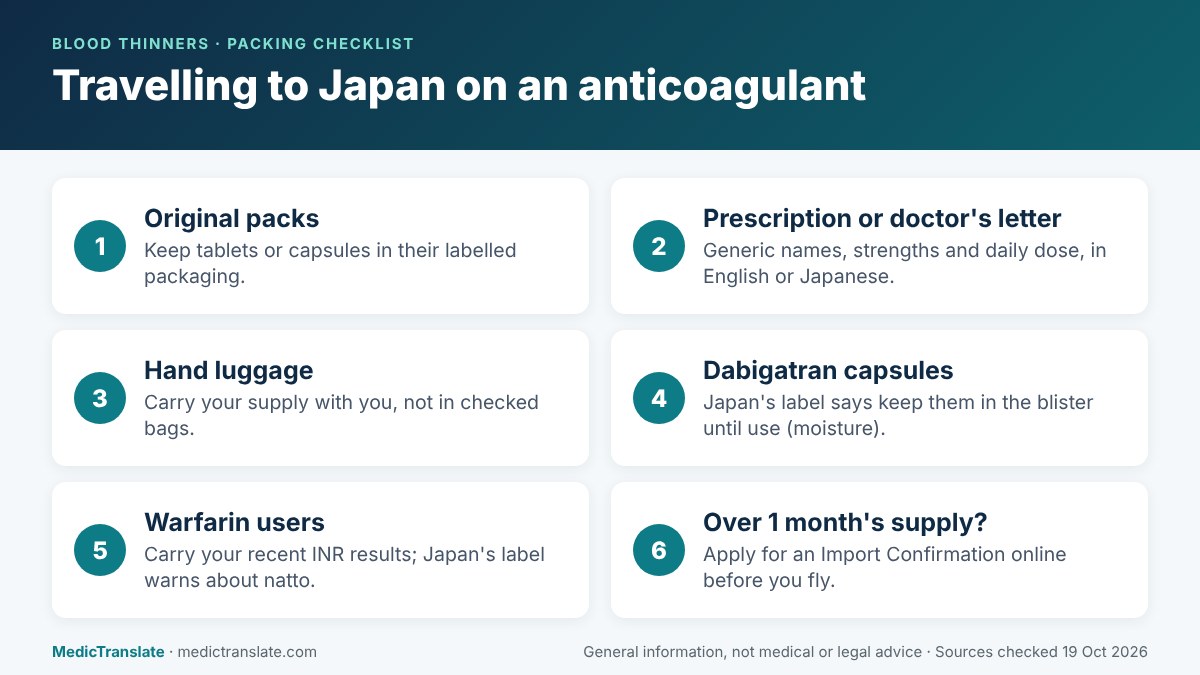
- Keep the original packaging. Customs officers check the label against your documents.
- Carry it in your hand luggage, together with the prescription or doctor’s letter, so a missed day is less likely if bags go astray.
- Use generic names. Brand names differ between countries (Pradaxa overseas is Prazaxa in Japan, for example), so write the ingredient and strength on every document.
- Dabigatran capsules: the Japanese label tells patients to keep them in the blister until use because of moisture. Do not decant them into a pill organiser without asking your pharmacist.
- Warfarin users: carry your most recent INR results. In addition, the Japanese warfarin label warns about natto, a common fermented soybean food in Japan, because of its vitamin K.
Translated documents help both at the border and at a clinic. A prescription translation keeps ingredient names, strengths and daily doses identical across every page.
Running out of your anticoagulant in Japan
In Japan, prescription-only medicines are dispensed against a prescription from a Japanese medical institution, and overseas prescriptions are generally not filled. If you are staying longer or lose your supply, plan to see a Japanese doctor early, because anticoagulants are not something to stop suddenly.
- Bring your current medication list, dose and the reason you take it, ideally in Japanese.
- For warfarin, bring your target INR range and recent results; the doctor may order a blood test.
- Doses can differ by country. Japanese labelled doses can differ from those used in other countries. Only your doctor can decide your dose.
Our guides to continuing an overseas prescription in Japan and lost or expired medication explain the steps.
Bleeding, a fall with a head injury or sudden severe symptoms? Call 119 for an ambulance and tell the crew you take a blood thinner. See calling 119 in Japan.
Not sure whether your supply needs an Import Confirmation?
Our written medication assessment summarises published Japanese guidance and identifies questions to raise with the relevant authority. It is not an individual clearance decision. You complete and submit any government application yourself. MedicTranslate does not submit, represent, or guarantee outcomes.
- Medicine-by-medicine summary of published Japanese guidance
- Questions to raise with the relevant authority
- Prescription translation if you need it
Price confirmed before you pay · Reply within 1–3 business days · You complete and submit any government application yourself. MedicTranslate does not submit, represent, or guarantee outcomes.
Common mistakes
- Packing three months of tablets for a long trip without an Import Confirmation.
- Bringing loose syringes or needles for injections without checking first.
- Posting a refill to a hotel or a friend’s address; mail sent anywhere other than your own home may need an Import Confirmation.
- Documents that only show brand names, or show a different strength from the box.
- Assuming a pharmacy in Japan can refill an overseas prescription.
Frequently asked questions
Can I bring Eliquis (apixaban) to Japan?
Yes. Apixaban is an ordinary prescription medicine in Japan and is not controlled. You can carry up to one month's supply for personal use with your prescription. For more than one month, apply for an Import Confirmation before you travel.
Do I need a permit to bring warfarin to Japan?
No narcotics permit is needed, because warfarin is not a controlled substance in Japan. The one-month personal-use limit still applies, so a longer supply needs an Import Confirmation from MHLW.
Can I bring Clexane injections to Japan?
Enoxaparin may qualify for the personal-use exemption. Confirm your formulation, quantity and injection equipment with the relevant Regional Bureau before travel. Syringes or needles carried on their own require Import Confirmation, even for a single piece.
How long does an Import Confirmation take?
MHLW says it is normally issued within a few business days, excluding weekends and holidays. Apply online before you travel and allow extra time in busy periods.
Are blood thinners sold in Japan?
Yes. Apixaban, rivaroxaban, dabigatran, edoxaban, warfarin and clopidogrel are all approved in Japan as prescription-only medicines. You need a Japanese doctor's prescription to get them.
Can a Japanese pharmacy fill my overseas prescription?
Generally no. Prescription-only medicines in Japan are dispensed against a prescription from a Japanese medical institution, so you would need to see a doctor in Japan.
Does MedicTranslate apply for the Import Confirmation for me?
No. MedicTranslate can summarise published guidance for your medicines and translate your prescription. You complete and submit any government application yourself. MedicTranslate does not submit, represent, or guarantee outcomes.
This article provides general information based on published Japanese government guidance reviewed on 19 October 2026. It is not medical or legal advice and is not an official customs determination. Never stop or change an anticoagulant without your doctor. Rules change and product-specific facts matter, so confirm current requirements with MHLW or the responsible Regional Bureau of Health and Welfare before travel.
MedicTranslate provides translation, information and administrative coordination services. It does not submit applications, represent you, give medical or legal advice, or guarantee outcomes. You complete and submit any government application yourself.
- MHLW: Bringing medicines into Japan for personal use (English)
- MHLW: Q&A for those who are importing medicines into Japan (English, PDF)
- MHLW: Import Confirmation Information System
- MHLW: Personal import of medicines (quantity counting, Japanese)
- Narcotics Control Department: Carrying medicines into or out of Japan
- Narcotics Control Department: Psychotropics quantity table (PDF)
- Japan Customs: Personal import of medicines (Customs Answer 1806, Japanese)
- PMDA: Eliquis (apixaban) package insert (Japanese)
- PMDA: Clexane (enoxaparin) package insert (Japanese)
- Tokyo Metropolitan Government: How medical care works in Japan