
Booking an Interpreter for a Family Member in Hospital in Japan
When someone you love is admitted to a Japanese hospital, the hardest conversations often come quickly: test results, consent for a procedure, discharge plans. Finding an interpreter for a family member in hospital is far easier if you start the moment you know about the admission. This guide explains what hospitals usually provide, which public programmes exist, and how to book a professional interpreter in time.
Quick answer
Ask the ward first what interpreting it offers and when the key meetings are. Many hospitals use phone or video interpreting; public programmes exist in some areas but are usually requested by the hospital, cover set hospitals and hours, and some are outpatient-only. For consent, results and discharge talks, a booked professional interpreter is the most reliable option, and it needs notice. MedicTranslate replies within 1–3 business days, so book as early as you can; same-day requests often cannot be filled.
Know the meeting dates? Send them now. Interpreters are booked in advance, and early requests are the ones we can usually fill.
Book an interpreterOn this page
Why an interpreter for a family member in hospital needs to be booked early
Japanese hospitals have a legal duty to explain care so that patients understand it. Under the Medical Care Act, providers must try to give appropriate explanations and gain the understanding of the person receiving care. In practice, explanation meetings for patients and families can be scheduled at short notice, around the doctors’ ward rounds and operating lists.
Professional interpreters, on the other hand, are booked ahead. If a meeting is set for tomorrow morning and the request arrives tonight, there may be no interpreter free, whoever you ask. For that reason, the single most useful step is to ask the ward for the likely meeting dates and book straight away.
Set expectations: MedicTranslate replies within 1–3 business days. Bookings depend on interpreter availability, so short-notice requests may not be possible. If a decision is urgent today, ask the hospital about its own phone or video interpreting.
What hospitals provide before you book an interpreter for a family member in hospital
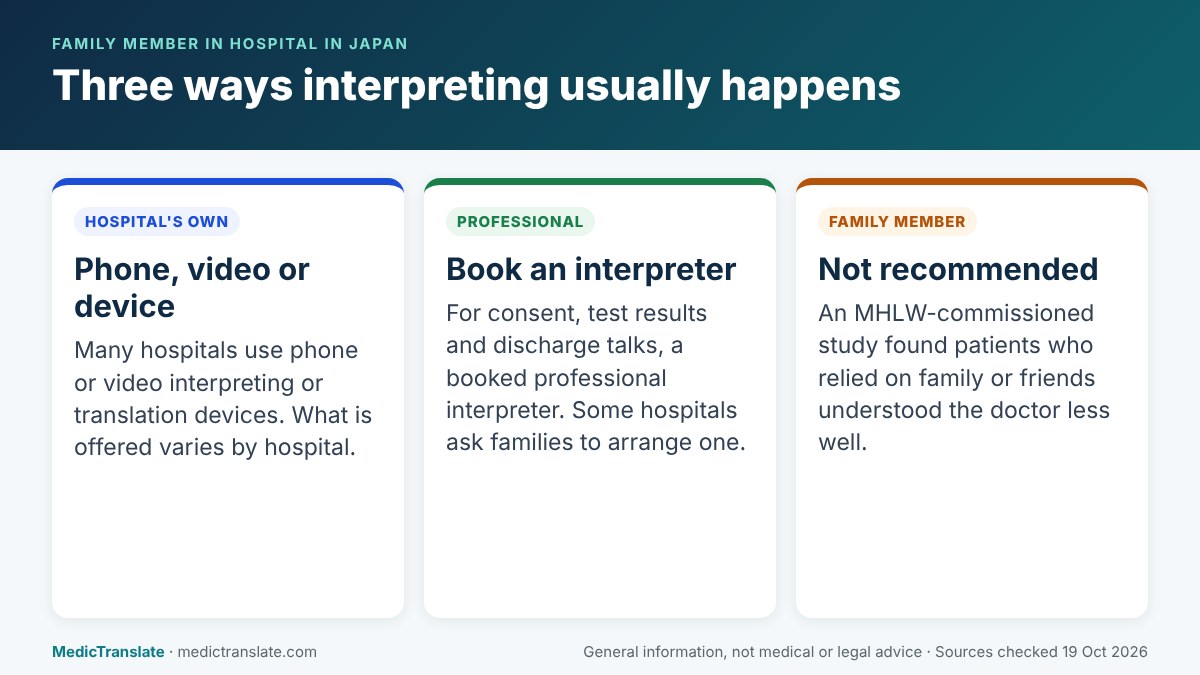
Phone, video or device
MHLW material describes interpreters employed by hospitals, contracted companies and remote interpreting by phone or tablet video. What is offered, and in which languages, varies by hospital.
A booked interpreter
For consent, results and discharge, many families book a professional. MHLW tracks whether hospitals ask patients to arrange their own interpreter, and some do.
A relative interpreting
An MHLW-commissioned study found about 30% of foreign patients relied on family or friends, and they understood the doctor’s explanation less well.
Hospitals may also charge for interpreting. An MHLW manual for hospitals notes that interpreting not directly part of treatment can be charged separately, by agreement with the patient, so ask before the meeting. If you are a visitor with travel insurance, the insurer’s assistance service may arrange interpreting within your policy’s cover.
Free and low-cost programmes: a public interpreter for a family member in hospital?
Some public programmes can help, but almost all are requested by the hospital, not the family, and each has limits:
| Area | Programme | Key limits |
|---|---|---|
| Kobe and Hyogo | FACIL medical interpreting at participating hospitals (10 listed in 2025) | Patient pays a flat daily fee at reception (lower for remote). Used on wards and in the ICU. Ask the hospital. |
| Osaka Prefecture | 24-hour remote interpreting in 9 languages for registered hospitals and pharmacies | The facility uses it, not the family. Video must be booked 2 days ahead. |
| Kyoto City | Free dispatch at 3 hospitals | Outpatient only, set days and morning hours, mainly for Kyoto residents; some hospitals need 5 days’ notice. |
| Tokyo | Emergency phone interpreting for registered hospitals | Hospitals register in advance; phone only. |
Phone lines can help you find care but do not interpret meetings: JNTO’s Japan Visitor Hotline (050-3816-2787, 24 hours) generally does not provide three-way interpretation, and Tokyo’s Himawari line (03-5285-8181) helps find hospitals. For an area-by-area list, see our guide to the free medical interpreter options in Japan.
Consent and privacy: what the family can be told
Japan’s personal information rules shape who hears what. According to guidance from the Personal Information Protection Commission and MHLW:
- Explaining a patient’s condition to family is treated as a normal part of care, and implied consent is assumed unless the patient objects.
- The patient’s wishes about who is told should be respected as far as possible.
- If the patient is unconscious and information is needed to protect their life or health, the hospital can share it without consent.
In practice, before you bring an interpreter for a family member in hospital, check consent. If the patient can communicate, ask them to tell the ward that you, and your interpreter, may join the explanations. It avoids delays on the day.
How to book an interpreter for a family member in hospital
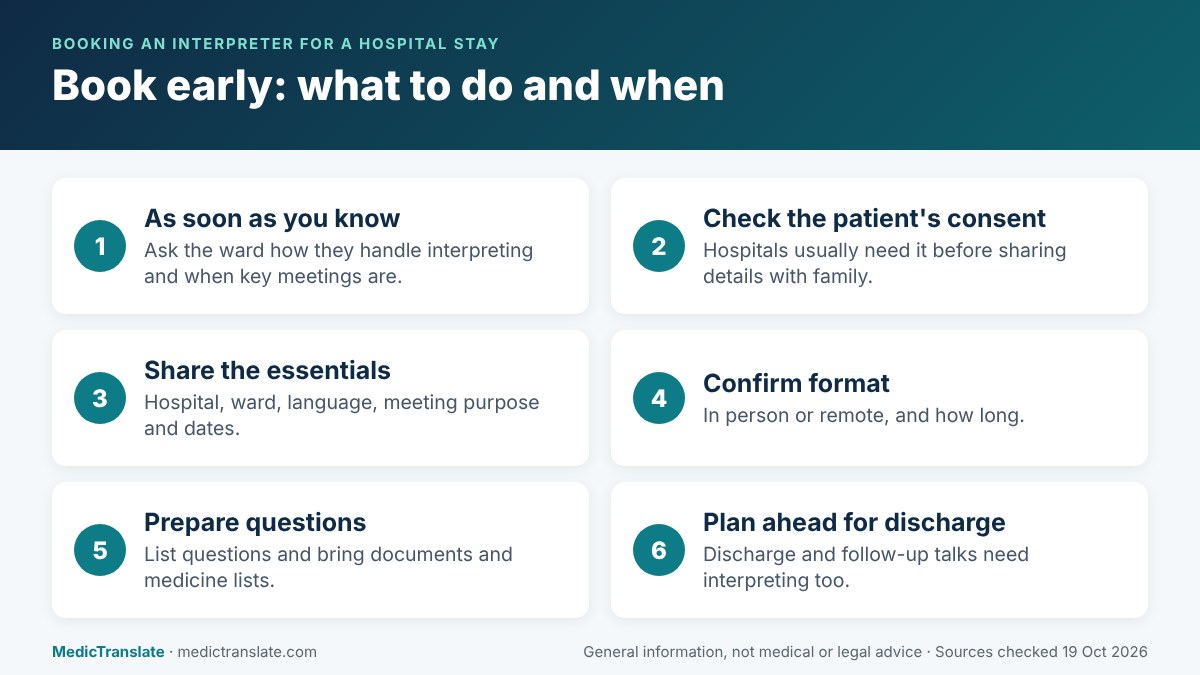
- Call the ward as soon as you knowAsk how the hospital handles interpreting, whether outside interpreters are allowed, and when the doctors plan to explain results or treatment.
- Check the patient’s consentMake sure the patient (if able) has agreed that family and an interpreter may attend.
- Send the essentials in one messageHospital name and ward, language, the purpose of each meeting, dates and times, and whether it is in person or remote.
- Confirm the formatIn person, video or phone, and how long. Ask the hospital whether video is allowed on the ward.
- Prepare questions and documentsA written list of questions, the medicine list and any overseas records. Long records are best translated in advance.
- Plan for discharge earlyDischarge instructions, follow-up appointments and new prescriptions need interpreting too. Book those dates at the same time.
MedicTranslate provides medical interpreters in person across Kansai and beyond and by video or phone anywhere in Japan. Interpreters relay what the doctors and family say; they do not give medical advice or make decisions. Current fees are on our pricing page, and the interpreter cost guide has worked examples.
Book an interpreter for your family member’s hospital meetings
Send the hospital, ward, language and meeting dates as early as you can. We will confirm availability and the price before anything is booked.
- In person across Kansai and beyond
- Video or phone anywhere in Japan
- Results, consent and discharge meetings
- Records translated before the meeting
Price confirmed before you book · Reply within 1–3 business days · Bookings depend on interpreter availability and the hospital’s policy; short-notice requests may not be possible. We do not give medical advice.
If you are overseas and your relative is in a Japanese hospital
- Ask the hospital whether a family member can join explanations by phone or video, and at what time in Japan.
- A remote interpreter can join the same call, so you hear the doctor in your language from home.
- Keep a single contact on the ward, and write down the names of the doctor and nurse in charge.
- For a long admission, the hospital may refer to admission documents and consent forms that you will want translated.
Emergencies come first. Do not delay urgent treatment while waiting for an interpreter. Hospitals can use their own phone or video services in an emergency.
Frequently asked questions
How far in advance should I book an interpreter for a family member in hospital?
As soon as you know about the admission and the likely meeting dates. Professional interpreters are booked ahead. MedicTranslate aims to reply within 1–3 business days, so same-day requests often cannot be filled.
Do Japanese hospitals provide interpreters for inpatients?
Some do, often by phone or video, and some areas have public programmes the hospital can request. Provision varies by hospital and language, and some hospitals ask families to arrange their own interpreter.
Can a family member interpret instead?
It is possible, but not recommended for important meetings. An MHLW-commissioned study found patients who relied on family or friends understood the doctor's explanation less well.
Will the hospital share my relative's information with me?
Usually yes. Guidance from the Personal Information Protection Commission treats explanations to family as part of care unless the patient objects. Diagnosis details normally need the patient's consent, except when needed to protect life or health.
Can an interpreter join by video from outside Japan?
Often yes, if the hospital allows video on the ward. Ask the hospital first, then book a remote interpreter for the same call.
Are public hospital interpreting programmes available in Kansai?
Some programmes exist, such as FACIL in Kobe and Hyogo (which charges the patient a daily fee), Osaka Prefecture's remote service and Kyoto City's outpatient dispatch. Most are requested by the hospital and have limits on hospitals, hours or patient type.
This article provides general information reviewed on 19 October 2026. Public interpreting programmes, hospital policies on outside or remote interpreters, visiting rules and fees are set by each operator and hospital and can change. Whether information is shared with family is decided by the hospital under Japanese privacy rules. It is not medical or legal advice. In an emergency, call 119.
MedicTranslate provides interpreting, translation and coordination. It is not a healthcare provider, does not give medical or legal advice, and cannot guarantee interpreter availability, short-notice bookings, hospital acceptance or any outcome.
- MHLW: Manual for medical institutions accepting foreign patients (Japanese)
- MHLW: FY2018 manual draft, interpreting fees and arrangements (Japanese, PDF)
- MHLW: Current state of medical interpreting, 2019 (Japanese, PDF)
- MHLW-commissioned study on foreign patients and interpreting, 2019 (Japanese, PDF)
- PPC and MHLW: Q&A on personal information in healthcare, April 2026 (Japanese, PDF)
- Personal Information Protection Commission: FAQ on sharing diagnosis with family (Japanese)
- FACIL: Medical interpreting in Kobe and Hyogo (Japanese)
- Osaka Prefecture: 24-hour remote medical interpreting (Japanese)
- Kyoto: City medical interpreter dispatch (Japanese)
- Tokyo Metropolitan Government: Emergency phone interpreting for hospitals (Japanese)
- JNTO: Guide for when you are ill or injured, and Japan Visitor Hotline (English)