

Wondering whether the standard allergy pill in your bag is fine to bring into Japan? The honest answer is that it depends on the exact formulation, because whether Benadryl is allowed in Japan comes down to the active ingredients, not the brand name. The standard antihistamine, diphenhydramine, is generally permitted for personal use, while some multi-symptom versions contain stimulants such as pseudoephedrine that are restricted or prohibited under Japanese law.
Navigating foreign medication rules can feel stressful, and no one wants a problem at the border. This guide gives clear, up-to-date guidance for 2026 so you can prepare the right way. Medicines that arrive without the correct paperwork may be held or refused, so a little preparation goes a long way.
You’ll learn how to check your specific product’s ingredients, understand the two-month personal-use limit for over-the-counter imports, and follow the steps to apply for a Yunyu Kakunin-sho if you need a larger supply. With a structured approach, you can focus on your trip rather than worrying about customs paperwork.
Key Takeaways
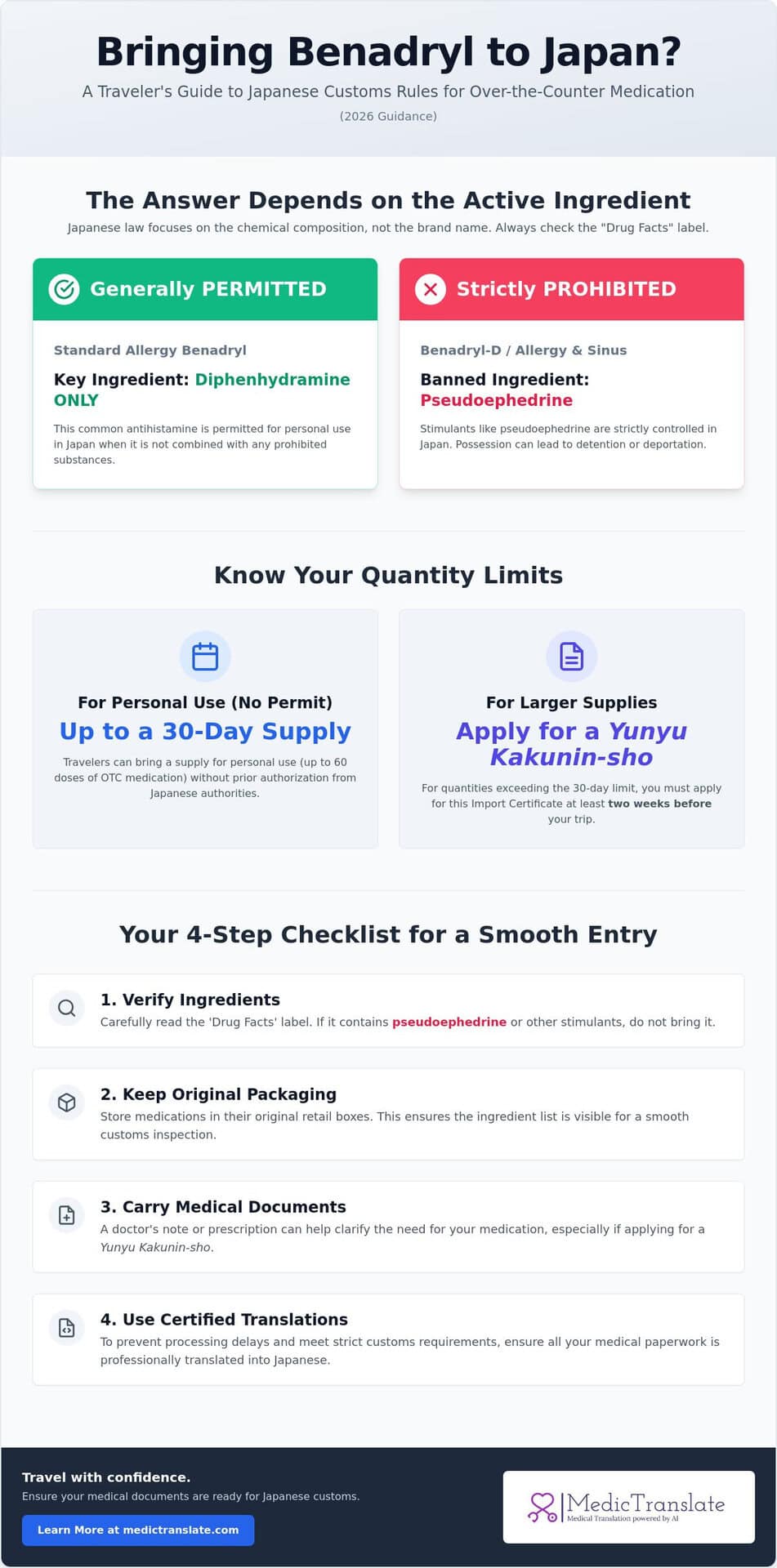
- Whether Benadryl is allowed in Japan depends on the specific ingredients: standard diphenhydramine is generally permitted, while stimulant-based versions such as Benadryl-D are restricted or prohibited.
- Travelers can generally bring up to a two-month supply of permitted over-the-counter medicine for personal use without an import certificate.
- You’ll need to apply for a Yunyu Kakunin-sho (import certificate) before your trip if your supply exceeds the personal-use limit. Aim to apply at least two to three weeks ahead.
- Keep medications in their original retail packaging with clear ingredient lists to help the inspection go smoothly at airport customs.
- A certified translation of your medical records can help prevent processing delays and meet Japanese customs requirements.
The Short Answer: Is Benadryl Legal in Japan?
The question of whether Benadryl is allowed in Japan doesn’t have a simple yes or no answer. “Benadryl” is a brand name that covers several different chemical formulations depending on where it was manufactured. The standard antihistamine version is generally permitted for personal use, while Japan restricts certain stimulants that are sometimes found in multi-symptom “Allergy & Sinus” products. To know where your specific product stands, look past the brand name and check the active ingredients.
Legality is determined by the active ingredient list, not the marketing name on the front of the package. It helps to distinguish between simple antihistamines and restricted decongestants. Japan’s medication rules are strict, and arriving with the wrong formulation can cause problems at customs. Here are the core points to keep in mind:
- Standard Benadryl containing only diphenhydramine is generally permitted for personal use.
- Legality depends on the active ingredient list, which varies by country.
- Japan tightly restricts stimulants such as pseudoephedrine, and high-concentration products are prohibited.
- Customs officers focus on chemical composition rather than the brand.
If your medication contains only the antihistamine, you’re generally able to bring it for personal use. If the label lists decongestants commonly found in “D” or “Sinus” versions, the product may be restricted or prohibited, so verify it before you travel.
Defining Diphenhydramine in the Japanese Context
Diphenhydramine is generally permitted in Japan when it is not combined with restricted stimulants. It is sold domestically in Japanese pharmacies under brand names such as Drewell, typically as a sleep aid or allergy treatment. Check the “Drug Facts” label on your specific packaging before you pack. If you see additional active ingredients listed, verify each one against the Japanese Ministry of Health, Labour and Welfare’s guidance, since some additives common in other countries are treated differently in Japan.
The “Brand Name” Trap
It is easy to assume a global brand name means a global formula, but that is not the case. A bottle of Benadryl bought in the United States may contain ingredients that are restricted in Japan, while the version sold in the UK or Australia can be different again. Japanese customs officers focus on the chemical components listed on the packaging, not the brand. To keep your entry smooth, keep your medication in its original retail box, and carrying a medical certificate or a translation of your medication’s purpose is also helpful. This shows customs officers that you are acting in good faith and following local rules.
Active Ingredients Matter: Diphenhydramine vs. Restricted Stimulants
Whether Benadryl is allowed in Japan comes down to the chemical composition of the tablets rather than the familiar branding. The Japanese Ministry of Health, Labour and Welfare (MHLW) regulates substances based on their pharmacological effects rather than their commercial names. Standard Benadryl Allergy, which contains only diphenhydramine, is generally permitted, but many variations are not. If your medication includes “D” or “Sinus” in the name, it may contain ingredients that are restricted at the border.
The key legal point is the Stimulants Control Act, which prohibits importing medicines containing stimulants such as pseudoephedrine above a 10% concentration. Even below that level, Japanese customs officers often treat foreign over-the-counter medicines with caution, so bringing a sinus or “D” formula without checking first can cause problems. Japan maintains strict controls to prevent imported precursors being used to manufacture illicit stimulants. If you want help getting your paperwork right, see our airport customs form guidance.
It is your responsibility to verify every ingredient in your travel kit, because “I didn’t know” is not accepted as a defense. If a prohibited substance is found in your luggage, the consequences can range from confiscation to more serious action. This is why distinguishing between simple antihistamines and restricted decongestants is the most important step in your preparation.
Commonly Restricted Ingredients to Screen For
Pseudoephedrine is the most common reason for medication being refused at Japanese customs. It is a common decongestant in the West but is highly restricted in Japan. Watch for codeine as well, which is often found in foreign cough and cold medicines and is regulated. Always check the current MHLW guidance to confirm your medication’s status before you travel. Note that some products marketed as “Benadryl-D” use phenylephrine rather than pseudoephedrine, so the ingredient list, not the name, is what matters.
Reading Labels Like a Customs Officer
Customs officers look past marketing terms like “non-drowsy” or “maximum strength” and go straight to the “Active Ingredients” section, matching names against their restricted lists. To make the process faster, keep all medications in their original, labeled packaging. Loose pills in a daily organizer are a red flag and are likely to trigger a closer inspection. If the original box is damaged, bring a clear photo of the ingredient list or a certified translation of the product’s components.
Quantity Limits and the Yunyu Kakunin-sho Requirement
Even once you’ve confirmed your specific formulation contains only permitted ingredients, you still need to consider how much you carry. Japan applies quantity limits to imported medicines. For over-the-counter products like standard Benadryl, the personal-use threshold is a two-month supply. Within that limit, you generally don’t need to submit advance paperwork to the Ministry of Health, Labour and Welfare (MHLW). Above it, the requirements change.
Bringing more than the personal-use limit requires a Yunyu Kakunin-sho, an official import certificate. This document is needed for anyone carrying more than a two-month supply of over-the-counter medicine, or more than a one-month supply of prescription medicine. In 2026, the application is handled through an online process, so you can submit your request before leaving home. Aim to start at least two to three weeks before your flight to allow for processing. Without the certificate, an excess supply may be held at the border.
Prescription-strength antihistamines are treated differently from over-the-counter ones. If a doctor has prescribed a high-dose version of diphenhydramine, the prescription rules apply, and the one-month prescription limit is the relevant one. Check your dosage against the applicable category before assuming the simpler over-the-counter rules apply.
When Do You Need a Yunyu Kakunin-sho?
The limit is based on the recommended dosage on the packaging. If the label suggests taking two pills a day, the number of tablets that make up a two-month supply is your threshold. Bringing a large “bulk bottle” from a warehouse club may trigger an inspection, since officers may not view a very large quantity as personal use. The MHLW grants approvals when you can show the medication is for your own health needs during your stay. If you’re planning a long-term stay, factor this approval process into any shipments you receive from abroad.
The Documentation Checklist
To apply for the certificate, you provide evidence to the Japanese authorities. A standard application requires a copy of your prescription or a detailed medical certificate from your doctor, clearly stating the name of the medication, the reason you need it, and the exact daily dosage. Because reviewers need precise information, a certified Japanese translation of these documents helps the process go smoothly and reduces the risk of delays or misunderstandings.
How to Safely Bring Medication Through Japanese Customs
Once you’ve confirmed your formulation is permitted and you’re within the quantity limits, the final step is the airport checkpoint. Presentation matters as much as legality. Officers look for clear evidence of personal use, and poor organization can cause delays even when your tablets are entirely legal.
Keep your medications in your carry-on rather than checked bags, so your supplies and paperwork are within reach for inspection if a bag is delayed. Keep Benadryl in its original retail packaging so officials can quickly read the ingredient list and dosage instructions. Loose pills in unlabelled containers are a red flag and are likely to trigger a closer search.
Completing the Customs Declaration Form
In 2026, travelers commonly use the Visit Japan Web portal to submit declarations before landing. In the section on prohibited or restricted items, be accurate about your medical supplies. If you’re carrying a standard personal supply of permitted Benadryl, keep the digital record ready for review. If you’re carrying a larger quantity that required a Yunyu Kakunin-sho, declare it to the officers. If you’re unsure about the digital process, see our airport customs form guidance.
Interacting with Customs Officials
If a customs officer asks you aside for a secondary check, stay calm and helpful. They’ll typically ask about the purpose of the medication and the length of your stay. A professional Japanese translation of your doctor’s letter or prescription is valuable here, because it removes the language barrier and gives the officer precise clinical context. Questions often focus on whether the medication contains stimulants and whether it was bought over the counter. Keeping your documents organized in one folder shows that you are prepared and compliant.
How MedicTranslate Simplifies Your Medical Documentation for Japan
Traveling to Japan rewards preparation, especially when medicines are involved. Whether Benadryl is allowed in Japan depends on the specific ingredients and the quantity, and the responsibility for showing that at the border falls on you. MedicTranslate acts as your facilitator, helping ensure the medical documentation you carry meets the standards of Japanese customs and the Ministry of Health, Labour and Welfare (MHLW).
We provide more than translation. From airport customs form guidance to certified translations of your medical history, we help you prepare paperwork that reduces the risk of delays or misunderstandings. Our services include:
- Certified Japanese translations of prescriptions and medical reports.
- Guidance on completing the digital Yunyu Kakunin-sho application.
- Certification services for official medical records.
- Interpreter coordination for healthcare interactions in Japan.
Understanding the rules is the first step; preparing the documentation is the next. We stay on the language and coordination side and do not provide medical advice, treatment, or pharmaceutical supply.
Certified Translation for Legal Compliance
Relying on machine translation for medical documents carries real risk, since these tools can struggle with pharmacology and Japanese administrative requirements. A mistranslated ingredient could lead an officer to misread a permitted medicine. We provide certified translations with a 72-hour standard turnaround for urgent travel needs, focusing on technical accuracy so that every dosage and chemical name is translated with clinical precision.
Comprehensive Healthcare Navigation
Our support extends beyond the customs desk. Navigating Japanese pharmacies as a visitor can be confusing when local brands use different names for familiar drugs. We can help you identify English-speaking pharmacies in major cities so you can find permitted local equivalents if your supply runs low, and our interpreter coordination can support clear communication with hospital staff if you need care during your stay. Contact MedicTranslate for a quote on your medical document translation to prepare with confidence.
Preparing for Your Journey with Confidence
Entering Japan with medication is manageable when you follow the established rules. Whether Benadryl is allowed in Japan hinges on two things: the specific active ingredients in your bottle and the quantity you carry. By avoiding restricted stimulants such as pseudoephedrine and staying within the two-month personal-use limit, you can move through customs smoothly.
If you need a larger supply or carry a prescription-strength formula, professional documentation is your best defense against delays. Our medical translators focus on Japanese customs compliance, with a 72-hour standard delivery for urgent travel needs, so you can meet requirements without the added stress of a language barrier.
Get a certified translation for your medical documents today. With the right preparation and clear documentation, you can focus on the experiences awaiting you in Japan.
Frequently Asked Questions
Is standard Benadryl Allergy (diphenhydramine) illegal in Japan?
Standard Benadryl Allergy containing only diphenhydramine is generally permitted to bring into Japan for personal use, as diphenhydramine is a recognized antihistamine. You must confirm that no other active ingredients are present in your specific bottle. Checking the “Drug Facts” label is the most reliable way to be sure before you pack.
Can I bring Benadryl-D or Benadryl Sinus to Japan?
These multi-symptom versions often contain a stimulant decongestant, which is tightly restricted under Japan’s Stimulants Control Act, and high-concentration products are prohibited. Even at lower levels, they can trigger closer customs inspection. It is safer to leave multi-symptom decongestants at home and verify the active ingredient before you travel.
What happens if I bring a prohibited medication to Japan by mistake?
Bringing a prohibited medicine into Japan can lead to the item being held and to legal consequences, as customs enforce strict rules on banned stimulants and narcotics. Even an unintentional error can mean questioning or refusal. A certified translation of your medical records can help clarify your intent during a secondary inspection.
How much Benadryl can I bring to Japan without a permit?
You can generally bring up to a two-month supply of permitted over-the-counter Benadryl without an import certificate. This is calculated from the maximum daily dosage on the original packaging. If you plan to stay longer or need more, secure approval before your flight, and keep the tablets in their original retail box so officials can verify the quantity quickly.
Do I need a doctor’s note for over-the-counter Benadryl in Japan?
A doctor’s note is not legally required for a personal supply of over-the-counter Benadryl, but it is helpful for a smooth entry. A medical certificate clarifies the purpose of the medication to officers who may not speak English fluently, which is especially useful if your pills are out of their box or you’re carrying several products.
What is a Yunyu Kakunin-sho and how do I get one?
A Yunyu Kakunin-sho is an official import certificate issued by the Ministry of Health, Labour and Welfare. You need it if you’re carrying more than the personal-use limit. To apply, submit a request through the MHLW online process, providing photos of the medication, its ingredient list, and a medical certificate explaining why the quantity is necessary.
Is diphenhydramine available to buy over-the-counter in Japanese pharmacies?
Yes, diphenhydramine is available over-the-counter in Japanese pharmacies, though it’s often marketed differently than in Western countries, for example as a sleep aid under brand names like Drewell. Because packaging is in Japanese, a translation of your requirements can help the pharmacist assist you if you run out of your own supply.
How long does it take to get a medication import certificate for Japan?
It typically takes at least two weeks after you submit your application. Processing times can vary with the complexity of your request and the current volume of applications. Start the online filing as soon as your travel dates are confirmed, and having your medical documents accurately translated into Japanese can help prevent delays.
Disclaimer
This article is for general information only and is not medical or legal advice. Rules in Japan can change, so please confirm current requirements with the Japanese Ministry of Health, Labour and Welfare (MHLW) or other official sources before acting. MedicTranslate provides medical translation and healthcare coordination services and does not provide medical treatment, diagnosis, or pharmaceutical supply. For help coordinating care or translating documents in Japan, contact MedicTranslate.

Article by
Ali Motahari
Ali is the founder and Representative Director of MedicTranslate Co., Ltd., a Kobe-based medical translation and healthcare coordination company that helps English-speaking foreign residents and visitors navigate the Japanese healthcare system, with a focus on the Kansai region. He has more than 20 years of experience in healthcare and healthcare IT, and is a doctoral researcher studying how healthcare organisations adopt clinical information systems. He writes about navigating medical care, translation, and the administrative and customs requirements that foreign patients face in Japan. MedicTranslate coordinates and translates; it does not provide medical treatment, diagnosis, or pharmaceutical supply.