
Is Healthcare Free in Japan? What Residents and Visitors Pay
Is healthcare free in Japan? No: Japan has universal health insurance, but care is not free. Insured residents pay a monthly premium and a share of every bill, while tourists who are not enrolled pay the full cost themselves. Here is what each group pays, and how to keep the bill under control.
Quick answer
No, healthcare in Japan is not free. Residents of Japan, generally those staying more than three months, must join public health insurance, which Japan has had for all residents since 1961. A few categories are excluded. Most insured adults pay 30% of the cost of covered treatment, plus a monthly premium. Children below school age and people aged 70 or over pay less. Tourists are not covered and pay the full bill, so travel medical insurance is essential.
Visiting Japan with a health condition? A Japanese translation of your medical summary helps a clinic treat you quickly and supports your travel insurance claim afterwards.
Request a translation quoteOn this page
Is healthcare free in Japan? Universal insurance explained
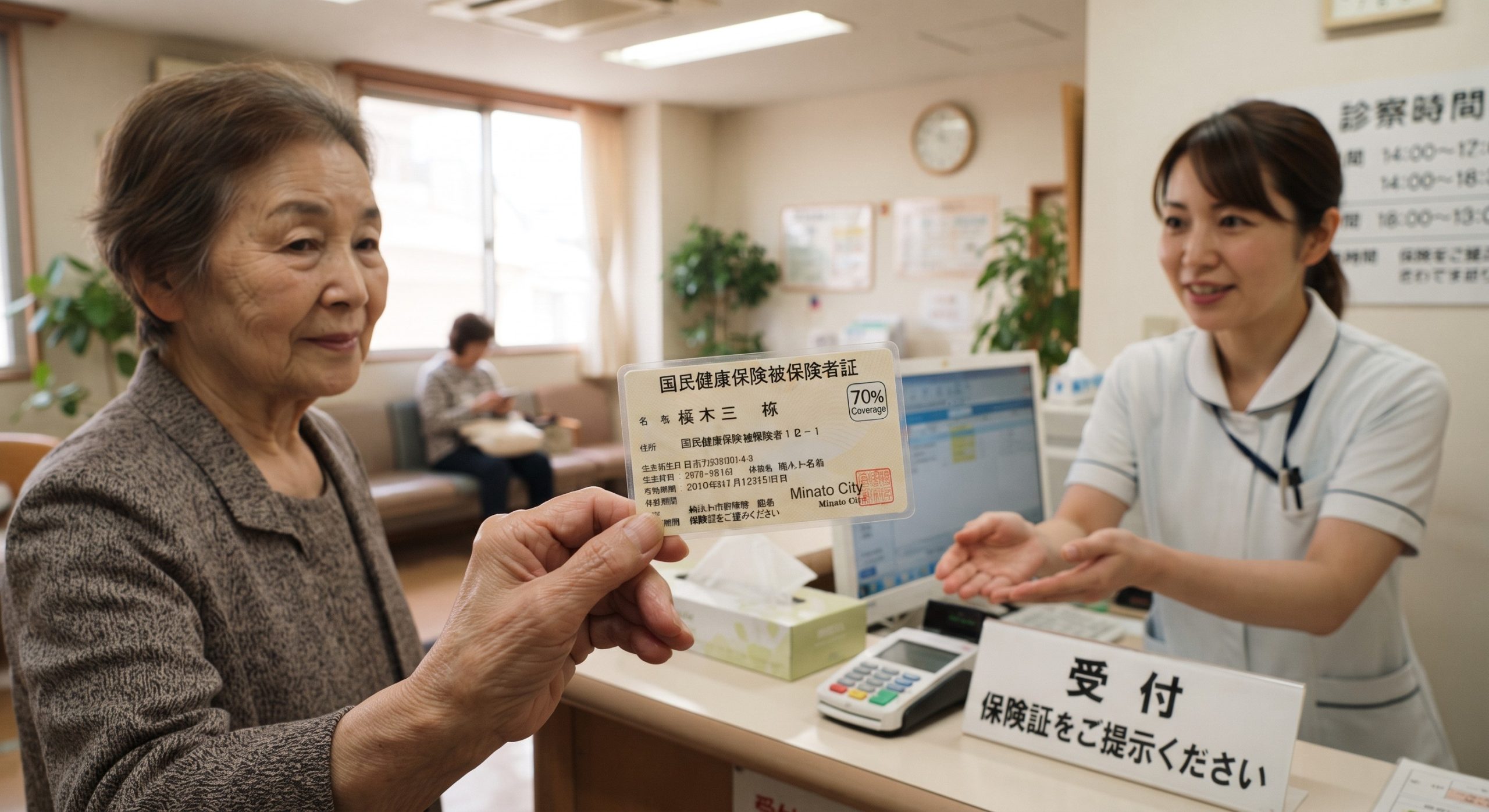
Japan achieved universal health insurance (国民皆保険) in 1961. Every resident is enrolled in a public scheme, either through an employer or through the National Health Insurance run by their city or ward. That is why Japan is often described as having universal healthcare.
However, universal coverage is not the same as free care. It is paid for in two ways. First, every enrolled person or household pays a premium, usually deducted from salary or billed by the local government based on income. Second, patients pay a co-payment at the clinic, hospital or pharmacy each time they receive covered care. The insurer pays the rest directly to the provider.
Show your insurance card, or your My Number card registered as a health insurance card, at reception. Without it, the clinic may ask you to pay the full amount and claim the refund from your insurer later.
How much insured patients pay in Japan
The share you pay depends on your age and, from age 70, your income. The Ministry of Health, Labour and Welfare (MHLW) sets these rates nationally.
| Age group | Share you pay | Notes |
|---|---|---|
| Before compulsory school age | 20% | Many cities and wards add their own child subsidies, so families often pay less. |
| School age to 69 | 30% | Applies to most working-age adults. |
| 70 to 74 | 20% | 30% for people with income at the level of the working population. |
| 75 and over | 10% | 20% for people above a set income, and 30% for those with working-level income. |
For example, if a covered clinic visit costs ¥10,000 in total, an insured adult aged 40 pays ¥3,000 at reception. The other ¥7,000 is paid by their insurer.
Monthly limits on what you pay
A 30% share of a large hospital bill can still be a lot of money. Japan's High-Cost Medical Expense Benefit (高額療養費) caps the amount a household pays for covered treatment each month. The cap depends on income, and costs from different facilities in the same month can be combined.
For a hospital stay, you can usually pay only up to the cap at the time of payment, rather than paying in full and waiting for a refund. Ask your insurer for a limit certificate before admission, or check whether the hospital can confirm your limit through your My Number card. The limits were revised in August 2026. Our guide to what Japanese health insurance does not cover explains the current rules in more detail.
Is healthcare free in Japan for foreign residents?
Staying more than 3 months
Foreign nationals living in Japan for more than three months must join public health insurance. Employees join their employer's scheme; everyone else joins National Health Insurance at their city or ward office.
Short-term stay and medical visas
People on a short-term stay status, and those who entered Japan for medical treatment or sightseeing under designated activities, cannot join National Health Insurance.
In short, healthcare is not free in Japan for foreign residents either, but once you are enrolled, routine care is affordable. Unpaid premiums can cause problems later, including when you apply to extend or change your visa status.
Is healthcare free in Japan for tourists?
No. Visitors to Japan are not part of the public insurance system. If you need treatment as a tourist, the clinic or hospital will bill you for 100% of the cost, and many facilities ask for payment before you leave. Fees for patients without Japanese insurance are set by each facility.
As a result, serious emergencies are expensive. A Japanese government notice for visitors gives the example of a bicycle collision that led to surgery, hospitalisation and transport costing around US$50,000. The same notice warns that visitors who leave medical bills unpaid may be refused entry to Japan in future.
Buy travel medical insurance before you travel, and check that it covers existing conditions, hospital admission and medical evacuation. Travel insurance can also be bought after arrival in Japan. Our guide on why travel insurance alone is not enough explains what else to prepare.
What Japanese health insurance never pays for
In addition, even insured residents pay the full price for care outside the public scheme. Common examples include cosmetic treatment, routine health checks, some vaccinations, private hospital rooms, medical certificates and some elective dental work. Normal pregnancy and childbirth are also outside standard insurance, although a lump-sum childbirth allowance helps with the cost.
See what Japanese health insurance does not cover for the full list, and Japan's healthcare system for foreign residents and visitors for how the system works overall.
Get treated in Japan without the language barrier
MedicTranslate helps residents and visitors communicate with Japanese clinics and hospitals. We translate medical records, prescriptions and receipts, and provide medical interpreters for appointments in person, by phone or by video.
- Medical document translation for doctors and insurers
- Interpreters for clinic and hospital visits
- Help finding foreign-friendly clinics
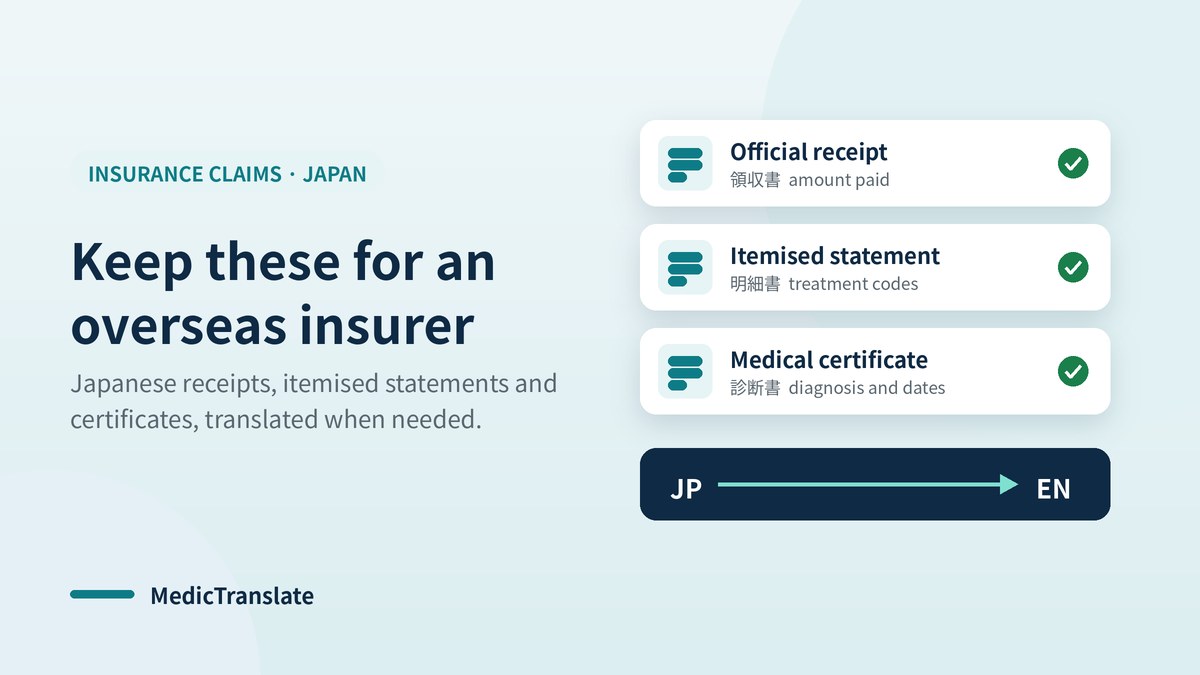
- Receipts translated for travel insurance claims
Price confirmed before work begins. Reply within 1–3 business days. We do not give medical or insurance advice.
Frequently asked questions
Is healthcare free in Japan?
No. Japan has universal health insurance, but insured patients pay a monthly premium and usually 30% of the cost of covered treatment. Children below school age and people aged 70 or over pay a lower share.
Does Japan have universal healthcare?
Yes. Japan achieved universal health insurance in 1961. Residents, generally those staying more than three months, must be enrolled in a public scheme, either through an employer or through National Health Insurance. A few categories are excluded.
How much do tourists pay for healthcare in Japan?
Tourists are not covered by Japanese public health insurance and pay 100% of the cost. Each facility sets its own fees for patients without Japanese insurance, so travel medical insurance is strongly recommended.
Do foreign residents have to join Japanese health insurance?
Yes. Foreign nationals staying in Japan for more than three months must join public health insurance, either through their employer or through National Health Insurance at their city or ward office.
Is there a limit to how much I pay for medical care in Japan?
Yes, for insured patients. The High-Cost Medical Expense Benefit caps what a household pays for covered treatment each month. The cap depends on income, and costs outside insurance are not included.
This article provides general information reviewed on 13 October 2026. Co-payment rates, monthly limits, premiums and facility fees can change, and eligibility depends on your visa status and circumstances. Confirm details with your insurer, city or ward office, or the treating facility. This page is not medical, insurance or legal advice.
- MHLW: About Japan's medical insurance, co-payment rates and High-Cost Medical Expense Benefit (Japanese)
- MHLW: Co-payments for people aged 70 to 74 (Japanese)
- MHLW: Protecting universal health insurance, achieved in 1961 (Japanese)
- Meguro City: National Health Insurance enrolment for foreign nationals (Japanese)
- MHLW: Health insurance law amendments, premium arrears and visa renewals (Japanese, 2019)
- Japan Tourism Agency: Medical costs and travel insurance notice for visitors