
Visiting Japan with Young Children: Medicines, Doctors and Emergencies
Visiting Japan with young children is easier when you have planned for the day someone gets sick. This guide covers what medicine you can bring, what to do if it runs out, how a doctor visit works, who to call in an emergency and which papers to translate before you fly.
Child seriously ill or injured right now? Call 119. Do not wait for an interpreter or a translation.
Quick answer
Bring each child's medicines in original packs, within MHLW's limits (one month for prescription medicine, two months for most others), with the prescription. Check ADHD, cold and sleep medicines by ingredient. Translate a medication list, allergies and a short medical summary into Japanese. If medicine runs out, a Japanese doctor must prescribe it, because pharmacies cannot fill overseas prescriptions. Save 119 (ambulance) and #8000 (children's advice line) in your phone, and carry travel insurance that covers every child.
Travelling soon? Get your child's medication list, prescription and medical summary translated into Japanese before you fly.
Request a translation quoteOn this page
Before you fly: medicines and limits when visiting Japan with young children
Japan's Ministry of Health, Labour and Welfare (MHLW) sets how much medicine you can bring for personal use without applying for anything. The limits are counted by the dose on the label or prescription, and they apply to each traveller, including children.
| What you bring | Without Import Confirmation (MHLW) |
|---|---|
| Prescription medicine (tablets, liquids, inhalers) | Up to one month's supply |
| Injectables in a pre-filled syringe or self-injection kit (for example an adrenaline auto-injector) | Up to one month's supply |
| Other medicines (children's paracetamol, antihistamines and similar) | Up to two months' supply |
| Non-prescription creams and other external medicines | Up to 24 items per product |
More than this needs an Import Confirmation 輸入確認証, obtained before you leave home. See our guide to the Import Confirmation certificate.
Children's medicines that need extra checks
Amphetamine ADHD medicines
Amphetamine products (for example Adderall) are treated as stimulants in Japan and individuals cannot bring them in, even with a prescription.
Methylphenidate and lisdexamfetamine
Methylphenidate (Ritalin, Concerta) is a psychotropic with a carrying limit. Lisdexamfetamine (Vyvanse) needs advance permission from the Narcotics Control Department. See our Concerta guide.
Cold and cough medicines
Some children's cold medicines contain pseudoephedrine or codeine, which Japan controls. Check the ingredients, not the brand. See Sudafed and pseudoephedrine.
Melatonin
Japan treats melatonin as a medicine ingredient, not an ordinary supplement. Bring a small, personal quantity only. See melatonin and Japan.
Do not stop or change your child's medicine because of travel rules. Talk to your child's doctor well before the trip about timing, quantities and any alternative.
Insurance for the whole family
Short-term visitors are generally not covered by Japanese public health insurance, so clinics and hospitals bill you directly, often in cash at smaller clinics. Check that your travel insurance covers each child, note the insurer's 24-hour assistance number, and read what a visit costs when you are uninsured.
Documents to carry, translate and keep
Most clinic staff, doctors and pharmacists in Japan work in Japanese. A one-page Japanese summary of your child's medicines and history saves time at the desk and reduces the risk of misunderstanding, especially at night when staff are few.
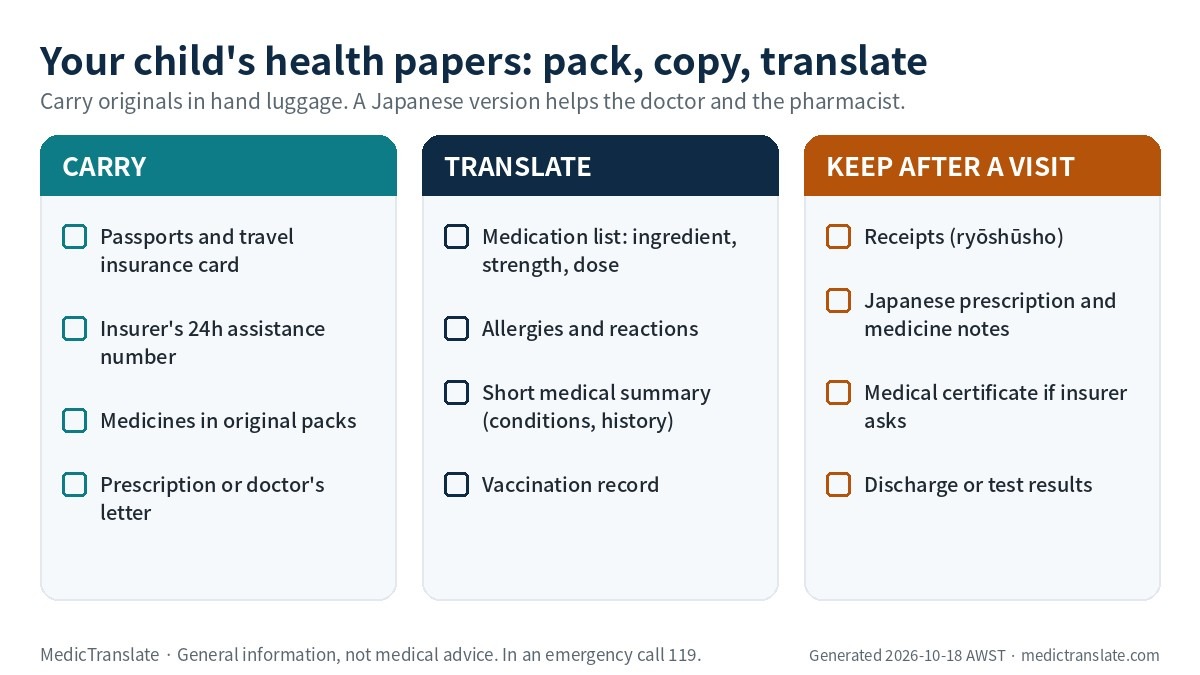
- Medication list: active ingredient, strength, dose and how often. Brand names differ between countries. See prescription translation for Japan.
- Allergies and past reactions, including food allergies and any adrenaline auto-injector.
- Short medical summary for any long-term condition such as asthma, epilepsy, diabetes or a heart condition.
- Vaccination record. See vaccination record translation.
After any visit, keep every receipt 領収書 and medical document for your travel insurer.
Already carrying a lot of medicine?
Families with a child on several medicines, or staying for weeks, often carry more than the limits allow. Your options are:
- Check each medicine against the rulesIngredient, strength, form and total quantity decide what applies. Our paid medication assessment checks this against current MHLW and Narcotics Control Department guidance.
- Apply for Import Confirmation if you are over the limitApply before departure. You apply yourself; we can translate the prescription and supporting letter.
- Plan local care for long staysBring a translated summary so a Japanese doctor can take over prescribing. See continuing an overseas prescription in Japan.
- Prepare the arrival paperworkCarry medicines in hand luggage with the prescription. You complete any customs declaration yourself.
If your child's medicine runs out in Japan
A Japanese pharmacy cannot fill an overseas prescription, translated or not. A pharmacist dispenses only against a prescription from a doctor in Japan.
- Count what is left as soon as you noticeLeave time to book a clinic. Weekends and holidays are harder.
- See a paediatric clinic 小児科Bring the empty pack, the overseas prescription and a translated medication list. The Japanese doctor decides what to prescribe, which may be a local equivalent.
- Fill the Japanese prescription quicklyA Japanese prescription is normally valid for four days including the day it is issued.
- Do not ask family to post controlled medicinesMHLW states psychotropics cannot be sent by post, and other medicines sent by mail follow the same personal-import limits.
For simple fever or pain, Japanese drugstores sell children's products. See buying children's fever and pain medicine in Japan.
How a doctor visit works in Japan
- Choose the right placeFor most illnesses, start with a local paediatric clinic. Large hospitals usually expect a referral letter for non-emergencies. Many cities run night and holiday emergency clinics 休日夜間急患センター.
- Call aheadAsk whether they can see a foreign visitor today, what to bring, and whether staff speak English. Our booking guide explains the steps.
- Register and fill in the questionnaire 問診票Bring passports, insurance details, the translated medication list and cash.
- ConsultationAn interpreter, in person or by phone, helps when you need to explain history or understand test results.
- Pay, then go to the pharmacyMost clinics give a prescription 処方箋 that you take to a nearby pharmacy. Keep the receipts and the medicine notes.
For lists of English-friendly care, see our clinic list and foreign-friendly clinics and what to bring to a clinic.
Emergencies: when to call 119 for a child
The national ambulance guide from Japan's Fire and Disaster Management Agency lists situations where you should call 119 straight away for a child, including:
- Blue or purple lips, or a very poor colour
- Severe breathing difficulty, or weak breathing
- A seizure that does not stop, or does not wake up after it stops
- Unresponsive, confused or unusual behaviour in a baby
- Head injury with heavy bleeding, loss of consciousness or seizure
- Severe vomiting or diarrhoea and unable to drink, or blood in the stool
- Hives over the body after a sting, with colour worsening
- Choking with trouble breathing, severe or large burns, drowning or a fall from a height
- Anything that seems clearly wrong to you as a parent
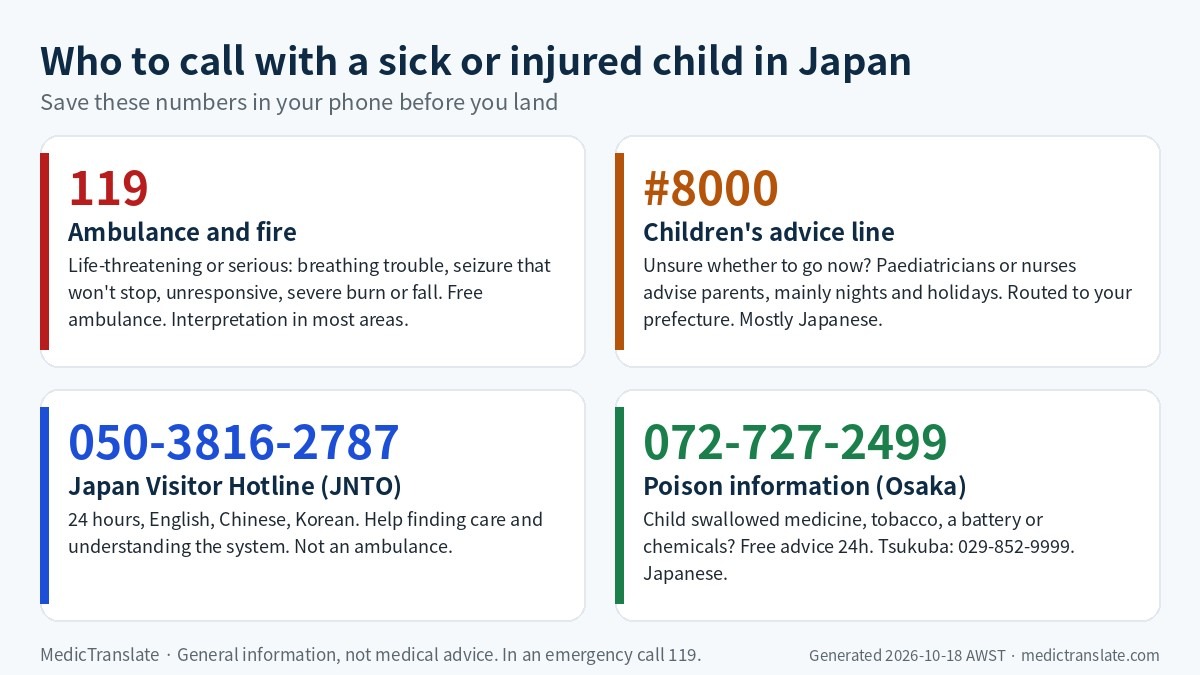
| Number | Use it for | Good to know |
|---|---|---|
| 119 | Ambulance and fire | Free ambulance. Most fire departments offer three-way interpretation. See calling 119 in Japan. |
| #8000 | Advice about a child's symptoms | Paediatricians or nurses, mainly nights and holidays, routed to your prefecture. Mostly Japanese. |
| #7119 | Emergency advice (some areas) | Not nationwide. Mostly Japanese. |
| 072-727-2499 | Poison information (Osaka) | Free for the public, 24 hours. Tsukuba line: 029-852-9999. Mostly Japanese. |
| 050-3816-2787 | Japan Visitor Hotline (JNTO) | 24 hours in English, Chinese and Korean. Help finding care. Not an ambulance. |
MedicTranslate is not an emergency service. In an emergency, call 119 first. We can help with documents, interpreting and insurer paperwork once your child is safe.
How families use MedicTranslate: five examples
Six weeks with an ADHD medicine
A family checks their child's methylphenidate against the carrying limit, then has the prescription and doctor's letter translated for the trip.
Severe food allergy
Parents carry two auto-injectors and a Japanese allergy card and summary, so restaurant and clinic staff understand the allergy.
Inhaler running low
We help arrange a paediatric clinic visit with an interpreter. The family brings a translated medication list, and the doctor decides what to prescribe.
Fever on a holiday weekend
After calling #8000, a family heads to a holiday clinic and books a phone interpreter for the consultation.
Claiming from the insurer
Receipts and the hospital's discharge notes are translated into English for the travel insurance claim.
These are illustrative examples, not case reports. What applies to your family depends on the medicines and your plans.
What MedicTranslate does, and what it does not do
| We can | We do not |
|---|---|
| Check your child's medicines against published MHLW and Narcotics Control Department guidance in a written assessment | Guarantee customs clearance or submit Import Confirmation applications for you |
| Translate prescriptions, medication lists, medical summaries and vaccination records, checked by a human translator | Diagnose, prescribe or give medical advice |
| Arrange a medical interpreter, in person in Kansai and beyond or by video or phone across Japan | Provide emergency or ambulance services |
| Help you contact clinics, including those on our list, and prepare the visit | Guarantee an appointment or a particular treatment |
Current prices are on our pricing page, and we confirm the price before work begins.
Plan your family's health support for Japan
Tell us your travel dates, your children's medicines and where you are staying. We will tell you what we can prepare before you fly and what help is available while you are in Japan.
- Japanese translation of medication lists, prescriptions and summaries
- Written medicine check against current MHLW guidance
- Interpreters in person in Kansai and beyond, by video or phone Japan-wide
- Help contacting clinics, including those on our list
Price confirmed before work begins. Reply within 1–3 business days. Secure document process. Not an emergency service: in an emergency call 119. We do not give medical advice or guarantee customs approval.
Frequently asked questions
What should I pack for a child's health when visiting Japan with young children?
Pack your child's medicines in their original packs with the prescription or a doctor's letter, a medication and allergy list, a short medical summary, the vaccination record, passports and travel insurance details. A Japanese translation of the medication list and summary helps a Japanese doctor or pharmacist.
How much of my child's medicine can I bring to Japan?
MHLW allows up to one month's supply of prescription medicine, up to two months' supply of other medicines and up to 24 items per product of non-prescription external medicines, for personal use, without Import Confirmation. Some medicines, such as certain ADHD medicines and cold medicines with pseudoephedrine or codeine, have extra rules or are not allowed, so check the exact ingredient before you travel.
Can a Japanese pharmacy refill my child's overseas prescription?
No. A Japanese pharmacist dispenses only against a prescription from a doctor in Japan. If your child's medicine runs out, see a Japanese doctor, ideally a paediatric clinic, and bring the original prescription and a translated medication list so the doctor can decide what to prescribe.
What is #8000 in Japan?
#8000 is the children's medical telephone advice line. Dialling it connects you to your prefecture's service, where paediatricians or nurses advise parents whether a child needs to see a doctor, mainly on nights and holidays. It is mostly in Japanese. If symptoms are severe, call 119 instead.
Is the ambulance free in Japan for tourists?
Public ambulance transport by the fire service after calling 119 is not charged, for residents and visitors alike. Hospital treatment is billed separately, and visitors without Japanese public health insurance usually pay the full cost, so carry your travel insurance details.
What should I do if my child swallows medicine or a battery in Japan?
If your child has trouble breathing, is unresponsive or has a seizure, call 119 immediately. For advice on what was swallowed, the Japan Poison Information Center runs a free 24-hour line for the public on 072-727-2499 (Osaka), mainly in Japanese. Keep the packet or product to show staff.
Can MedicTranslate give medical advice about my child?
No. MedicTranslate is not a healthcare provider. We translate documents, check medicines against the published import rules, arrange interpreters and help you contact clinics. Your child's doctor makes all medical decisions, and in an emergency you should call 119.
This article provides general information reviewed on 18 October 2026. It is not medical, pharmaceutical or legal advice. Medicine import limits, controlled-substance rules, advice lines and clinic arrangements are set by the authorities and providers and can change, so confirm your child's medicines with MHLW or the Narcotics Control Department and your child's doctor before you travel. Customs decisions are made by the authorities, and treatment decisions by your child's doctor. MedicTranslate provides translation, interpreting and coordination; it is not a healthcare provider, customs authority or emergency service. In an emergency, call 119.
- MHLW: Bringing medicines into Japan for personal use (English)
- Narcotics Control Department: Carrying controlled medicines (English)
- MHLW: Children's medical telephone consultation #8000 (Japanese)
- MHLW: #8000 service hours by prefecture (Japanese)
- FDMA: Ambulance guide for foreign visitors (multilingual)
- FDMA ambulance-use manual, children's symptoms (Japanese, PDF via Tokyo Fire Department)
- Japan Poison Information Center (Japanese)
- Tokyo Metropolitan Government: Japan Visitor Hotline (English)
- JNTO: Guide for when you are ill or injured (English)