
Giving Birth in Japan as a Foreigner: Costs, Insurance and Paperwork
Giving birth in Japan as a foreigner involves more paperwork than most people expect, but the system is well organised once you know the order. You notify your city office, receive a handbook and checkup vouchers, use a lump-sum allowance from your health insurance to cover the delivery, and then register the birth. This guide walks through each step, the costs and the 2026 law that will change how childbirth is paid for.
Quick answer
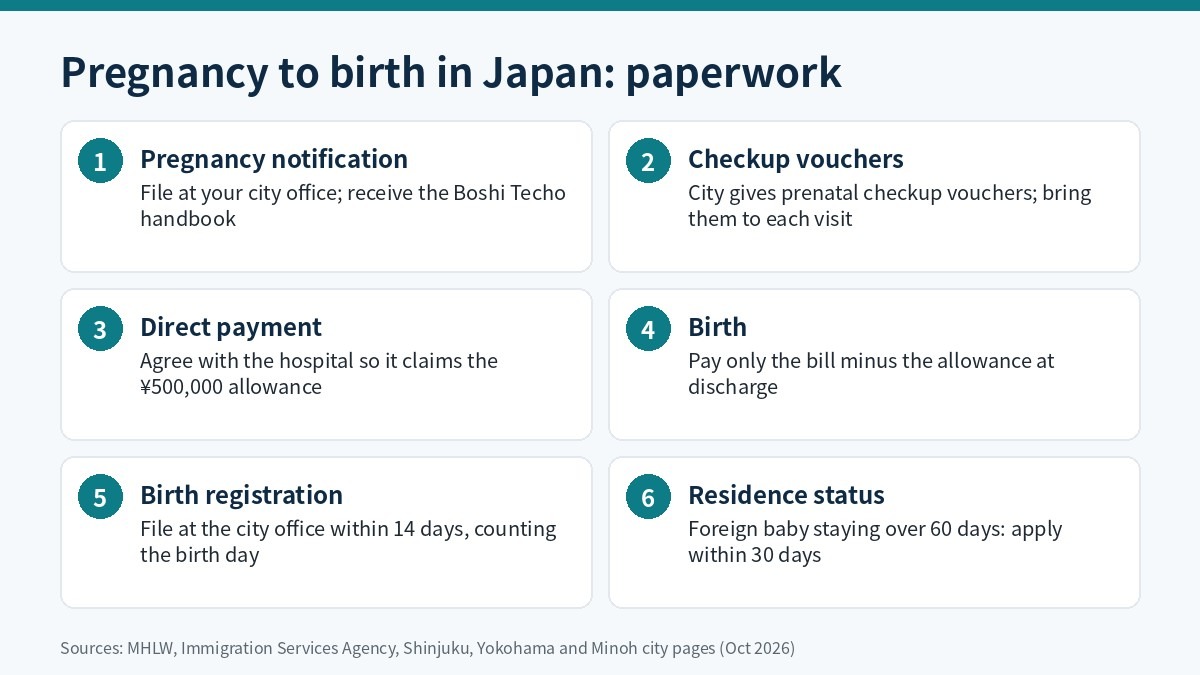
When giving birth in Japan, a routine delivery is not paid for as insured medical care, so the hospital bills it to you. However, if you are in Japan’s public health insurance (National Health Insurance or employee insurance), you receive the Childbirth and Childcare Lump-sum Allowance, in principle ¥500,000 per baby (MHLW). Under the direct payment system, the hospital usually claims it for you, so you pay only the difference. Before the birth, you file a pregnancy notification at your city office; after it, you file the birth registration within 14 days, and a foreign baby who will stay longer than 60 days needs a residence status application within 30 days.
Need help with a Japanese hospital or appointments? We can help you find a maternity facility, book visits and arrange language support. You complete and submit government applications yourself.
Arrange healthcare supportOn this page
How giving birth in Japan is paid for
Many newcomers assume their health insurance card will simply cover the delivery. It does not work quite that way. In MHLW’s own materials, a standard delivery is described as childbirth without insured medical care (保険診療を伴わない分娩). In practice, therefore, the hospital sets its own price for a routine birth, and you pay it.
Instead of insurance coverage, Japan uses a cash benefit. The Childbirth and Childcare Lump-sum Allowance (出産育児一時金, shussan ikuji ichijikin) is paid by your public health insurer to offset the bill. In addition, your municipality supports you during pregnancy with a handbook and checkup vouchers.
Insured care during delivery is different. If medical treatment covered by insurance is needed during the birth, that part follows the normal insurance rules. MHLW’s worked example includes an emergency caesarean, with the usual co-payment share and the high-cost medical expense system applying. Ask your hospital how it will bill your case.
Pregnancy notification and the Boshi Techo
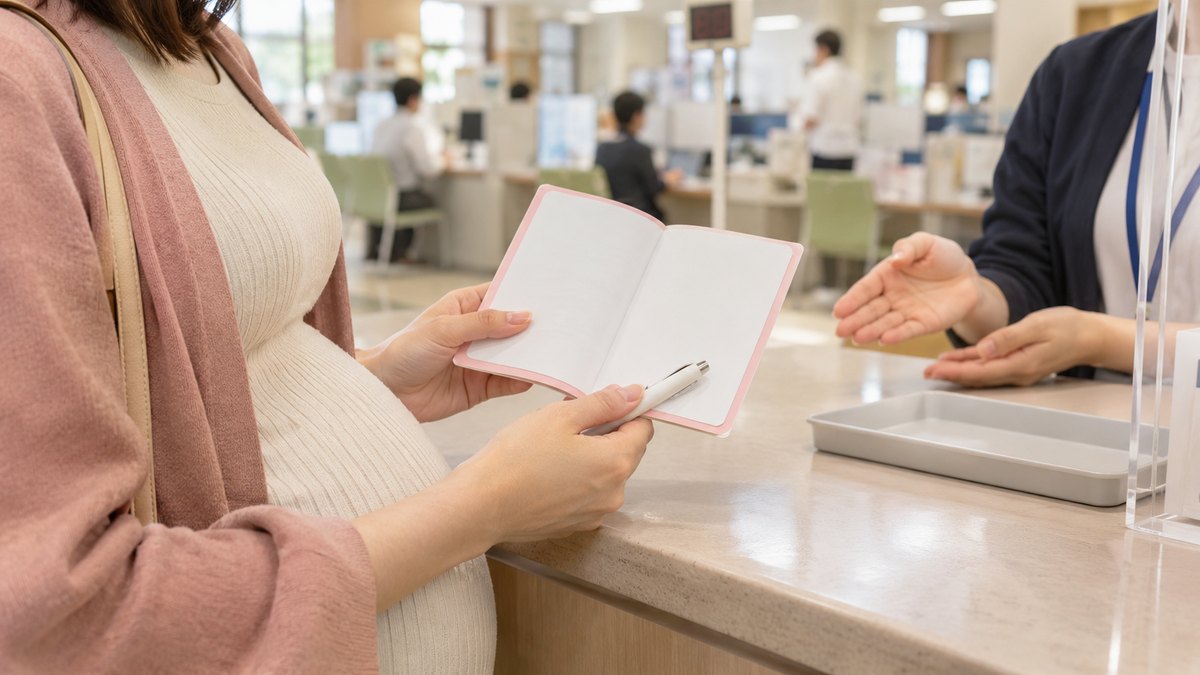
The first official step in giving birth in Japan is the pregnancy notification (妊娠届, ninshin todoke). You file it at the office of the municipality where you are registered as a resident. In return, you receive the Maternal and Child Health Handbook (母子健康手帳, boshi kenkō techō), often called the Boshi Techo.
Requirements differ by city. For example, Minoh City in Osaka asks the pregnant person to file in person, with proof of My Number and photo ID, and states that a doctor’s certificate is not required. Other cities may ask for different documents, so check your own city’s page before you go.
- Bilingual handbooks: Minoh offers handbook versions with Japanese alongside English, Chinese, Korean, Indonesian, Tagalog, Vietnamese, Portuguese, Thai, Spanish and Nepali. Many cities offer similar versions, so ask at the counter.
- Keep it with you: the handbook records your pregnancy, the birth, your child’s growth and vaccinations, and it is needed again for the birth registration.
Our Boshi Techo guide explains each section of the handbook in more detail.
Prenatal checkup vouchers
Along with the handbook, your municipality gives you prenatal checkup vouchers (妊婦健康診査受診券). Minoh City, for instance, hands out the vouchers together with the handbook at the time of notification. You bring them to each checkup, and the municipality pays part or all of the cost of the covered tests.
However, the number of vouchers, the amount each one covers and the tests included are set by each municipality. As a result, you may still pay something at some visits, for example for extra tests. In addition, vouchers are designed for facilities in your area. If you plan to have checkups elsewhere, such as in your home prefecture or abroad, ask your city in advance how reimbursement works.
Moving during pregnancy? Vouchers are issued by the municipality where you live. If you move to another city, ask both offices how to switch, because one city’s vouchers may not be accepted in another.
Costs of giving birth in Japan and the lump-sum allowance
MHLW states that when a member of the public health insurance system gives birth, the insurer pays in principle ¥500,000 per child. The amount rose from ¥420,000 in April 2023. Who pays it depends on your insurance:
| Your insurance | Who pays the allowance (MHLW) |
|---|---|
| Employee insurance (Kyokai Kenpo or a company health insurance society) | Your insurer. Your employer can usually tell you how to claim. |
| National Health Insurance | The National Health Insurance office of your municipality. Yokohama, for example, lists ¥500,000 per child for its members. |
| Recently left a job | If you left within 6 months before the birth and had been insured there for at least 1 year, you may choose to claim from your former insurer. |
MHLW also sets two key conditions: the birth must be at 4 months (85 days) of pregnancy or later, and you must be covered by Japanese public health insurance at the time. The delivery method and location do not matter. Consequently, a short-term visitor who is not enrolled in Japanese public insurance does not receive this allowance and should check private or travel insurance instead.
The direct payment system
Under the direct payment system (直接支払制度), the hospital applies to your insurer on your behalf, and the allowance goes straight to the hospital. You then pay only the total cost minus the allowance at the hospital counter. If the bill is lower than the allowance, MHLW explains that you can claim the difference from your insurer.
- Agree to direct paymentThe hospital explains the system and you sign an agreement, usually before the birth.
- Hospital claims the allowanceThe hospital sends the claim to your insurer.
- You pay the differenceAt discharge you pay the bill minus the allowance.
- Claim any surplusIf the bill was below the allowance, ask your insurer for the difference.
Some smaller facilities use a proxy receipt system (受取代理制度) instead, where you apply to the insurer yourself and the facility receives the money. If neither applies, you pay the full bill first and then claim the allowance. MHLW states that the claim period is 2 years from the day after the birth.
The 2026 law on childbirth costs
Japan is changing how giving birth in Japan is paid for. MHLW reports that the Act Partially Amending the Health Insurance Act (健康保険法等の一部を改正する法律, 令和8年法律第31号) was promulgated on 5 June 2026. Its aim is to make the standard cost of childbirth free of out-of-pocket charges for the pregnant person.
- Direct payment to facilities: insurers will pay facilities a standard amount directly, so that the standard birth costs nothing at the counter.
- A cash benefit for every mother: a separate fixed payment is planned for remaining costs, such as insured co-payments. The amount will be set later by government ordinance.
- Price transparency: facilities will have to show what their services cost, including extras.
Not in force yet. MHLW states that the childbirth benefit changes take effect on a date set by cabinet order within two years of promulgation, and the benefit levels were still being discussed in October 2026. Until then, the ¥500,000 lump-sum allowance and direct payment system described above continue to apply.
After giving birth in Japan: registration and residence status
The paperwork continues after the birth. Shinjuku City explains that the birth registration (出生届, shussei todoke) must be filed within 14 days of the birth, counting the day of birth. If the last day falls on a day the office is closed, the deadline moves to the next business day. Shinjuku also states that a child born in Japan to foreign-national parents must be registered.
- What to bring: the registration form with the birth certificate completed by the doctor or midwife, and the Maternal and Child Health Handbook (Shinjuku City).
- Where: Shinjuku lists the filer’s place of residence, the registered domicile or the place of birth. However, it notes that filing outside your home city can delay the child’s resident record and allowances.
- Who: for married parents, either parent; for unmarried parents, the mother (Shinjuku City).
If both parents are foreign nationals, Yokohama City explains that the baby can stay 60 days without a status of residence. To stay longer, you apply to the Immigration Services Agency within 30 days of the birth. The Immigration Services Agency confirms the 30-day period and allows a parent or relative to apply for a child under 16.
In addition, enrol the baby in health insurance as soon as possible after the birth registration, as Yokohama advises. Your own country’s embassy or consulate has separate rules for reporting the birth and issuing a passport, so contact it directly.
Interpreting and translation for giving birth in Japan
Most maternity care in Japan happens in Japanese, from consent forms to discharge instructions. Therefore, many foreign parents use language support at the moments that matter most. MedicTranslate does not provide medical care, but it can help in these ways:
Birth plan translation
Translate your birth preferences so the team can read them. Discuss each point with your doctor or midwife, who decides what is possible.
Medical records
Translate records from home, such as previous pregnancy notes, into English or Japanese, or Japanese records for your doctor abroad.
Interpreting at checkups
A medical interpreter can join key appointments, such as the first visit or the delivery planning visit.
Finding a facility
We can help you find foreign-friendly clinics and request appointments. Bookings are not guaranteed.
Our document translation covers German, French, Arabic, English and Japanese. See our medical document translation page for details.
Get support for your pregnancy and birth in Japan
MedicTranslate helps foreign parents find maternity facilities, request appointments, translate medical documents and arrange interpreters for important visits.
- Help finding foreign-friendly maternity care
- Interpreters for checkups and planning visits
- Birth plan and medical record translation (quoted separately)
Price confirmed before you pay · Reply within 1–3 business days · MedicTranslate does not provide medical care or guarantee bookings.
Frequently asked questions
Is giving birth in Japan covered by health insurance?
A routine delivery is not paid as insured medical care, so the hospital bills you for it. Instead, members of Japanese public health insurance receive the Childbirth and Childcare Lump-sum Allowance, in principle 500,000 yen per baby. If insured treatment is needed during the birth, that part follows the normal insurance rules.
Do foreigners get the 500,000 yen childbirth allowance?
MHLW ties the allowance to membership of Japanese public health insurance, not nationality. If you are enrolled in National Health Insurance or employee insurance at the time of birth, and the birth is at 4 months (85 days) of pregnancy or later, you can claim it. Visitors without Japanese public insurance cannot.
What is the direct payment system?
The hospital claims the allowance from your insurer for you and receives it directly. You pay only the bill minus the allowance at discharge. If the bill is lower than the allowance, you can claim the difference from your insurer.
Where do I get the Boshi Techo?
You receive the Maternal and Child Health Handbook when you file a pregnancy notification at your municipal office. Many cities also give you prenatal checkup vouchers at the same time and offer bilingual versions of the handbook.
How long do I have to register a birth in Japan?
The birth registration must be filed within 14 days, counting the day of birth. If both parents are foreign nationals and the baby will stay longer than 60 days, you also apply to the Immigration Services Agency for a status of residence within 30 days of the birth.
Will childbirth in Japan become free from 2026?
A 2026 law aims to make the standard cost of childbirth free at the counter, but the childbirth changes start on a date set later by cabinet order, within two years of June 2026. Until then, the lump-sum allowance system continues.
Can MedicTranslate help during my pregnancy?
Yes, with language and coordination. MedicTranslate can help you find maternity facilities, request appointments, arrange interpreters and translate documents such as a birth plan. It does not provide medical care or advice, and your doctor or midwife makes all medical decisions.
This article provides general information based on published Japanese government and municipal guidance reviewed on 31 October 2026. It is not medical, legal or insurance advice. Benefit amounts, municipal procedures and deadlines can change and differ between cities and insurers, so confirm current requirements with your municipal office, your health insurer, the Immigration Services Agency and your maternity facility. Medical decisions about pregnancy and birth belong to your doctor or midwife.
MedicTranslate provides translation, interpreting, information and healthcare coordination services. It does not provide medical care, process insurance claims or government applications on your behalf, act as your legal representative, or guarantee bookings or approvals.
- MHLW: Childbirth and Childcare Lump-sum Allowance and direct payment system (Japanese)
- MHLW: Health Insurance Subcommittee materials on childbirth cost reform, 16 October 2026 (Japanese, PDF)
- Shinjuku City: Birth registration (Japanese)
- Immigration Services Agency: Application for permission to acquire status of residence (Japanese)
- Yokohama City: Procedures after childbirth
- Minoh City: Pregnancy notification and Maternal and Child Health Handbook (Japanese)