
Japanese Medical Receipt Translation for Insurance Claims
Paid a clinic or hospital bill in Japan and need to claim it back? Japanese medical receipt translation turns the receipt and the itemised statement into documents your travel insurer or home-country insurer can read. This guide explains the two documents, what insurers usually look for, and how Japan's own health insurance handles medical bills from abroad.
Quick answer
A Japanese clinic or hospital gives you a receipt (領収書, ryōshūsho) and often an itemised statement (診療明細書, shinryō meisaisho). Keep both. Overseas insurers usually need the itemised detail in a language they can read, so a translation of both documents is often part of a claim. In the other direction, people insured in Japan who pay for care abroad can apply for overseas medical expenses (海外療養費, kaigai ryōyōhi), and the foreign forms must be submitted with a Japanese translation. No insurer is obliged to pay just because documents are translated.
Have receipts to claim? Send them for a quote on a human-validated translation that follows the layout of your originals.
Request a translation quoteOn this page
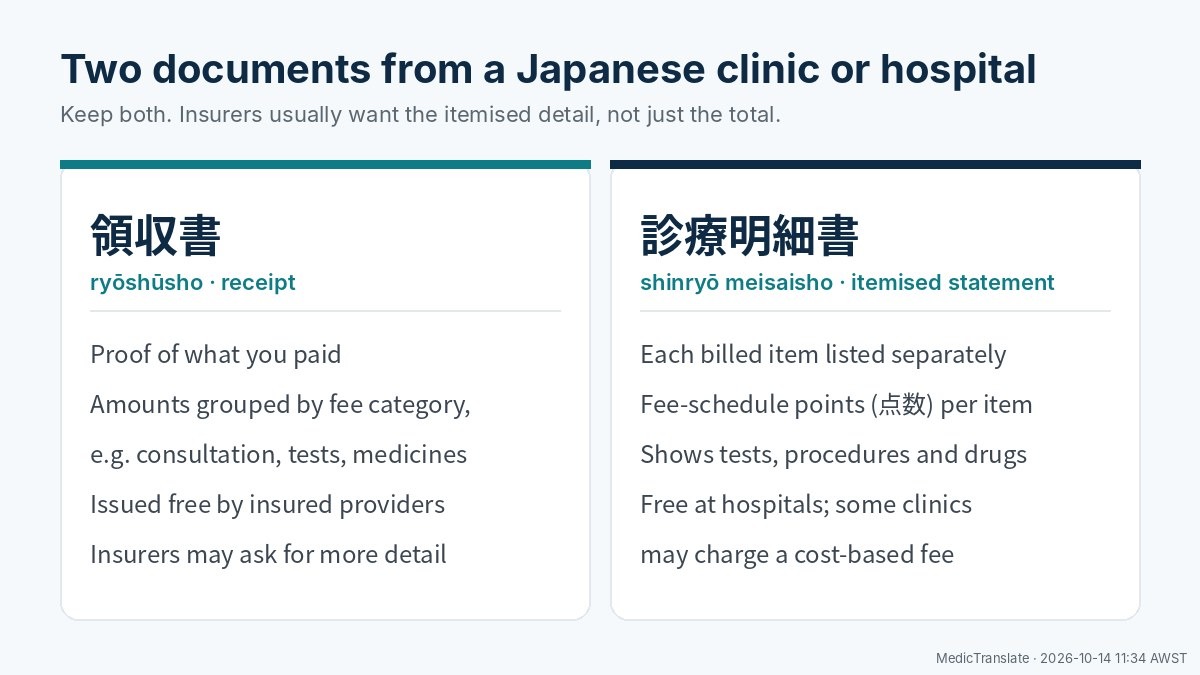
Ryōshūsho and shinryō meisaisho: the two documents
領収書 · ryōshūsho
Proof of what you paid. Insured medical institutions and pharmacies must, unless they have a justified reason, issue it free of charge with charges divided by category, such as initial or follow-up consultation, medical management, tests and medicines.
診療明細書 · shinryō meisaisho
Lists each billed item under Japan's fee schedule, so you can see the individual tests, procedures and medicines. Hospitals issue it free. Some clinics may charge a fee close to the actual cost, so ask in advance.
You can decline the itemised statement at the counter, but if you might claim on insurance, ask for it. Some clinics issue it only on request. Japanese receipts and statements group charges under fee-schedule headings and often show them as points (点数, tensū) under category headings, which is one reason an overseas claims handler often struggles to read them without help.
Ask for the statement at the payment counter: 明細書もお願いします (meisaisho mo onegai shimasu), meaning "the itemised statement too, please".
Japanese medical receipt translation for travel and home-country insurers
If you are visiting Japan, or living here with insurance from your home country, your insurer decides what it needs. Requirements differ, but claims teams commonly ask for:
- Itemised costs, not just a totalThe shinryō meisaisho, or an equivalent breakdown, shows what each charge was for.
- Proof of paymentThe ryōshūsho, showing the date and the amount you paid.
- Medical informationSome insurers also ask for a diagnosis or a doctor's certificate. See our guide to the medical certificate (shindansho).
- A translation they can readMany insurers ask for documents in English or their own language. Check the claim form or ask the insurer before you order a translation.
Read your policy's claim section first. It usually lists the documents, any deadline for claiming and whether a translation is required. For why travel cover alone may not fit everyone staying in Japan, see travel insurance is not enough in Japan.
A translation makes your documents readable. It does not decide the claim. Your insurer applies its own policy terms, and some charges may not be covered.
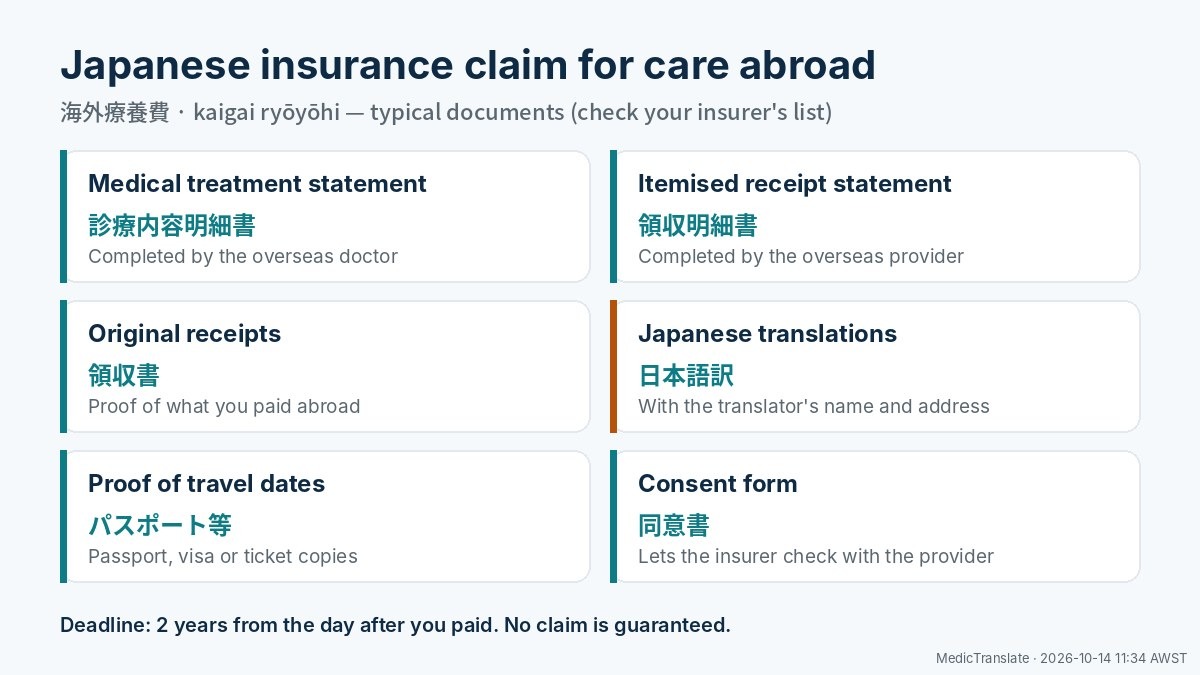
Japan's overseas medical expenses claim (kaigai ryōyōhi)
This works the other way round. If you are covered by Japanese public health insurance, such as Japan Health Insurance Association (協会けんぽ) cover or a city's National Health Insurance, and you suddenly fall ill or are injured abroad, you can apply to have part of the cost refunded.
Documents usually required
The Japan Health Insurance Association lists the application form, a statement completed by the overseas medical provider (Form A for medical, Form C for dental), an itemised receipt statement (Form B), the original receipts, copies showing your travel dates (passport, visa or ticket) and a consent form. National Health Insurance offices ask for similar documents. Kagoshima City, for example, lists the treatment statement (診療内容明細書) and the receipt statement (領収明細書) and recommends collecting the forms before you travel.
The translation requirement
Forms and receipts completed in another language must be submitted with a Japanese translation. The Japan Health Insurance Association asks the translator to sign the translation and include their address and phone number. Kagoshima City asks for the translator's address and name, warns that mistranslations or omissions can count against the applicant, and notes that the applicant pays the translation fee.
How the refund is worked out
- The amount is based on what the same treatment would cost in Japan (or what you actually paid, if that is lower), minus your normal co-payment share.
- Because medical systems differ, the refund can be much lower than what you paid abroad.
- The Japan Health Insurance Association converts costs paid in a foreign currency to yen at the exchange rate on the date it decides the payment.
- Treatment not covered by insurance in Japan, and trips made for the purpose of treatment, are excluded.
- The claim expires two years from the day after you paid.
National Health Insurance rules can differ by city. Kagoshima City, for example, states that people living abroad for a long period (roughly a year or more) are outside the scheme. Check with your own insurer or city office before you apply.
What a good receipt translation includes
| Element | What to check |
|---|---|
| Provider details | Clinic or hospital name and address, carried over exactly. |
| Patient and dates | Patient name as on the passport, and each date of treatment. |
| Each line item | Every category or item translated, in the same order as the original. |
| Amounts | Figures, points and currency copied exactly. A translator does not convert currency. |
| Stamps and notes | Official seals, handwritten notes and "paid" marks noted, not left out. |
| Translator details | Included where the insurer requires them. |
Our translations show the translator's full name with MedicTranslate's company email and phone number. Some insurers, such as the Japan Health Insurance Association, also ask for a signature and the translator's address, so name your insurer when you request a quote and check its current requirements before you submit.
Practical tips before you claim
- Ask for the itemised statement every visit, and keep every receipt, including pharmacy receipts.
- Keep the originals. Many insurers, including Japanese public insurers for overseas claims, ask for the original receipts.
- Check your claim deadline as soon as you can.
- Translate everything the insurer lists in one batch, so names, dates and terms stay consistent.
- If you were uninsured in Japan, see uninsured in Japan: medical costs and travel insurance.
Get your medical receipts translated
MedicTranslate translates Japanese receipts, itemised statements and medical certificates into English, and overseas medical bills and forms into Japanese, with human-validated translation and standard delivery from 72 hours.
- Receipts and itemised statements, line by line
- Amounts, dates and provider details carried over exactly
- Japanese to English and English to Japanese
- Medical certificates and records in the same order
Price confirmed before work begins. Reply within 1–3 business days. We do not give legal or insurance advice, and we cannot promise any claim will be paid.
Frequently asked questions
What is the difference between a ryoshusho and a shinryo meisaisho?
The ryoshusho is the receipt showing what you paid, with charges grouped by category. The shinryo meisaisho is the itemised statement listing each billed item under the Japanese fee schedule. Insurers often want both.
Do Japanese clinics charge for an itemised statement?
Hospitals issue it free. Clinics that submit claims electronically usually issue it free too, but a clinic with a justified reason may charge a fee close to the actual cost. Ask at the counter before you pay.
Does my travel insurer need a translation of my Japanese receipts?
Many do, because claims teams need to read each charge. Requirements differ between insurers, so check your policy or the claim form before ordering a translation.
Do I need a Japanese translation to claim overseas medical expenses from Japanese insurance?
Yes. Forms and receipts completed in another language must be submitted with a Japanese translation. The Japan Health Insurance Association asks the translator to sign it and give their address and phone number.
How long do I have to claim kaigai ryoyohi?
The claim expires two years from the day after you paid the overseas medical bill.
Will a translation make sure my claim is paid?
No. A translation makes your documents readable, but the insurer decides the claim under its own rules, and some treatment may not be covered.
This article provides general information reviewed on 14 October 2026. Insurance claim rules, required documents, deadlines and translation requirements are set by each insurer and can change. MedicTranslate translates documents; it is not an insurer, claims agent or law firm, it does not give legal or insurance advice, and it cannot promise that any claim will be accepted or paid. Check the requirements with your insurer or city office.
- Japan Health Insurance Association (Kyokai Kenpo): Overseas medical expenses (Japanese)
- Kagoshima City: National Health Insurance refunds, including overseas medical expenses (Japanese)
- Osaka Prefecture: Receipts and itemised statements issued by insured medical institutions and pharmacies (Japanese)
- Saitama Prefecture: Receipts showing the breakdown of medical costs (Japanese)