
AI Medical Translation vs Human Translation: What the Evidence Says
AI medical translation tools are fast, free or cheap, and often surprisingly good. But medical documents carry details where one wrong word matters: drug names, doses, units and instructions such as do not. This guide looks at what published studies and official guidance say, where machine translation helps, and when you should have a human check the result.
Quick answer
Machine translation is useful for understanding the gist of a medical document, but it is not reliable enough on its own for anything clinical or official. Published studies found that accuracy varies by language and that some errors could cause harm. Have a qualified human review any translation that a doctor, pharmacist, insurer or official body will rely on, especially prescriptions, medication lists, discharge instructions and medical reports.
Have a medical document to translate? Human-validated translation, standard delivery from 72 hours.
Request a translation quoteOn this page
What the research says about AI medical translation
Several peer-reviewed studies have tested general-purpose machine translation on real hospital instructions. They used emergency or paediatric discharge instructions, which are short, practical texts that patients act on at home.
- Khoong and colleagues (JAMA Internal Medicine, 2019) machine-translated 100 sets of emergency department discharge instructions into Spanish and Chinese. Most of the translations were accurate, 92% for Spanish and 81% for Chinese, but some of the errors had the potential to cause harm.
- Taira and colleagues (Journal of General Internal Medicine, 2021) tested seven languages. The overall meaning was kept in 82.5% of translations, but accuracy ranged from 94% for Spanish to 55% for Armenian. The authors concluded the tool should not be relied on for patient instructions. One example turned do not blow your nose into a sentence that was meaningless or potentially harmful.
- A 2024 study in Pediatrics, which compared two machine translation tools, including a large language model, with professional translation, found comparable performance for Spanish and Portuguese, but a higher risk of clinically significant errors for Haitian Creole, a language with a smaller digital footprint.
Two lessons stand out. First, machine translation has improved and can perform well for some language pairs. Second, quality depends heavily on the language, so a good result in one language tells you little about another. None of these studies tested Japanese, so their figures cannot be applied to Japanese documents.
Official guidance points the same way. In the United States, a federal rule for health programmes that receive federal funding requires a qualified human translator to review machine translation when the text is critical to a person's rights, benefits or access to care, when accuracy is essential, or when it contains complex, non-literal or technical language.
Where AI medical translation helps
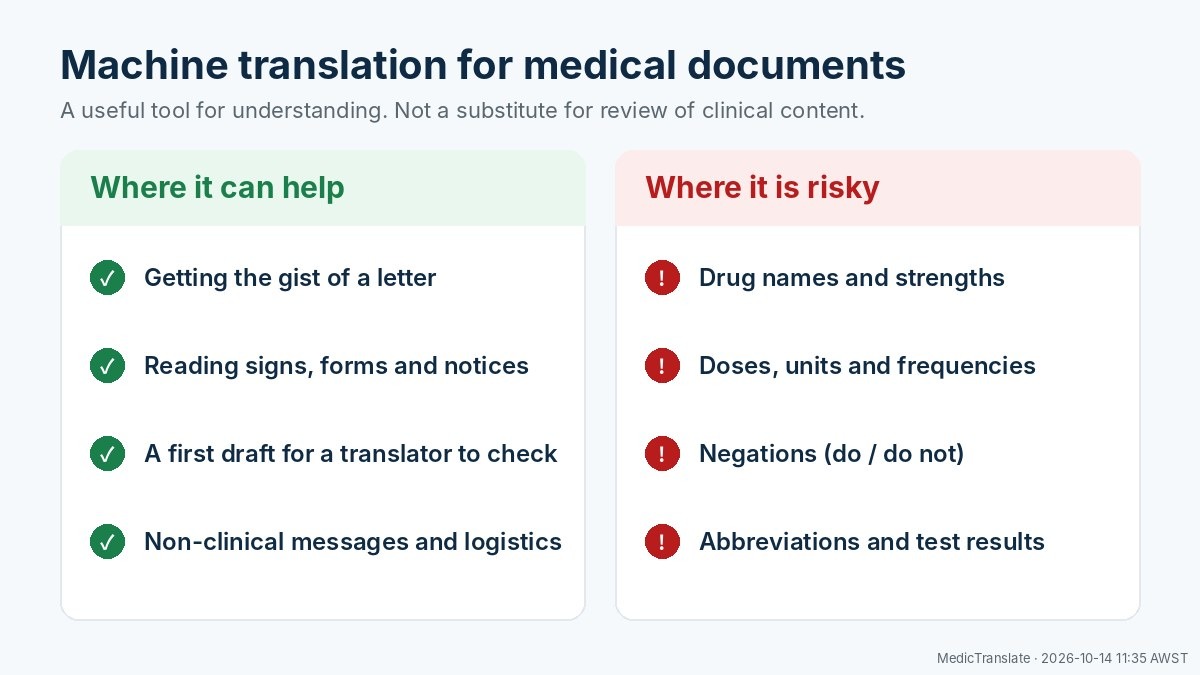
Used with care, machine translation is a practical tool. It is fast, available at any hour and good at giving you a general sense of a text. Reasonable uses include:
- Getting the gistWorking out what a letter from a hospital or city office is about before you decide what to do next.
- Everyday logisticsReading signs, opening hours, appointment reminders and simple forms.
- Preparing questionsDrafting the questions you want to ask your doctor, then checking them with a professional.
- A first draftA starting point that a qualified translator reviews and corrects.
Where it is risky: drug names, units, dosages and negations
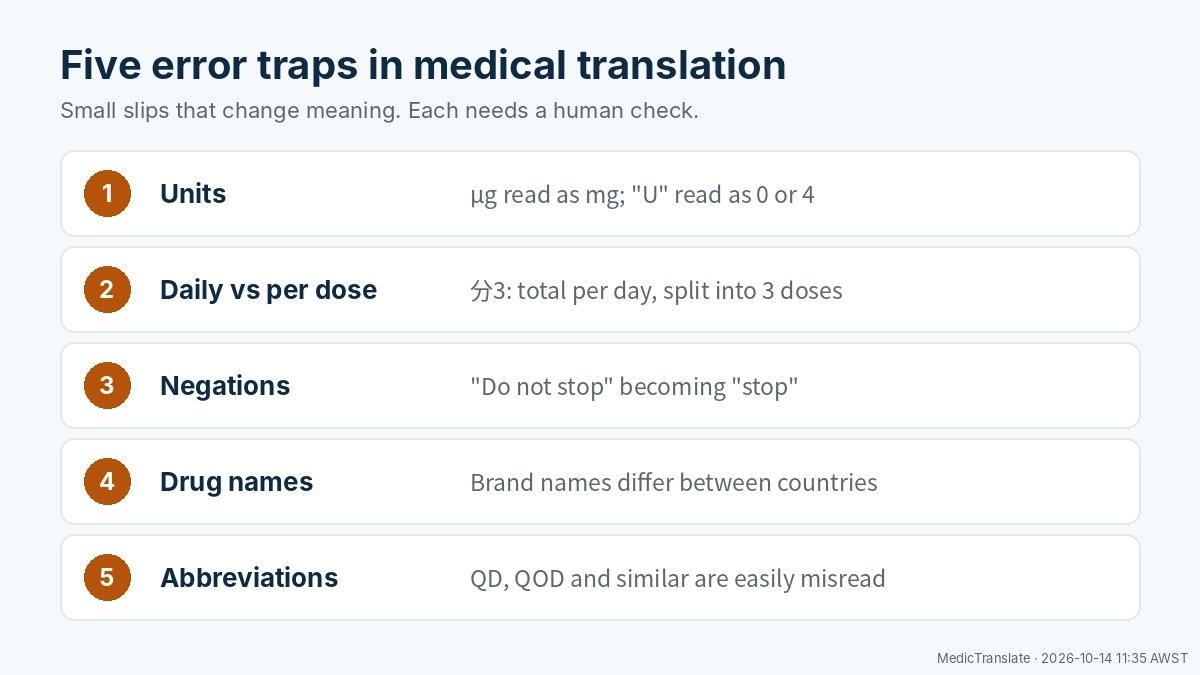
Medical documents contain small details that carry large meaning. These are the places where errors in any translation, machine or human, are most dangerous, and where a human check matters most.
Drug names
Brand names differ between countries, and similar-looking names can be confused. A translator needs to identify the active ingredient, not just copy or translate a brand name.
Units and doses
The US Institute for Safe Medication Practices (ISMP) lists symbols that are easily misread: μg can be mistaken for mg, U for 0 or 4, and a trailing zero can make 1.0 mg look like 10 mg.
Negations
Do and do not are one small word apart. A dropped or misplaced negation can reverse an instruction about taking or stopping a medicine.
Abbreviations
Abbreviations such as QD (daily) and QOD (every other day) are easily confused, which is why ISMP recommends writing them out. Machine translation may leave them unchanged or guess.
Context is another weak point. A machine has no way of knowing whether a number is a dose or a lab value, or whether a term was used in a specialist sense. A medically trained reviewer checks that the translation makes clinical sense as a whole.
Japanese medical documents: specific traps
Japanese prescriptions and medical documents have conventions that can catch out both machines and non-specialist readers.
- Daily versus per-dose amounts. Japanese prescriptions have often stated the total daily amount, followed by a note such as 分3 (divided into three doses). An MHLW report on prescription writing (2010) cites cases where 分3 was misread as three times the amount, leading to dosing errors.
- Product amount versus active ingredient. The same MHLW report notes overdoses caused by confusing the amount of the product with the amount of the active ingredient.
- Frequency phrases. Instructions such as 1日3回 毎食後 (three times a day, after each meal) need to be rendered exactly, including timing.
If you are bringing medicines to Japan or continuing an overseas prescription, these details matter. See our guide to continuing an overseas prescription in Japan.
When to use human review
| Document or task | Machine translation alone? |
|---|---|
| Understanding the gist of a letter | Often reasonable, then check anything important |
| Signs, opening hours, simple forms | Usually reasonable |
| Prescriptions and medication lists | No. Use human review |
| Discharge instructions and test results | No. Use human review, and ask your doctor about results |
| Medical reports and referral letters | No. Use human review |
| Documents for insurers, employers or government offices | No. Use human review, and check the receiving body's requirements |
For translated records you will hand to a Japanese doctor, see our guide to medical records translation in Japan.
Using machine translation more safely
- Treat it as a draftUse the output to understand a document, not as the final version anyone will rely on.
- Keep the originalAlways keep the source document with the translation so a doctor or pharmacist can check it.
- Check the numbers yourselfCompare every dose, unit, date and frequency against the original.
- Mind your privacyMedical documents contain sensitive personal data. Check how any online tool stores what you upload.
- Get a human check for clinical or official useAnything a clinician, insurer or official body will act on should be reviewed by a qualified translator.
Human-validated medical translation for Japan
MedicTranslate translates prescriptions, medication lists, medical reports and records between Japanese and English. Human-validated translation, standard delivery from 72 hours.
- Drug names, doses and units checked
- Prescriptions and medication lists
- Medical reports and referral letters
- Records for Japanese doctors and pharmacies
Price confirmed before work begins. Reply within 1–3 business days. We do not give medical or legal advice.
Frequently asked questions
Is AI medical translation accurate?
It can be accurate for some languages and simple texts, but published studies found accuracy varies widely by language and that some errors could cause harm. It is useful for getting the gist, not for clinical or official documents on its own.
Can I use machine translation for a prescription?
Use it only to understand the gist. Drug names, doses, units and frequencies are where translation errors are most dangerous, so have a qualified human check any prescription or medication list that a doctor or pharmacist will rely on.
Why are Japanese prescriptions hard to translate?
Japanese prescriptions have often stated the total daily amount followed by a note such as 分3, meaning divided into three doses. An MHLW report cites cases where this was misread as three times the amount. Product amount versus active ingredient amount can also be confused.
Is human translation always error-free?
No translation is guaranteed to be error-free. Human review by someone who understands medical terminology reduces the risk of misunderstanding, especially for doses, units, drug names and negations.
Is it safe to upload medical documents to free translation tools?
Medical documents contain sensitive personal data. Before uploading, check how the tool stores and uses what you submit, and remove details that are not needed.
How long does MedicTranslate take to translate a medical document?
MedicTranslate offers human-validated translation with standard delivery from 72 hours. The price is confirmed before work begins.
This article provides general information reviewed on 14 October 2026. It summarises published studies and guidance and does not assess any specific translation tool. Research findings depend on the languages and texts tested. MedicTranslate provides translation services and does not give medical or legal advice; always confirm medicine doses and instructions with your doctor or pharmacist. Whether a translated document is accepted is decided by the receiving organisation.
- Khoong EC et al. Assessing the Use of Google Translate for Spanish and Chinese Translations of Emergency Department Discharge Instructions. JAMA Intern Med. 2019;179(4):580-582 (AHRQ PSNet summary; DOI 10.1001/jamainternmed.2018.7653)
- Taira BR et al. A Pragmatic Assessment of Google Translate for Emergency Department Instructions. J Gen Intern Med. 2021;36(11):3361-3365
- American Academy of Pediatrics: Research evaluates machine translation for paediatric discharge instructions (Pediatrics, 2024)
- US eCFR: 45 CFR 92.201, language assistance and human review of machine translation
- ISMP: List of Error-Prone Abbreviations, Symbols, and Dose Designations (2024)
- MHLW: Report on how oral prescriptions should be written, January 2010 (Japanese)