
Seeing a Dentist in Japan: A Guide for Foreigners
Seeing a dentist in Japan is usually straightforward once you know how the system works. Most dental care happens in small local clinics, public health insurance covers standard treatment, and some extras are self-paid. This guide explains where to go, how to book, what insurance covers, what to bring and where to find holiday dental care.
Quick answer
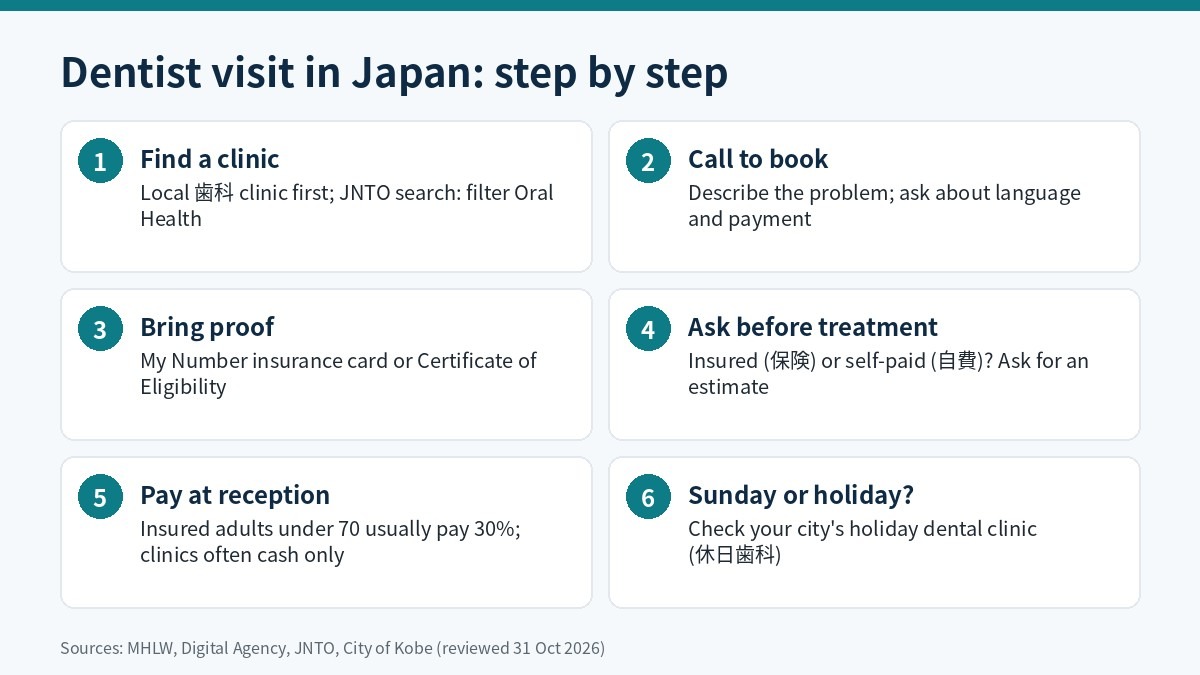
To see a dentist in Japan, most people go to a local dental clinic (歯科医院, shika iin) and book ahead by phone. If you have Japanese public health insurance, you usually pay 30% of the insured cost (20% for children under school age). You show your My Number card registered as an insurance card or a Certificate of Eligibility; the old paper insurance cards cannot be used from 2 December 2025. Some materials and options are self-paid (自費, jihi). On Sundays and holidays, some cities, such as Kobe, run a holiday dental clinic.
Need help finding a dentist or explaining your problem? We can help you find a clinic, request an appointment and arrange an interpreter.
Arrange healthcare supportOn this page
Dentist in Japan: clinic or hospital dental department?
In Japan, you can choose where you receive care. However, dental care is organised differently from what many visitors expect. Most routine dentistry takes place in independent neighbourhood clinics, not in hospitals.
Local dental clinic
Signs say 歯科 (shika) or 歯科医院. These clinics handle checkups, cleanings, fillings, extractions, dentures and most toothaches.
Hospital dental department
Larger hospitals may have a dental or oral surgery department (歯科口腔外科). They tend to handle more complex cases, and some ask for a referral letter.
For a normal problem, therefore, a local clinic is the usual first stop. In addition, MHLW lists a first visit to a large hospital as one of the items for which hospitals may charge an extra, self-paid fee. As a result, going straight to a big hospital without a referral letter can cost more. Ask the hospital about this before you go.
How to book a dentist in Japan
Booking a dentist in Japan usually starts with a phone call to the clinic. Some clinics also take online bookings, but those pages may be in Japanese only. If you are a traveller, the Japan National Tourism Organization (JNTO) has a search tool for medical institutions. You can filter it by area, language and department; dental care appears under “Oral Health”.
JNTO also advises contacting each medical institution before you visit, because listings show only basic information. For example, opening hours and language support can change, and a clinic may not be able to treat you on the day. Therefore, call first, even if a clinic appears in a search.
- Find a clinicSearch near your home or hotel, or use the JNTO search with the Oral Health filter.
- Call to bookExplain your problem briefly, for example pain, swelling, a lost filling or a broken tooth.
- Confirm the basicsAsk about language support, payment methods and what to bring.
- Arrive a little earlyFirst visits usually start with a registration form and a medical questionnaire.
- Pay at receptionJNTO notes that clinics generally accept cash only, so bring enough cash.
If phoning in Japanese feels difficult, our guide on how to book a doctor appointment in Japan covers the same process, and our list of foreign-friendly clinics can be a starting point.
What insurance covers at a dentist in Japan
If you are enrolled in Japanese public health insurance, standard dental treatment is covered. You pay a share of the cost at the counter, and your insurer pays the rest. The share depends on your age, according to MHLW.
| Patient’s age | Usual share you pay (MHLW) |
|---|---|
| Under school age (under 6) | 20% |
| School age to 69 | 30% |
| 70 to 74 | 20% (30% for people with working-level income) |
| 75 and over | 10% (20% or 30% for some higher-income people) |
In addition, many municipalities help with children’s medical costs, so families should check their own city’s rules.
Insured care, self-paid care and the mixing rule
Japan generally does not allow insured and uninsured treatment to be mixed in one course of care. MHLW explains that when they are mixed, the whole treatment is treated as uninsured (自由診療, jiyū shinryō). In practice, this means you pay the full cost yourself.
However, there are set exceptions. Under the 選定療養 (sentei ryōyō) system, patients can choose certain extras and pay for them separately, while insurance still covers the standard part. MHLW’s list includes three dental items:
- Gold alloys and similar materials in dental treatment (歯科の金合金等)
- Full dentures with a metal base (金属床総義歯)
- Ongoing management of tooth decay in children (小児う蝕の指導管理)
Ask before treatment starts. For any treatment plan, ask whether each step is insured (保険, hoken) or self-paid (自費, jihi), and ask for an estimate. This matters most for cosmetic work, orthodontics, implants and special materials.
If you are visiting Japan on a short trip and have no Japanese public insurance, you pay the clinic’s full fee. JNTO recommends travel insurance and notes that some policies offer cashless payment, so check your policy terms before you go. Keep your receipts, too; a medical receipt translation can help with an overseas insurance claim.
What to bring to a dentist in Japan
The rules on insurance proof changed recently. According to the Digital Agency, the old health insurance cards stopped being issued on 2 December 2024 and could no longer be used from 2 December 2025. Instead, you now use one of the following:
My Number insurance card
Your My Number card registered for use as a health insurance card (マイナ保険証). The clinic checks your coverage online.
Certificate of Eligibility
A 資格確認書 (shikaku kakunin-sho), issued free by your insurer if you have not registered your My Number card as an insurance card.
The insurance notice alone is not enough. The Digital Agency states that the Notice of Insurance Information (資格情報のお知らせ) cannot be used on its own to receive insured care. Ask your insurer if you are unsure which document you have.
Beyond insurance proof, bring the following:
- Cash, because JNTO notes that clinics generally accept cash only.
- Your passport if you are a visitor without Japanese insurance.
- A list of your medicines and allergies, ideally in Japanese. Blood thinners and allergies matter to a dentist.
- Previous dental records or X-rays, if you have them, especially for ongoing treatment.
Our checklist of what to bring to a doctor, clinic or hospital in Japan covers this in more detail.
Emergency and holiday dental care in Japan
Dental problems do not wait for opening hours. When your usual clinic is closed on a Sunday or public holiday, check whether your city runs a holiday dental clinic (休日歯科診療所, kyūjitsu shika shinryōjo) for urgent problems such as severe toothache.
For example, the City of Kobe lists a holiday dental clinic in Sannomiya (Chuo-ku). It opens on Sundays, public holidays and substitute holidays, with morning and early-afternoon sessions, and on extended hours over the New Year period (29 December to 3 January). Kobe’s page also lists #7119, a phone line for advice on whether you need emergency care.
Check your own city. Holiday dental services, hours and booking rules differ by city and change over time. Search your city’s official website for 休日歯科 and call before you go.
Serious injuries are different. Heavy bleeding that will not stop, facial swelling that affects breathing or swallowing, or a major face or jaw injury may need emergency medical care. In that case, call 119. Our guide to calling 119 in Japan explains what to say.
Children’s dental checkups in Japan
Japan has public dental checkups for young children. MHLW’s e-health site explains that dental checkups at 1 year 6 months and 3 years are required under the Maternal and Child Health Act. Municipalities run them as part of routine infant health checkups. Their aim is early detection and prevention of dental disease, along with health guidance.
Your city or ward will tell you how and when the checkups take place. Keep your child’s Boshi Techo (Maternal and Child Health Handbook) ready, as health checkups often ask for it. If you are unsure of the schedule, contact your local health centre.
How an interpreter or dental record translation helps
Dental visits involve detailed choices. For instance, you may need to compare an insured option with a self-paid one, agree to an extraction, or explain an allergy. As a result, misunderstandings can cost money or affect your care.
- Interpreting: a medical interpreter can help you describe symptoms, understand the treatment plan and ask about costs.
- Records and treatment plans: a medical document translation lets your new dentist in Japan read your history, or lets your dentist at home read Japanese records. MedicTranslate translates between English, Japanese, German, French and Arabic.
- Coordination: we can help you find a clinic and request an appointment. The clinic decides on availability and treatment.
Get help seeing a dentist in Japan
MedicTranslate helps you find a suitable clinic, request an appointment and communicate clearly with the dental team, in person or remotely.
- Help finding a clinic and requesting a booking
- Medical interpreting for your appointment
- Dental record translation (quoted separately)
Price confirmed before you pay · Reply within 1–3 business days · MedicTranslate does not provide dental or medical care and cannot guarantee appointments.
Frequently asked questions
Do I need an appointment to see a dentist in Japan?
It is best to call ahead and book. JNTO advises contacting a medical institution before you visit, because hours and language support vary.
Does Japanese health insurance cover dental treatment?
Yes, standard dental treatment is covered for people enrolled in Japanese public health insurance. Most adults under 70 pay 30 percent of the insured cost. Some materials and options are self-paid, and mixing insured and uninsured treatment is generally not allowed outside set exceptions.
Can I still use my old health insurance card at the dentist?
No. According to the Digital Agency, the old health insurance cards could no longer be used from 2 December 2025. Use your My Number card registered as an insurance card, or a Certificate of Eligibility issued by your insurer.
What does jihi mean at a Japanese dental clinic?
Jihi means self-paid. It is treatment or material that public insurance does not cover, so you pay the full price. Ask the clinic which parts of your treatment plan are insured and which are self-paid before treatment starts.
Where can I see a dentist on a Sunday or holiday in Japan?
Some cities run a holiday dental clinic on Sundays and public holidays. For example, the City of Kobe lists one in Sannomiya. Search your city's official website for its holiday dental service and call before you go. For a serious injury, call 119.
Are there public dental checkups for children in Japan?
Yes. Municipalities run dental checkups for children at 1 year 6 months and 3 years under the Maternal and Child Health Act. Contact your local health centre for the details where you live.
Can MedicTranslate book a dentist for me?
MedicTranslate can help you find a clinic, request an appointment and arrange an interpreter. However, the clinic decides whether it can see you, and MedicTranslate does not provide dental care or guarantee bookings.
This article provides general information based on published Japanese government and municipal guidance reviewed on 31 October 2026. It is not medical, dental or legal advice. Insurance rules, clinic hours and holiday services change, so confirm current details with your insurer, your city or ward office and the dental clinic before your visit. For any dental or medical problem, follow the advice of a dentist or doctor.
MedicTranslate provides translation, interpreting, information and healthcare coordination services. It does not provide dental or medical care, recommend treatments, decide insurance coverage, or guarantee appointments with any clinic or hospital.
- MHLW: Combining insured and uninsured treatment, including dental selected-care items (Japanese)
- MHLW: Patient co-payment rates for medical costs (Japanese, PDF)
- Digital Agency: My Number insurance card and Certificate of Eligibility (Japanese)
- MHLW e-health net: Infant and toddler dental checkups (Japanese)
- City of Kobe: Emergency and holiday medical care, including the holiday dental clinic (Japanese)
- JNTO: Guide for when you are feeling ill