
Hospitals in Tokyo for International Patients: How to Find One
Looking for hospitals in Tokyo for international patients? Rather than relying on a ranking, use the official tools that show which hospitals accept foreign patients, which languages they support and how to contact them. This guide explains each tool, the helplines that can point you to a hospital, and what to prepare before you go.
Quick answer
Start with the official searches. The JNTO medical institution search lets you filter Tokyo hospitals by language, department and JMIP accreditation. If you would rather ask by phone, Tokyo's foreign-language medical information line (03-5285-8181, daily 9:00–20:00) and the Japan Visitor Hotline (050-3816-2787, 24 hours) can point you to a suitable facility. In an emergency, call 119. Large hospitals usually expect a referral letter, so a clinic is often the better first stop.
Need help booking a Tokyo hospital? We can help arrange the appointment and provide a medical interpreter by video or phone.
Arrange healthcare supportOn this page
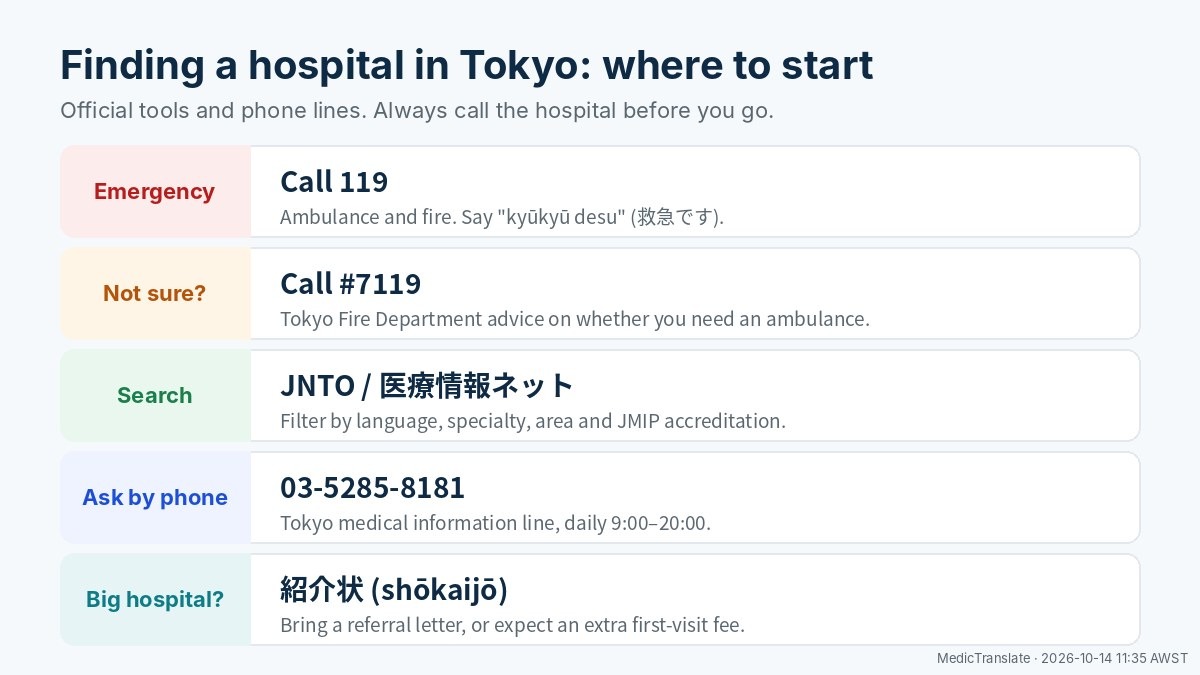
Official tools to find hospitals in Tokyo for international patients
Tokyo has many hospitals that accept foreign patients, but language support, departments and payment options differ from one hospital to the next. These official tools are the most reliable way to check before you go. They are free to use.
JNTO medical institution search
Run by the Japan National Tourism Organization for visitors. Filter by area, language, department, accepted credit cards, JMIP accreditation and 24-hour emergency care. It shows basic information only, so confirm hours and language support with the hospital.
JMIP accredited hospital list
The JMIP search lists hospitals accredited for receiving international patients. Choose 東京都 (Tokyo) from the prefecture menu; you can also search by department.
MHLW medical information net
Japan's national search, 医療情報ネット (Navii), covers hospitals and clinics. You can search by department, location and supported language, and switch the site to English from the menu.
The JNTO search shows up to 30 results, sorted by straight-line distance rather than travel time. A short list near your hotel or home is a good starting point, but always phone ahead.
What JMIP accreditation means
JMIP stands for Japan Medical Service Accreditation for International Patients. It is run by the Japan Medical Education Foundation (日本医療教育財団) as part of a national project to help hospitals receive foreign patients smoothly.
In practice, JMIP looks at how a hospital receives international patients, for example multilingual guidance and care that considers different cultures and religions. The review includes a document check and an on-site visit. Hospitals applying for JMIP must already hold, or expect to obtain, another recognised hospital accreditation.
JMIP is not a ranking of medical quality, and many hospitals without JMIP also see foreign patients every day. Use it as one signal of how ready a hospital is to receive you, together with language support and the department you need.
Helplines that can point you to a hospital in Tokyo
If you prefer to talk to someone, these services can help you find a hospital or clinic that supports your language. They do not book appointments for you.
| Service | Phone | Hours and languages |
|---|---|---|
| Tokyo medical information service for foreign patients (ひまわり) | 03-5285-8181 | Daily 9:00–20:00. English, Chinese, Korean, Thai and Spanish. Free, but you pay the call charge. |
| Japan Visitor Hotline (JNTO) | 050-3816-2787 | 24 hours, 365 days. English, Chinese and Korean. |
| Tokyo Fire Department advice line | #7119 | Advice on whether you need an ambulance. |
| Ambulance and fire | 119 | For emergencies. Multilingual support is available. |
Tokyo's information line can also explain how Japan's medical system works and what treatment can cost if you have no Japanese health insurance. For what to say on an emergency call, see our guide to calling 119 in Japan.
Clinic or large hospital?
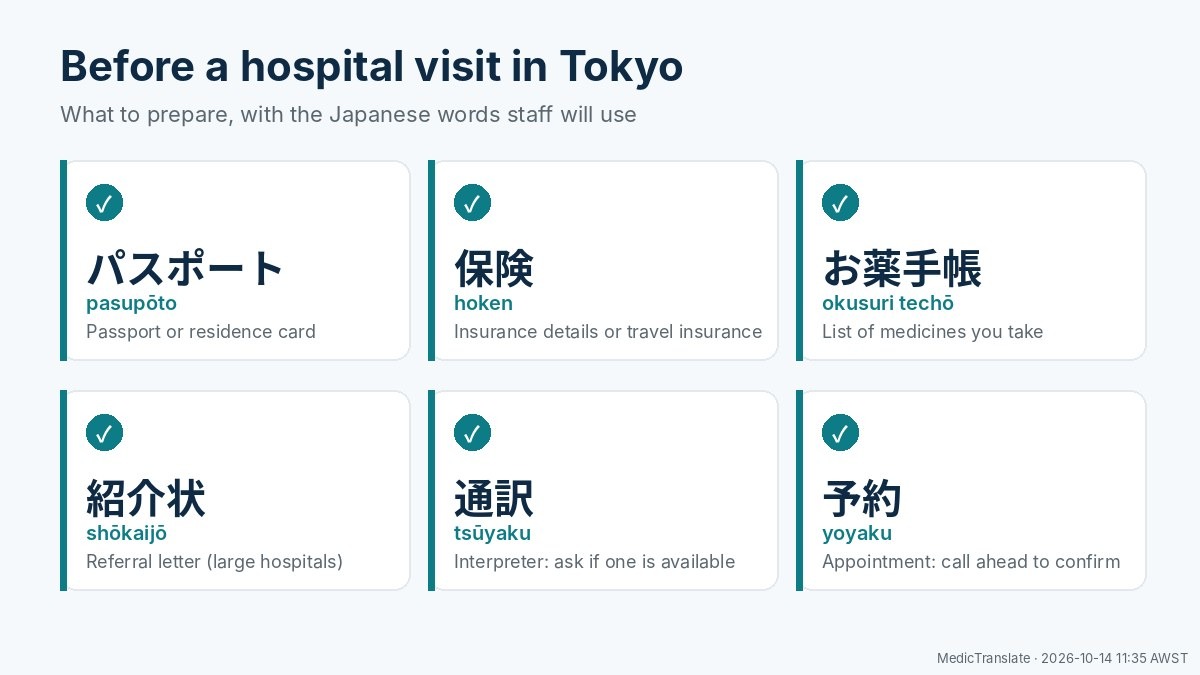
In Japan, large hospitals focus on specialist and referred care. For most non-urgent problems, a local clinic (クリニック or 医院) is the usual first stop. The clinic can write a referral letter (紹介状, shōkaijō) if you need a hospital.
If you go to a large hospital without a referral letter, expect an extra charge on top of the treatment cost. Under MHLW rules, hospitals such as advanced treatment hospitals and other designated hospitals with 200 or more general beds must charge at least ¥7,000 for a first visit without a referral (from October 2022). Some hospitals charge more. Our guide to the referral letter and large-hospital fee explains how it works.
Visiting Tokyo without Japanese health insurance? You usually pay the full cost of treatment yourself. Check your travel insurance first, and see medical costs if you are uninsured in Japan.
Before you go: how to prepare for a Tokyo hospital visit
- Phone the hospital firstConfirm the department, opening hours, whether you need an appointment (予約) and what language support is available that day.
- Bring identification and insurance detailsYour passport or residence card, plus your Japanese health insurance details or travel insurance documents.
- List your medicinesBring the medicines themselves, a written list or your medicine notebook (お薬手帳).
- Bring any referral letter and recordsYour referral letter, and a translated summary of relevant medical history if you have one.
- Plan how to payCheck which payment methods the hospital accepts. The JNTO search shows accepted credit cards.
For a fuller checklist, see what to bring to a doctor, clinic or hospital in Japan.
Language support at the hospital
Some Tokyo hospitals have international patient desks, on-site interpreters or phone interpreting. Others work mainly in Japanese, and support can depend on the day and the department. Some hospitals ask patients to bring their own interpreter.
A professional medical interpreter reduces the risk of misunderstanding during consultations, consent discussions and test results. MedicTranslate provides interpreters in person across Kansai and beyond and by video or phone anywhere in Japan, including Tokyo. See our guide on what to do if a hospital asks you to bring an interpreter.
Get help with a Tokyo hospital visit
MedicTranslate helps international patients contact Japanese hospitals and clinics, and provides medical interpreters in person or by video or phone for appointments in Tokyo.
- Help contacting hospitals and arranging appointments
- Medical interpreters by video or phone
- Translation of referral letters and medical records
- Interpreting from US$360 for the first 3 hours
Price confirmed before work begins. Reply within 1–3 business days. Bookings depend on hospital availability. We do not give medical advice.
Frequently asked questions
How do I find hospitals in Tokyo for international patients?
Use the JNTO medical institution search, which filters by language, department and JMIP accreditation, or the JMIP list of accredited hospitals. You can also call Tokyo's medical information service on 03-5285-8181 (daily 9:00 to 20:00). Always phone the hospital before you go.
What is a JMIP accredited hospital?
JMIP is an accreditation for hospitals that receive international patients, run by the Japan Medical Education Foundation. It reviews how a hospital receives foreign patients, such as multilingual guidance. It is not a ranking of medical quality.
Can I go to a large hospital in Tokyo without a referral letter?
Usually yes, but large hospitals designated under MHLW rules must charge an extra fee of at least 7,000 yen for a first visit without a referral letter. A local clinic is often the better first stop and can refer you if needed.
Is there a phone number tourists can call for medical help in Japan?
The Japan Visitor Hotline, 050-3816-2787, is run by JNTO and answers 24 hours a day in English, Chinese and Korean. In an emergency, call 119.
Do Tokyo hospitals provide interpreters?
Some do, through international desks, on-site staff or phone interpreting, but it varies by hospital and department. Ask when you phone ahead. If the hospital asks you to bring an interpreter, a professional medical interpreter can join by video or phone.
Can MedicTranslate book a Tokyo hospital appointment for me?
We can help you contact hospitals and arrange appointments, and provide a medical interpreter. Bookings depend on the hospital's availability, and we do not give medical advice.
This article provides general information reviewed on 14 October 2026. Hospital services, language support, phone line hours and fees can change. Always confirm details directly with the hospital or service. MedicTranslate is not a healthcare provider and does not recommend or endorse any hospital. We do not give medical advice, and appointments depend on each hospital's availability. In an emergency, call 119.
- JNTO: Medical institution search and Japan Visitor Hotline
- Japan Medical Education Foundation: JMIP overview (English)
- JMIP: Accredited medical institution search (Japanese)
- Tokyo Metropolitan Government: Medical information service for foreign patients
- Tokyo Metropolitan Government: Medical information services for foreigners (Japanese)
- MHLW: Medical information net (Navii)
- Minato City: Medical information for foreign residents, including Navii language search (Japanese)
- Chuo City: Medical consultation services, including AMDA hours
- MHLW: Fixed charge for large-hospital visits without a referral, from October 2022 (Japanese)
- Tokyo Fire Department: 119 and #7119