
Japanese Health Check Results in English: Reading the Sheet
Need your Japanese health check results in English? This guide shows how a Japanese 健康診断 or 人間ドック result sheet is laid out, what the common headings say, and how to get the sheet translated for a doctor at home or in Japan. It does not explain what any result means. Only a doctor can do that.
Quick answer
A Japanese health check result sheet usually has four parts: your details and the test date, an overall judgement (総合判定), a table of tests with your result, the reference range (基準値) and a judgement grade (判定), and the doctor's comments. Many facilities grade results A to E, but the key is printed on your own sheet. To get your results in English, ask the facility whether it issues an English report, or have the Japanese sheet translated. Ask a doctor what any result means for you.
Need the sheet in English for your doctor? We translate Japanese health check and ningen dock results, with every translation validated by a person.
Request a translation quoteOn this page
Which health check is on your sheet?
Japan has several kinds of health check, and the name at the top of the sheet tells you which one you had. Knowing this helps you, and your translator, understand why certain tests are included.
Regular health check 定期健康診断
Employers must arrange a checkup by a doctor for regularly employed workers once within each one-year period, under the Industrial Safety and Health Act.
Specific health check 特定健康診査
Run by your health insurer (employee insurance or National Health Insurance) for insured people and dependants aged 40 to 74, with a focus on metabolic syndrome.
Ningen dock 人間ドック
A more comprehensive check you book yourself, sometimes with support from an employer or insurer. The tests included depend on the course you choose.
For how these checks are booked and what happens on the day, see our guide on how to get a medical check (teiki kenshin) in Japan.
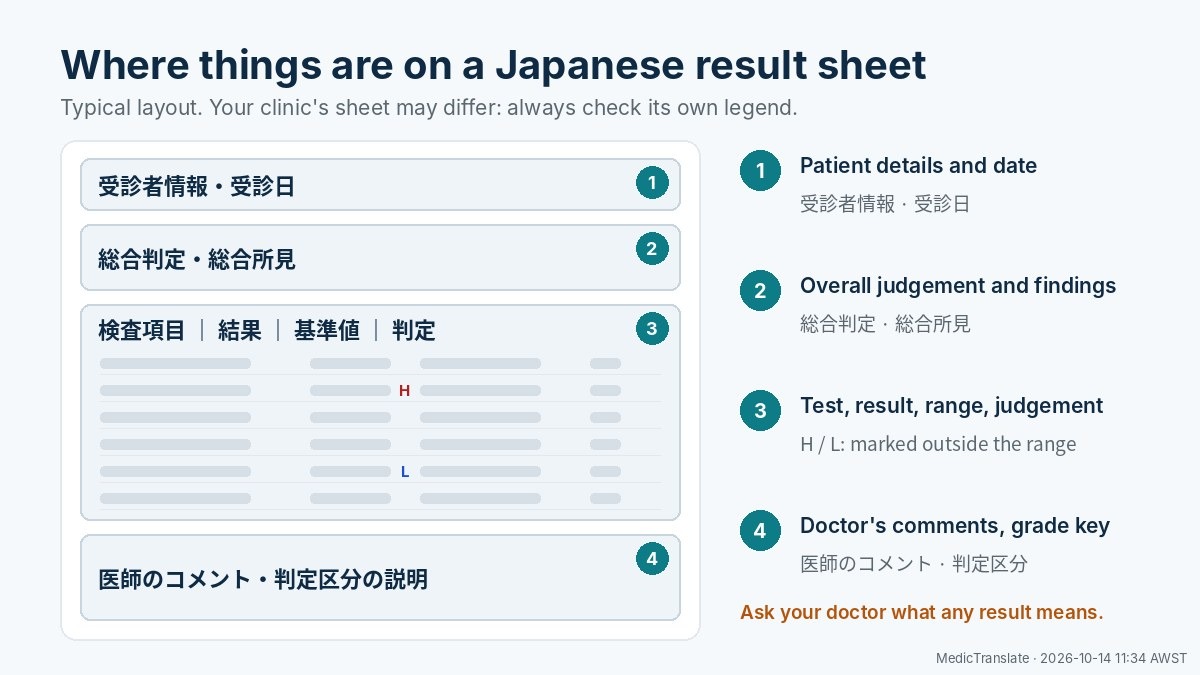
How a Japanese health check result sheet is laid out
Layouts differ between hospitals, clinics and health check centres, but most result sheets (健康診断結果報告書 or 人間ドック成績表) follow a similar pattern. Find these four parts first.
- Your details and the test dateName, date of birth, ID or insurance number and the date of the check (受診者情報, 受診日). Check these are yours before anything else.
- Overall judgement and findingsA summary box (総合判定, 総合所見) near the top, often with the doctor's main comments.
- The results tableOne row per test (検査項目), grouped by area such as body measurements, blood pressure, blood tests or urine tests, with columns for your result (結果), the reference range (基準値) and a grade (判定). Many sheets show previous years side by side.
- Comments and the key to the gradesThe doctor's comments (医師のコメント) and an explanation of the grading system (判定区分), often at the bottom or on the back page.
Keep every page together, including the back pages and any separate imaging or ECG reports. The key to the grades is often on a different page from the results.
Common Japanese headings on health check results
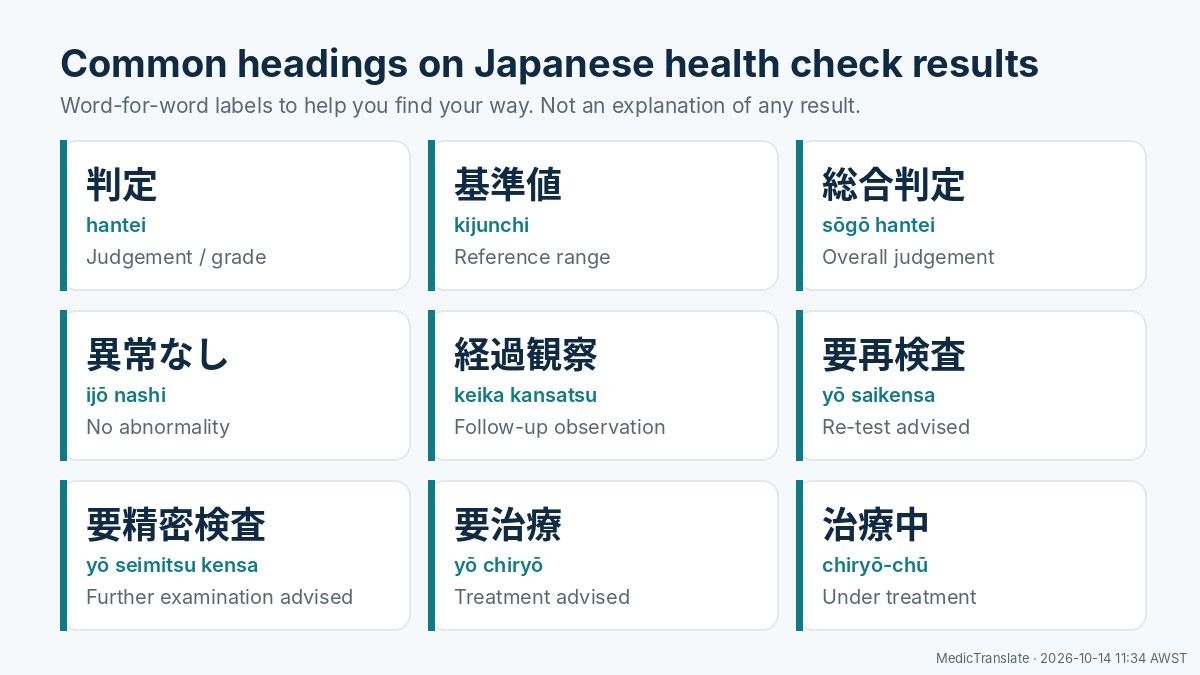
The table below gives a word-for-word English label for headings you will often see. These are translations of the words, not explanations of any result.
| Japanese | Reading | Literal English |
|---|---|---|
| 判定 | hantei | Judgement, grade |
| 総合判定 | sōgō hantei | Overall judgement |
| 基準値 | kijunchi | Reference range (reference value) |
| 今回 / 前回 | konkai / zenkai | This time / last time |
| 所見 | shoken | Findings |
| 異常なし | ijō nashi | No abnormality |
| 経過観察 | keika kansatsu | Follow-up observation |
| 要再検査 | yō saikensa | Re-test advised |
| 要精密検査 | yō seimitsu kensa | Further detailed examination advised |
| 要治療 | yō chiryō | Treatment advised |
| 治療中 | chiryō-chū | Currently under treatment |
The prefix 要 (yō) means required or advised. When it appears on your sheet, the facility is telling you to take a further step. Ask a doctor what that step is for you.
Judgement grades (判定区分) on Japanese results
Many facilities grade each result with a letter. The Japan Society of Ningen Dock publishes a widely used set of categories, revised from April 2018:
| Grade | Japanese label | Literal English |
|---|---|---|
| A | 異常なし | No abnormality |
| B | 軽度異常だが問題なし | Mild abnormality, no problem |
| C | 要経過観察・要再検査 | Follow-up observation or re-test advised |
| D | 要精密検査・要治療 | Further examination or treatment advised |
| E | 治療中 | Under treatment for that item |
Your facility may use a different system. Some split grades further, use numbers, or word them differently. Always read the key printed on your own sheet, and ask the facility or your doctor what your grades mean for you.
Reference ranges and H/L marks
The 基準値 column shows the reference range the facility uses for each test. Ranges can differ between facilities and laboratories, and some depend on sex or age, so compare your result only with the range printed on your own sheet.
Many sheets mark results outside the range with H (high) or L (low), an asterisk, or coloured text. The legend on the sheet explains the marks it uses. A mark tells you where a value sits against the range; it does not tell you what that means for your health. That is a question for your doctor.
How to get Japanese health check results in English
There are two main routes, and many people use both.
- Ask the facility firstSome health check centres and hospitals can issue an English report, sometimes for an extra fee. Ask when you book, because it can be harder to arrange afterwards.
- Have the Japanese sheet translatedIf you have only the Japanese version, a medical translation gives you and your doctor an English version that follows the original layout, including the grades, reference ranges and comments.
If your doctor is overseas
A doctor at home may want to compare your Japanese results with earlier tests. Send the whole sheet for translation, including the key to the grades and all comments, so nothing is read out of context. Units and reference ranges should be translated as printed, not converted, so your doctor sees exactly what the Japanese facility reported.
If you need follow-up in Japan
If your sheet says 要精密検査 or 要再検査, the facility is advising a further step. Bring the original sheet to the follow-up appointment. You may be given a referral letter, which our guide on referral letters (shokaijo) explains. If you are worried about understanding the doctor, a medical interpreter reduces the risk of misunderstanding during the consultation.
What to send for a translation quote
- A clear scan or photo of every page, including the back pages and the grade key.
- Any separate reports, such as imaging, ECG or endoscopy reports, if you want them included.
- Who the translation is for (for example, your doctor overseas or an insurer) and any deadline.
Translating a sheet is different from explaining it. A translator renders what the Japanese facility wrote; it is your doctor who explains what it means. See medical records translation in Japan for how this works for other documents.
Get your Japanese health check results in English
MedicTranslate translates Japanese health check and ningen dock result sheets into English for you and your doctor, keeping the original layout, grades, reference ranges and comments.
- Human-validated medical translation
- Standard delivery from 72 hours
- Layout, grades and comments kept as printed
- Interpreters for follow-up appointments
Price confirmed before work begins. Reply within 1–3 business days. We translate; we do not interpret results or give medical advice.
Frequently asked questions
Can I get my Japanese health check results in English?
Some health check centres and hospitals can issue an English report, so ask when you book. If you only have the Japanese sheet, you can have it translated into English for yourself and your doctor.
What does 判定 mean on a Japanese health check?
判定 (hantei) means judgement or grade. Many facilities grade each result with a letter, such as A to E, and print the key to the grades on the sheet. Ask your doctor what your grades mean for you.
What does 要精密検査 mean?
要精密検査 (yō seimitsu kensa) literally means further detailed examination advised. It shows the facility is recommending a further step. Only a doctor can explain why it appears on your sheet and what to do next.
What do H and L mean next to a result?
On many sheets, H and L mark values above or below the facility's reference range (基準値). Check the legend on your sheet, and ask a doctor what any marked value means for you.
Will MedicTranslate explain what my results mean?
No. We translate the sheet so that you and your doctor can read it in English. We do not interpret results or give medical advice.
What should I send for a translation quote?
Send a clear scan or photo of every page, including the grade key, the doctor's comments and any separate reports, and tell us who the translation is for and when you need it.
This article provides general information reviewed on 14 October 2026. It explains the layout and vocabulary of Japanese health check result sheets only. It does not interpret any result, and it is not medical advice. Grading systems, reference ranges and report formats vary between facilities. Ask your doctor or the facility that carried out the check what your results mean and whether you need any follow-up. A translation reproduces what the original document says; it does not add clinical interpretation.