
Medical Tourism in Japan: Visa, Hospitals, Costs and Interpreters
Thinking about medical tourism in Japan for a health check-up, specialist treatment or surgery? This guide explains how the Visa for Medical Stay works, how to find hospitals that receive foreign patients, what self-pay treatment costs, which medicines you can bring and how to handle the language barrier, using official Japanese government sources.
Quick answer
Patients who come to Japan for planned treatment use the Visa for Medical Stay. You apply through a registered guarantor (a medical coordinator or travel agency on the Ministry of Foreign Affairs list), which arranges the hospital and supplies a certificate of planned care and a letter of guarantee for your embassy application. Stays can be 90 days, 6 months or 1 year. Japan's public health insurance does not cover visitors, and each hospital sets its own self-pay prices, so get a written estimate. Plan translated records and an interpreter before you fly.
Preparing for treatment in Japan? We translate your medical records into Japanese and the results back into your language, with the price confirmed before work begins.
Request a translation quoteOn this page
What medical tourism in Japan involves
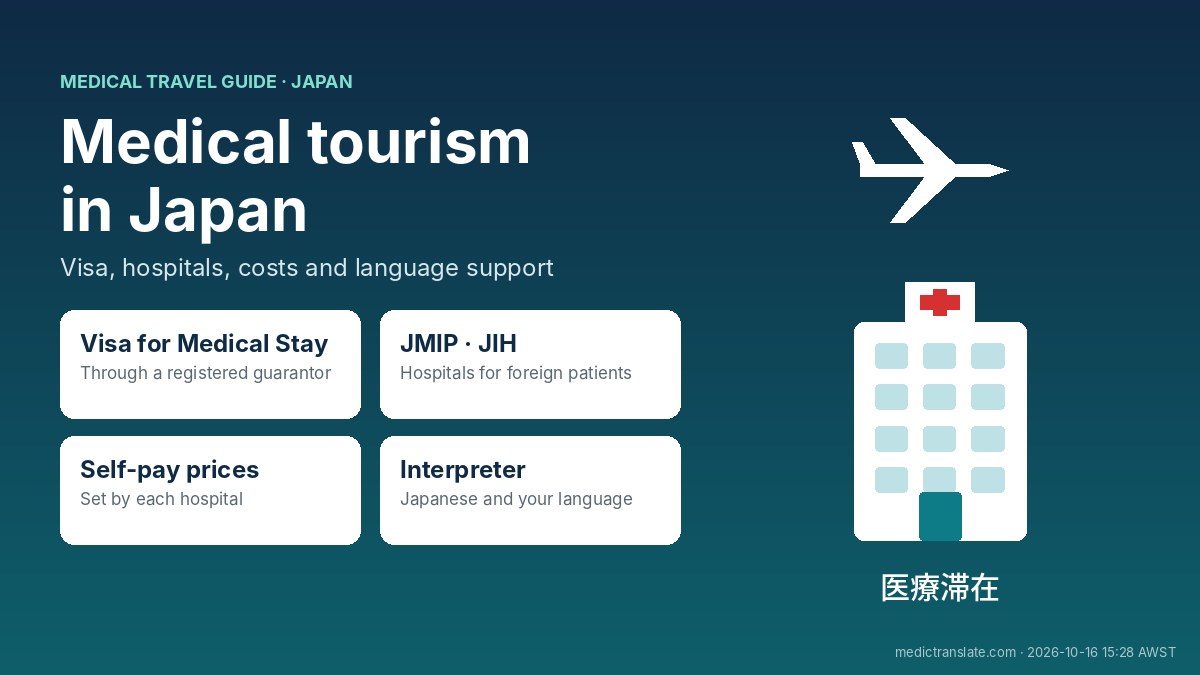
Medical tourism in Japan means travelling to Japan specifically to receive medical care. The Ministry of Foreign Affairs (MOFA) describes the range broadly: comprehensive health check-ups (人間ドック, ningen dokku), medical examinations, treatment of illness, dental care and recuperation, including hot spring recuperation. In every case, the care is arranged in advance with a Japanese medical institution.
This is different from getting sick while on holiday. If you fall ill unexpectedly during a short trip, you are treated as a regular visitor and pay the hospital directly. Our guide to medical costs if you are uninsured in Japan covers that situation. This guide is about planned treatment.
Already live in Japan with a residence card? You are usually enrolled in Japanese public health insurance and do not need a medical visa. See Japan's healthcare system for foreign residents and visitors.
The Visa for Medical Stay (医療滞在ビザ)
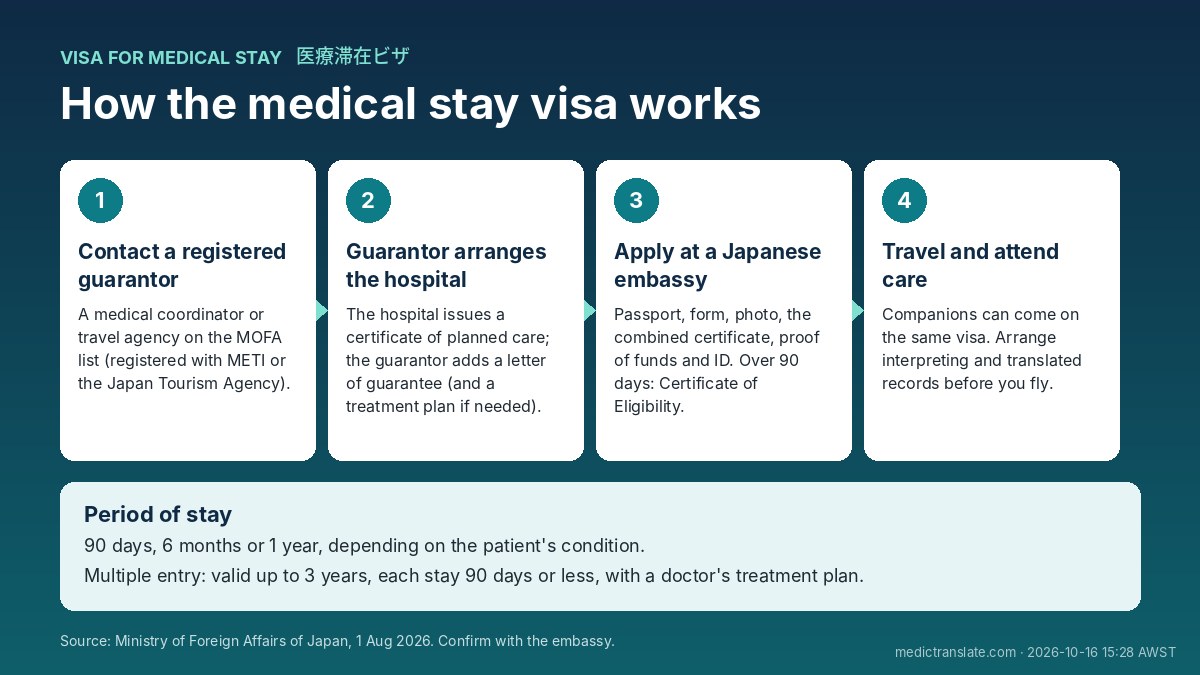
The Visa for Medical Stay is for foreign patients living overseas who come to Japan for treatment, and for the people who accompany them. You cannot apply for it on your own. MOFA requires every applicant to go through a registered guarantor (身元保証機関): a medical coordinator registered with the Ministry of Economy, Trade and Industry (METI), or a travel agency registered with the Japan Tourism Agency. Both lists are published on the MOFA website.
- Contact a registered guarantorChoose an organisation from the MOFA lists of medical coordinators or travel agencies, and ask it to arrange your treatment.
- The guarantor arranges the hospitalThe guarantor finds a hospital that will accept you. If you contact a hospital directly, MOFA says the hospital should bring in a registered guarantor.
- Get the visa documentsThe hospital issues a certificate of planned care (受診等予定証明書) and the guarantor adds a letter of guarantee (身元保証書). For a multiple-entry visa, a doctor's treatment plan (治療予定表) is also needed.
- Apply at a Japanese embassy or consulateSubmit your passport, application form, photo, the certificate and guarantee, proof that you can pay and proof of identity. Stays over 90 days also need a Certificate of Eligibility.
| Item | What MOFA says |
|---|---|
| Period of stay | 90 days or less, 6 months or 1 year, depending on the patient's condition. |
| Stays over 90 days | Require hospitalisation and a Certificate of Eligibility from the Immigration Services Agency. Hospital staff or a relative living in Japan can apply on the patient's behalf. |
| Multiple entry | Possible if needed, valid for up to 3 years, but only when each stay is 90 days or less. A doctor's treatment plan is required. |
| Companions | Relatives or other companions can come on the same visa if needed. They cannot run a business or earn income in Japan. |
Visiting visa-free? Being able to enter Japan without a visa for sightseeing does not automatically mean you can come for planned treatment. Ask the Japanese embassy or consulate in your country which visa applies before you book. MedicTranslate is not a registered guarantor and cannot advise on visa eligibility.
Finding a hospital for foreign patients
Your guarantor normally arranges the hospital, but it helps to know the two official recognition schemes so you can ask the right questions.
JMIP
Japan Medical Service Accreditation for International Patients, run by the Japan Medical Education Foundation as a third-party evaluator. It assesses how a hospital receives foreign patients, such as multilingual guidance. Search the JMIP accredited hospital list.
Japan International Hospitals (JIH)
A recommendation by Medical Excellence JAPAN for hospitals that accept, and are working to accept, patients travelling to Japan for treatment. The hospitals are listed on its JAPAN Hospital Search site.
Neither scheme is a ranking of medical quality. They show that a hospital has systems for receiving international patients. Ask the hospital or your guarantor which departments and procedures are available to you, what language support is provided on the day, and who explains results and consent forms.
Costs and insurance for medical tourism in Japan
Japan's public health insurance only covers people enrolled in it, so medical tourists pay the full cost themselves. MHLW's guidance for hospitals states that for visitors without Japanese public insurance, each medical institution sets its own self-pay price. The same check-up or procedure can therefore cost different amounts at different hospitals.
- Ask for a written estimateRequest an itemised estimate (見積書) for the treatment, tests, room charges and any follow-up visits.
- Check the payment termsAsk whether a deposit is required, which payment methods are accepted and how extra costs are handled if your treatment changes.
- Check your insuranceJNTO strongly recommends travel insurance for all visitors, but check whether your policy covers planned treatment in Japan, not just sudden illness.
- Budget for the guarantor and interpreterGuarantor fees, interpreting and translation are usually charged separately from the hospital bill.
For background, see is healthcare free in Japan? and why travel insurance is not always enough.
Bringing your medicines
If you take regular medicines, you can bring a limited supply for personal use. MHLW sets these amounts for bringing medicines without an Import Confirmation (薬監証明, yakkan shoumei):
| Type | Without Import Confirmation |
|---|---|
| Prescription medicines | Up to 1 month's supply |
| Other medicines (including non-prescription) | Up to 2 months' supply |
| Topical medicines | Up to 24 items per product |
| Prefilled or self-injection syringes | Up to 1 month's supply |
Narcotics need advance permission, and some medicines, including stimulants such as amphetamine, cannot be brought into Japan at all. A long medical stay may need more than one month of medicine, so check early. See how to bring medication to Japan and the Import Confirmation (yakkan shoumei) guide.
Language support: translation and interpreting
Treatment in Japan usually happens in Japanese. Some hospitals have international desks or staff interpreters, but support varies by hospital, department and day. Three points matter most:
Before you travel
Your referral letter, test results, imaging reports and medicine list translated into Japanese, so the doctor can review them in advance.
During treatment
A professional medical interpreter for consultations, consent discussions and results, where misunderstandings carry the most risk.
After you return
Results, the discharge summary (退院時要約) and prescriptions translated for your own doctor at home.
MedicTranslate provides medical translation and interpreting. Interpreters work in person across Kansai and beyond and by video or phone anywhere in Japan. Read more about medical records translation for Japan, what a medical interpreter costs and hospital admission support for foreign patients.
Before you fly: checklist
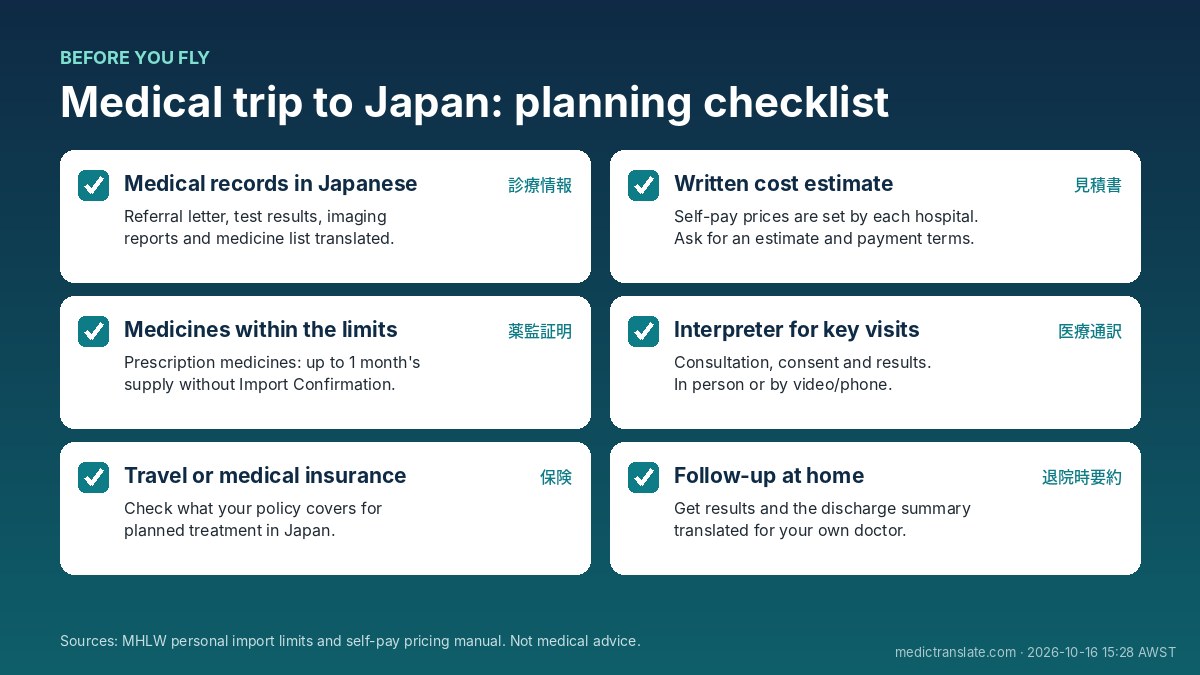
- Visa confirmedVisa for Medical Stay issued through a registered guarantor, or written confirmation from the embassy of which visa applies.
- Hospital and dates confirmed in writingDepartment, appointment dates, estimate and payment terms.
- Records translatedSummary, results, imaging reports and medicine list in Japanese.
- Medicines checkedWithin the personal-use limits, or Import Confirmation arranged.
- Interpreter bookedFor the consultations, consent and results that matter most.
- Emergency contacts saved119 for an ambulance, and the JNTO Japan Visitor Hotline, 050-3816-2787, open 24 hours in English, Chinese and Korean.
Get your records and your words across in Japan
MedicTranslate translates medical records for Japanese hospitals and provides medical interpreters for your consultations, so you understand your care and your doctor understands you.
- Records translated into Japanese before you travel
- Results and discharge summaries translated back
- Interpreters in person across Kansai and beyond, by video or phone Japan-wide
- Medical translation from US$120 per page
Price confirmed before work begins. Reply within 1–3 business days. Interpreting prices: see our pricing page. We are not a visa guarantor and do not give medical advice.
Frequently asked questions
Can foreigners travel to Japan for medical treatment?
Yes. Japan has a Visa for Medical Stay for foreign patients who come for treatment, health check-ups, dental care or recuperation. You apply through a registered guarantor, such as a medical coordinator or travel agency, which arranges the hospital and supplies the documents for your visa application.
Do I need a guarantor for the Japan medical stay visa?
Yes. The Ministry of Foreign Affairs requires a guarantor from its registered list. Medical coordinators register with the Ministry of Economy, Trade and Industry, and travel agencies with the Japan Tourism Agency. If you contact a hospital directly, the hospital should bring in a registered guarantor.
How long can I stay in Japan on a medical stay visa?
The period of stay is 90 days, 6 months or 1 year, depending on your condition. Stays over 90 days require hospitalisation and a Certificate of Eligibility. A multiple-entry visa valid for up to 3 years is possible when each stay is 90 days or less.
Does Japanese health insurance cover medical tourists?
No. Visitors who are not enrolled in Japan's public health insurance pay the full cost themselves. According to MHLW, each hospital sets its own self-pay prices for these patients, so ask for a written estimate before you travel.
Can a family member come with me for treatment in Japan?
Yes, if needed. Relatives or other companions can come on the same Visa for Medical Stay, but they cannot do paid work in Japan.
Can I bring my own medicines to Japan for treatment?
Usually, within limits. Without an Import Confirmation (yakkan shoumei) you can bring up to one month's supply of prescription medicines and up to two months of other medicines. Narcotics need advance permission, and some medicines cannot be brought in at all.
Can MedicTranslate arrange my medical stay visa?
No. MedicTranslate is not a registered guarantor and does not arrange visas or choose hospitals. We translate medical records between Japanese and other languages and provide medical interpreters in person across Kansai and beyond and by video or phone anywhere in Japan.
This article provides general information reviewed on 16 October 2026. It is not medical, legal, immigration or insurance advice. Visa requirements, guarantor lists, hospital services, prices and import rules can change, so confirm them with the Japanese embassy or consulate, your registered guarantor, the hospital and your insurer. MedicTranslate is not a healthcare provider, a registered guarantor or a visa agent, and does not recommend or endorse any hospital. We provide medical translation and interpreting. In an emergency in Japan, call 119.
- Ministry of Foreign Affairs of Japan: Visa for Medical Stay, information for patients (Japanese, 1 August 2026)
- Ministry of Foreign Affairs of Japan: Visa for Medical Stay, steps for guarantors and medical institutions (Japanese)
- Ministry of Foreign Affairs of Japan: Visa for Medical Stay (English)
- MOFA: Registered guarantors, medical coordinators
- MOFA: Registered guarantors, travel agencies
- MOFA: Notice on guarantor registration with METI and the Japan Tourism Agency (Japanese, 1 August 2026)
- Ministry of Economy, Trade and Industry: Registration of medical stay guarantors (Japanese)
- Medical Excellence JAPAN: Japan International Hospitals (JIH)
- Japan Medical Education Foundation: JMIP accreditation for hospitals receiving international patients
- MHLW: Manual on setting medical fees for foreign visitors (Japanese)
- MHLW: Bringing medicines into Japan for personal use
- JNTO: Travel insurance in Japan
- JNTO: Japan Visitor Hotline