
Medical Japanese Phrases for the Clinic, Pharmacy and Emergencies
These medical Japanese phrases cover the moments that matter most at a Japanese clinic: checking in, describing symptoms and pain, mentioning allergies and medicines, asking the pharmacist, and getting help in an emergency. Each phrase has the Japanese, the romaji and the meaning. We also explain when a phrase list stops being enough.
Quick answer
The most useful medical Japanese phrases are 「〜が痛いです」 (… ga itai desu, my … hurts), 「熱があります」 (netsu ga arimasu, I have a fever) and 「救急車を呼んでください」 (kyūkyūsha o yonde kudasai, please call an ambulance). In an emergency, call 119; many fire departments can connect an interpreter. For consent to treatment, a serious diagnosis, mental health, children or pregnancy, use a medical interpreter rather than a phrase list.
Emergency? Call 119 and say 「救急です」 (kyūkyū desu, it's a medical emergency), then ask for English. Visitors can also call the JNTO Japan Visitor Hotline on 050-3816-2787 (24 hours, English, Chinese, Korean). More emergency phrases.
Need more than a phrase list? A medical interpreter can join your appointment to reduce the risk of misunderstanding.
Book an interpreterOn this page
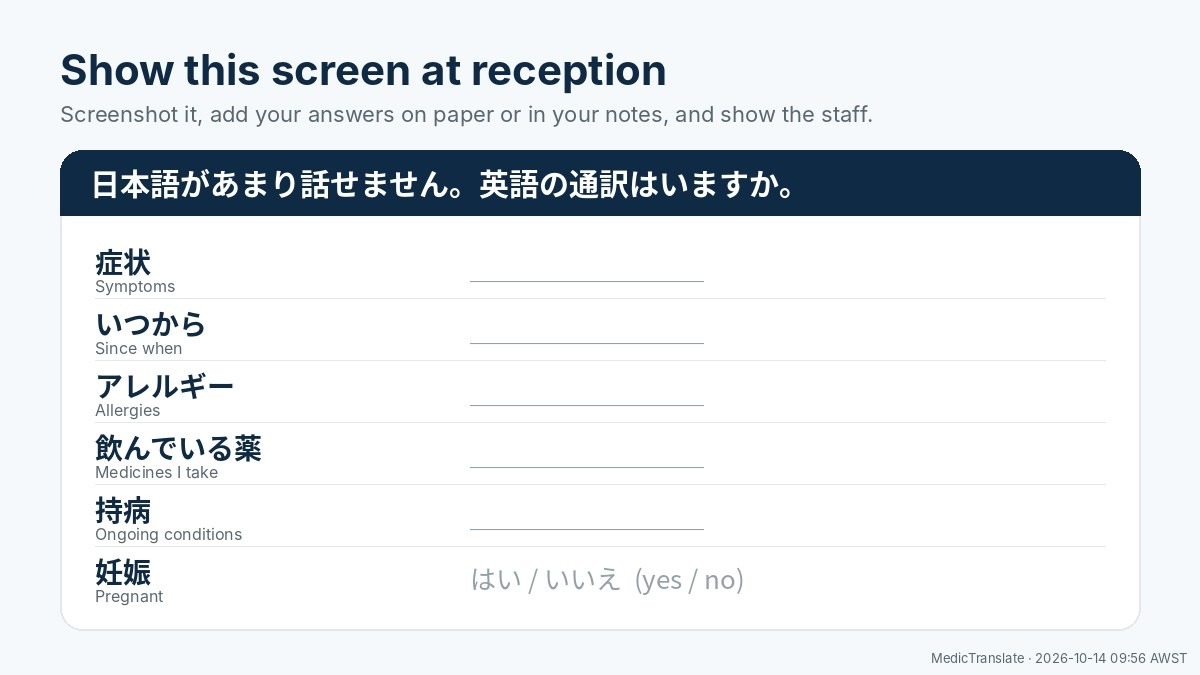
Medical Japanese phrases for reception
Reception (受付, uketsuke) is where you hand over your insurance details and fill in a questionnaire (問診票, monshinhyō). Some clinics have it in English, and free multilingual versions exist (see the tip below).
| Japanese | Meaning |
|---|---|
| 初めてです。Hajimete desu. | This is my first visit here. |
| 予約していません。Yoyaku shite imasen. | I don't have an appointment. |
| 英語を話せる人はいますか?Eigo o hanaseru hito wa imasu ka? | Is there anyone who speaks English? |
| 日本の健康保険に入っていません。Nihon no kenkō hoken ni haitte imasen. | I don't have Japanese health insurance. |
| 海外旅行保険に入っています。Kaigai ryokō hoken ni haitte imasu. | I have travel insurance. |
| クレジットカードは使えますか?Kurejitto kādo wa tsukaemasu ka? | Can I pay by credit card? |
| だいたいいくらかかりますか?Daitai ikura kakarimasu ka? | Roughly how much will it cost? |
The Kanagawa International Foundation publishes a free multilingual medical questionnaire in 23 languages for 11 medical departments. Each version is side by side with Japanese. JNTO says credit cards are generally accepted only at major hospitals, and clinics usually take cash, so carry some yen.
Describing symptoms in Japanese
Keep it short: what the symptom is, where it is, and since when. Doctors in Japan usually ask 「いつからですか?」 (itsu kara desu ka?, since when?).
| Japanese | Meaning |
|---|---|
| 熱があります。Netsu ga arimasu. | I have a fever. |
| 咳が出ます。Seki ga demasu. | I have a cough. |
| 喉が痛いです。Nodo ga itai desu. | I have a sore throat. |
| 吐き気がします。Hakike ga shimasu. | I feel nauseous. |
| 吐きました。Hakimashita. | I vomited. |
| 下痢をしています。Geri o shite imasu. | I have diarrhoea. |
| めまいがします。Memai ga shimasu. | I feel dizzy. |
| 発疹が出ています。Hasshin ga dete imasu. | I have a rash. |
| けがをしました。Kega o shimashita. | I've been injured. |
| 昨日からです。Kinō kara desu. | Since yesterday. |
| 三日前からです。Mikka mae kara desu. | Since three days ago. |
| だんだん悪くなっています。Dandan waruku natte imasu. | It's getting worse. |
Describe your symptoms, and mention any condition a doctor has already diagnosed. For medicines you already take, show the packet. The doctor decides the diagnosis and what to prescribe.
How to describe pain in Japanese
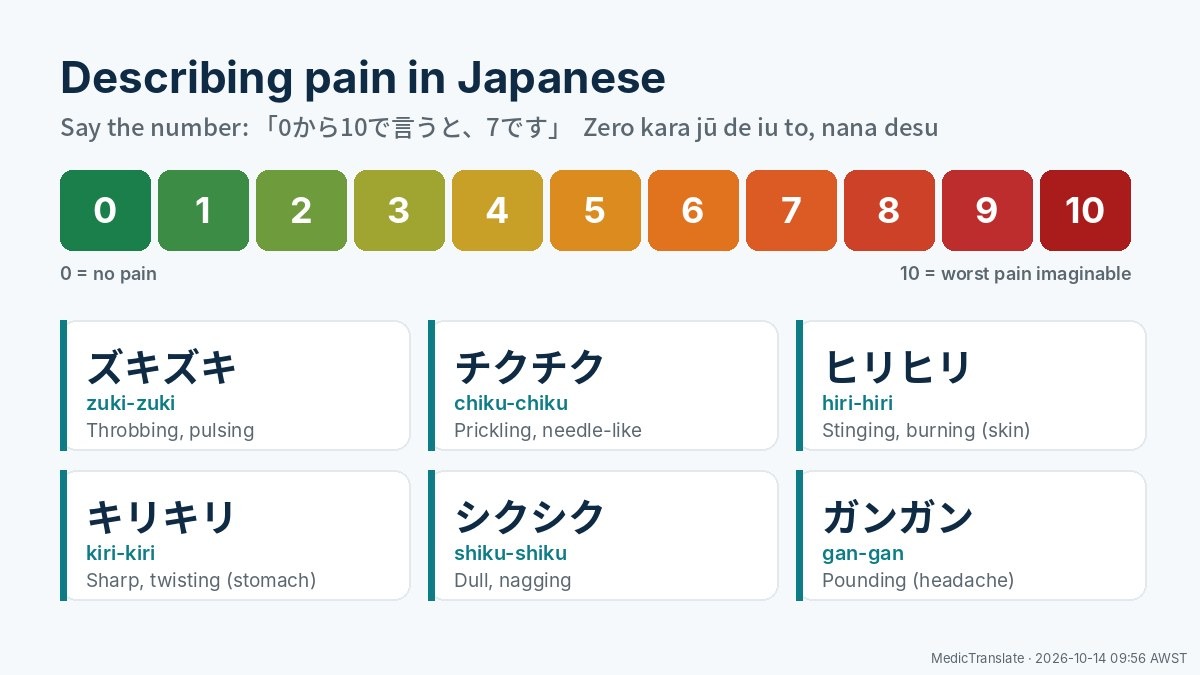
Japanese uses sound words (onomatopoeia) to describe the type of pain, and doctors understand them well. Combine the type with a number from 0 to 10.
| Japanese | Meaning |
|---|---|
| ここが痛いです。Koko ga itai desu. | It hurts here. (Point to the place.) |
| ズキズキ痛みます。Zukizuki itamimasu. | A throbbing pain. |
| キリキリ痛みます。Kirikiri itamimasu. | A sharp, twisting pain (often stomach). |
| チクチク痛みます。Chikuchiku itamimasu. | A prickling, needle-like pain. |
| ヒリヒリします。Hirihiri shimasu. | A stinging, burning feeling (often skin). |
| シクシク痛みます。Shikushiku itamimasu. | A dull, nagging pain. |
| ガンガンします。Gangan shimasu. | A pounding pain (often a headache). |
| 0から10で言うと、7です。Zero kara jū de iu to, nana desu. | On a scale of 0 to 10, it's a 7. |
| ずっと痛いです。Zutto itai desu. | It hurts all the time. |
| 時々痛いです。Tokidoki itai desu. | It hurts on and off. |
Body parts in Japanese
Put the body part in front of 「が痛いです」 (ga itai desu): for example 「頭が痛いです」 (atama ga itai desu, I have a headache).
| Japanese | Meaning | Japanese | Meaning |
|---|---|---|---|
| 頭atama | Head | 背中senaka | Back |
| 喉nodo | Throat | 腰koshi | Lower back |
| 胸mune | Chest | 腕ude | Arm |
| お腹onaka | Stomach, abdomen | 足ashi | Leg, foot |
| 目me | Eye | 歯ha | Tooth |
| 耳mimi | Ear | 皮膚hifu | Skin |
Allergies, medicines and conditions
This is the most important information to get right, so don't rely on spoken phrases for it. Before your visit, write your allergies, current medicines, ongoing conditions and any pregnancy in one place and get it into Japanese:
- Use the free multilingual medical questionnaire from the Kanagawa International Foundation, which puts the questions in your language side by side with Japanese.
- Or bring a translated medical summary and medicine list. MedicTranslate translates medical documents with the translator named.
- For anything serious, such as a severe allergy, pregnancy or a complex condition, use a medical interpreter.
Medicine names often differ between countries. Show the actual packet or a list with the active ingredient, not just the brand name. Japan's okusuri techō (medicine notebook) keeps this record once you start getting prescriptions here.
Making sure you understand the doctor
| Japanese | Meaning |
|---|---|
| すみません、分かりません。Sumimasen, wakarimasen. | Sorry, I don't understand. |
| もう一度、ゆっくりお願いします。Mō ichido, yukkuri onegai shimasu. | Once more, slowly, please. |
| 紙に書いてもらえますか?Kami ni kaite moraemasu ka? | Could you write it down? |
| 通訳をお願いできますか?Tsūyaku o onegai dekimasu ka? | Could I have an interpreter? |
| 診断書をお願いします。Shindansho o onegai shimasu. | Could I have a medical certificate? |
If you need a certificate for work, school or insurance, see our guide to the shindansho (medical certificate).
Medical Japanese phrases at the pharmacy
Prescriptions are usually filled at a separate pharmacy (薬局, yakkyoku), and you pay for the medicine there. The pharmacist explains how to take it. These phrases help you check you've understood.
| Japanese | Meaning |
|---|---|
| 処方箋です。Shohōsen desu. | Here is my prescription. |
| 1日に何回飲みますか?Ichinichi ni nankai nomimasu ka? | How many times a day do I take it? |
| 食前ですか、食後ですか?Shokuzen desu ka, shokugo desu ka? | Before or after meals? |
| 英語の説明書はありますか?Eigo no setsumeisho wa arimasu ka? | Is there an English information sheet? |
Emergencies: calling 119 in Japan
Call 119 for an ambulance or fire. The operator first asks whether it is a fire or an emergency: answer 「救急です」 (kyūkyū desu, it's a medical emergency). Then give the address and what happened. Japan's Fire and Disaster Management Agency promotes three-way telephone interpreting on 119 calls, and many fire departments offer it. Inagi City in Tokyo, for example, covers English, Chinese, Korean, Portuguese and Spanish 24 hours a day, and Otaru City in Hokkaido lists 32 languages. Ask for English and stay on the line while you are connected. Availability varies by area.
| Japanese | Meaning |
|---|---|
| 救急車を呼んでください。Kyūkyūsha o yonde kudasai. | Please call an ambulance. |
| 救急です。Kyūkyū desu. | It's a medical emergency (said to the 119 operator). |
| 助けてください!Tasukete kudasai! | Please help! |
| 住所は〜です。Jūsho wa … desu. | The address is … (Visitors: read it from your hotel card or booking, or name a nearby landmark.) |
日本語があまり話せません。英語の通訳をお願いできますか。
Nihongo ga amari hanasemasen. Eigo no tsūyaku o onegai dekimasu ka.
I don't speak much Japanese. Could I have an English interpreter?
Visitors can also call the JNTO Japan Visitor Hotline, 050-3816-2787. It runs 24 hours a day, every day, in English, Chinese and Korean, and helps with illness, injury and disasters. JNTO notes that, as a rule, the hotline does not interpret three-way between you and a hospital. For the full emergency process, see calling 119 in Japan.
When a phrase list is not enough
Phrases help with simple exchanges such as checking in, describing a symptom or asking the pharmacist. They are not a safe substitute for an interpreter when a misunderstanding could change your treatment:
- ConsentBefore surgery, procedures, anaesthesia or any form you are asked to sign.
- A new or serious diagnosisWhen the doctor explains test results, a diagnosis or a treatment plan.
- Mental healthWhere nuance and how you describe feelings matter.
- Children, pregnancy and birthWhen you are speaking for someone else, or two patients are involved.
- EmergenciesCall 119 and use its interpreter. Arrange a medical interpreter for the hospital stay that follows.
Free and low-cost options exist in many areas. Our guide to free medical interpreters in Japan lists them, and medical interpreter cost in Japan explains what paid interpreting costs.
Understand your doctor, and be understood
MedicTranslate provides medical interpreters for appointments in Japan, and translates medical summaries, medication lists and records into Japanese so your doctor has the full picture.
- Interpreters for clinic and hospital appointments
- Medication lists and allergies translated into Japanese
- Medical summaries and records translated
- Help finding foreign-friendly clinics
Price confirmed before work begins. Reply within 1–3 business days. We do not give medical advice.
Frequently asked questions
How do I say "I need a doctor" in Japanese?
Say 「医者に診てもらいたいです」 (isha ni mite moraitai desu), which means I would like to see a doctor. In an emergency, say 「救急車を呼んでください」 (kyūkyūsha o yonde kudasai), please call an ambulance, or call 119 yourself.
How do I describe pain to a Japanese doctor?
Point and say 「ここが痛いです」 (koko ga itai desu), it hurts here. Add the type of pain, such as zukizuki for throbbing or kirikiri for sharp and twisting, and a number from 0 to 10.
Do Japanese hospitals have English-speaking staff?
Some do, especially larger hospitals in big cities, but many clinics do not. JNTO's medical institution search lets you filter by language, and you can ask 「英語を話せる人はいますか?」 (eigo o hanaseru hito wa imasu ka?) at reception.
Can I get an interpreter when I call 119?
Many fire departments in Japan can connect a three-way telephone interpreter on 119 calls. Say it is a medical emergency, then ask for English and stay on the line. Availability, languages and hours vary by area.
Is a phrase list enough for a hospital visit in Japan?
Phrases help with simple exchanges. For consent to treatment, a serious diagnosis, mental health, children or pregnancy, use a medical interpreter to reduce the risk of misunderstanding.
How do I tell a Japanese doctor about my allergies and medicines?
Write them down before your visit and get them into Japanese, for example with the free multilingual medical questionnaire from the Kanagawa International Foundation or a translated medical summary. Show the actual medicine packets. For a severe allergy or anything serious, use a medical interpreter.
This article provides general language help. Sources reviewed on 14 October 2026. Phrases are simplified, cover everyday situations only and may not fit every case. For allergies, medicines, pregnancy, consent or emergencies, use written information in Japanese or a medical interpreter. They do not replace a qualified medical interpreter, and this page is not medical advice. In an emergency, call 119. Interpreting services, languages and hours vary by area and can change.
- JNTO: Guide for when you are feeling ill (medical institution search, payment, interpreting)
- Tokyo Metropolitan Government: Japan Visitor Hotline (JNTO)
- Inagi City: Multilingual interpretation for emergency calls (119)
- Fire and Disaster Management Agency: Support for foreign residents and visitors, including 119 three-way interpreting (Japanese)
- Otaru City Fire Department: How to call 119 (English)
- Kanagawa International Foundation: Multilingual medical questionnaire (Japanese)