
Seniors Visiting Japan: Health and Medication Guide
For seniors visiting Japan, the country is one of the easiest places to travel, but it has strict rules on medicines, no public health cover for tourists, and hot, humid summers. This guide shows older travellers (and the families helping them plan) what to prepare, which official rules apply, and where MedicTranslate can help.
Quick answer
Before you fly, check every medicine against Japan's personal import rules: you can usually bring up to a 1-month supply of prescription medicine without paperwork, but larger amounts need an Import Confirmation, and narcotic pain medicines such as oxycodone need permission applied for at least 14 days ahead. Buy travel insurance that covers existing conditions, because visitors pay the full cost of care. Save the 24-hour Japan Visitor Hotline (050-3816-2787), and arrange interpreting early if you expect to see a doctor. New Year 2026–27: earlier deadlines apply. Entry 21 Dec to 4 Jan: documents by 7 Dec. Entry 5 to 11 Jan: by 14 Dec. Entry 12 to 18 Jan: by 21 Dec.
Travelling with several regular medicines? We check your list against Japan's published personal import rules before you fly.
Check medication requirementsOn this page
- Medicine rules that catch travellers out
- CPAP machines, insulin and other devices
- Documents worth translating before you go
- Insurance and medical costs for visitors
- Getting care while you are in Japan
- If you run out of medicine in Japan
- Seeing a doctor in Japan: how it works
- Emergencies and key numbers
- Heat, walking, stairs and mobility
- Pre-trip checklist
- How MedicTranslate helps: use cases
- FAQ
- Official sources
Seniors visiting Japan: the medicine rules that catch travellers out
Many of the medicine lists we review for Japan trips are typical of older travellers: cholesterol tablets, diabetes medicines, blood pressure tablets, thyroid hormone, blood thinners and pain relief. Most of these are permitted. The problem is usually quantity or one controlled ingredient hidden in a longer list.
The Ministry of Health, Labour and Welfare (MHLW) sets these personal-use limits for bringing medicines into Japan without applying for anything:
| Item | Limit without an Import Confirmation |
|---|---|
| Prescription medicines | Up to a 1-month supply |
| Over-the-counter medicines | Up to a 2-month supply |
| Injectable medicines with their syringes (pre-filled syringes or self-injection kits only) | Up to a 1-month supply |
| Medical device for household use | 1 set |
If you will stay longer than a month and carry your full supply, you need an Import Confirmation (輸入確認証), applied for online through MHLW and received before you leave home. Our guide to bringing medication to Japan walks through the process.
Common long-term medicines
Most cholesterol, blood pressure, diabetes and thyroid medicines, within a 1-month supply.
Sleep and anxiety medicines
Psychotropics such as lorazepam are allowed within set limits; above them you need a doctor's certificate.
Injection forms always need extra steps.
Strong pain medicines
Narcotics such as oxycodone, morphine and fentanyl need permission before you travel. Codeine does too, unless the product contains 1% or less.
Apply at least 14 days before departure.
The MHLW Narcotics Control Department says narcotics and stimulant raw materials need permission before you enter Japan, and asks for applications at least 14 days before travel. Amphetamine-based medicines such as Adderall cannot be brought in at all. See our guide to Import Confirmation and narcotic permission applications.
Keep medicines in their original labelled packs, carry them in your hand luggage, and bring a copy of your prescription or a doctor's letter listing each medicine by its generic (ingredient) name. Brand names often differ in Japan.
CPAP machines, insulin and other devices
MHLW allows 1 set of a household medical device without an Import Confirmation, and up to a 1-month supply of injectable medicine with its pre-filled syringes or self-injection kits. Syringes brought without their medicine need an Import Confirmation, even for one.
The official pages do not name CPAP machines, insulin pumps or nebulisers individually, so check your device before you travel. Ask your airline separately about carrying it on board and about batteries. Our guide to bringing medical devices to Japan covers each device type.
Documents worth translating before you go
Most doctors and pharmacists in Japan work in Japanese. A clear Japanese translation lets them understand your history in minutes, especially if you cannot explain it yourself after a fall or sudden illness.
Medicine list and prescriptions
Active ingredient, strength, dose and timing for each medicine. See what a prescription translation must show.
Medical summary and allergies
Diagnoses, past operations, allergies and your usual doctor's contact details, on one or two pages.
Device and specialist letters
Pacemaker or implant cards, CPAP prescriptions, dialysis or oxygen details, recent test results. See medical records translation.
MedicTranslate's translators check drug names, doses and units as part of the job, and every translation is checked by a person, not just a machine. A translation helps doctors and customs officers read your documents, but it does not replace any permission the rules require.
Want your medicine list and summary in Japanese? Send them over for a quote before you travel.
Request a translation quoteInsurance and medical costs for seniors visiting Japan
Tourists are not part of Japan's public health insurance. If you need treatment, the clinic or hospital charges you the full cost, and each facility sets its own fees for patients without Japanese insurance. Many ask for payment before you leave.
The Japan Tourism Agency recommends that visitors buy private medical insurance with sufficient cover, and warns that unpaid medical bills may lead to refusal of entry on a future visit.
For older travellers, read the policy's wording on pre-existing conditions, age limits, hospital admission and medical evacuation. Ask the insurer how claims work in Japan and which documents they need. If they want English translations of Japanese receipts or certificates, see Japanese medical receipt translation.
More detail: why travel insurance alone is not enough in Japan and is healthcare free in Japan?
Getting care while you are in Japan
- Emergency: call 119 for an ambulance or fire.
- Help in English, 24 hours: the Japan Visitor Hotline, run by JNTO, on 050-3816-2787. It covers accidents, illness and disasters, in English, Chinese, Korean and Japanese.
- Find a hospital or clinic: the Japan Tourism Agency's medical institution search lets you filter by prefecture, language, department, card payment and 24-hour emergency care.
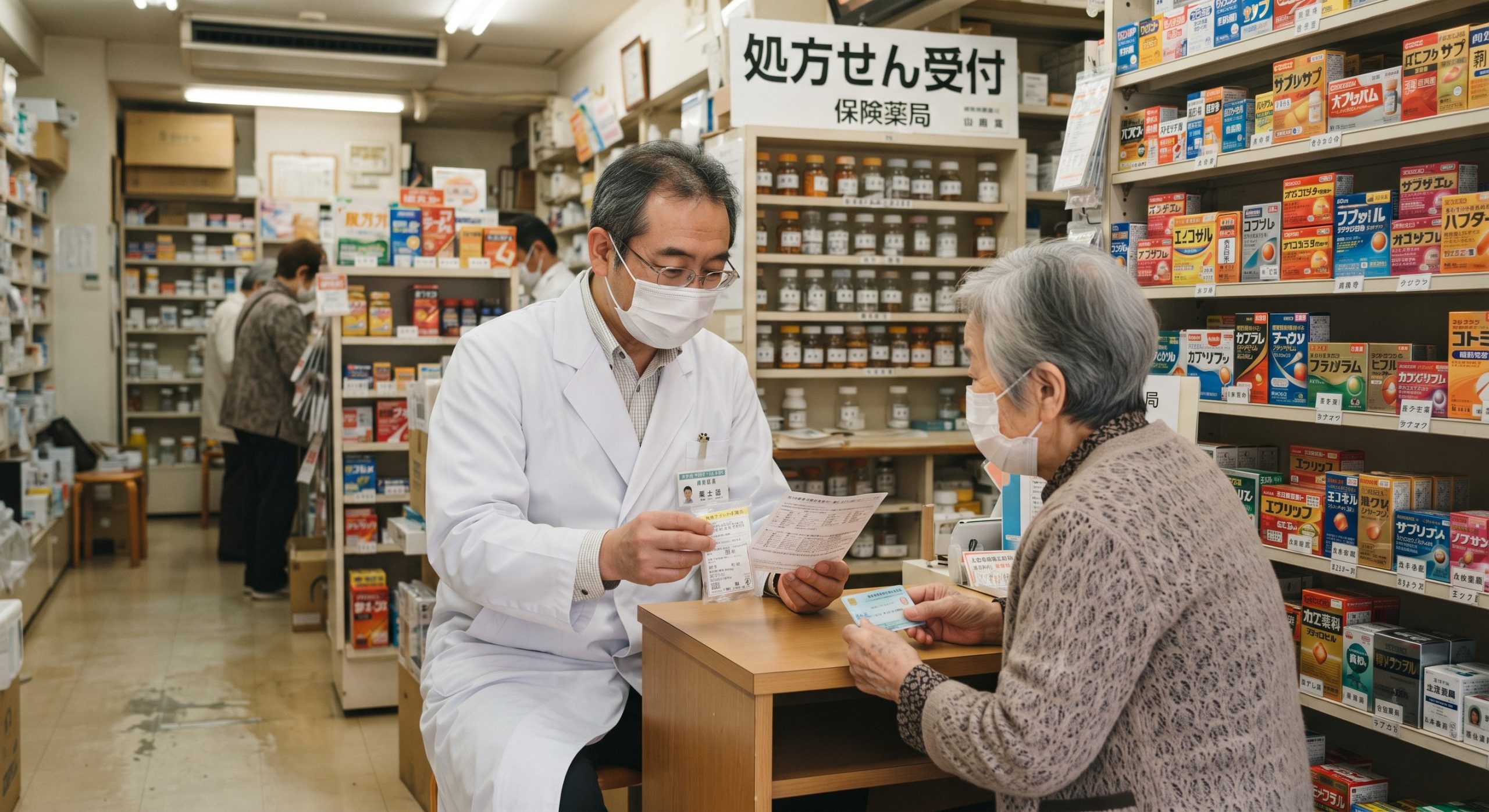
- Pharmacies: a Japanese prescription is filled at a dispensing pharmacy. Your overseas prescription cannot be filled in Japan, so bring enough medicine. If you run low, see what to do. See continuing an overseas prescription in Japan.
- Lost medicine: see what to do if you lose your medication in Japan.
Japanese doctors work in Japanese. Bring a translated summary of your conditions, medicines and allergies, and arrange interpreting for planned appointments. MedicTranslate provides medical interpreters in person across Kansai and beyond and by phone or video anywhere in Japan. Interpreting is best booked ahead: we may not be able to arrange same-day attendance at short notice.
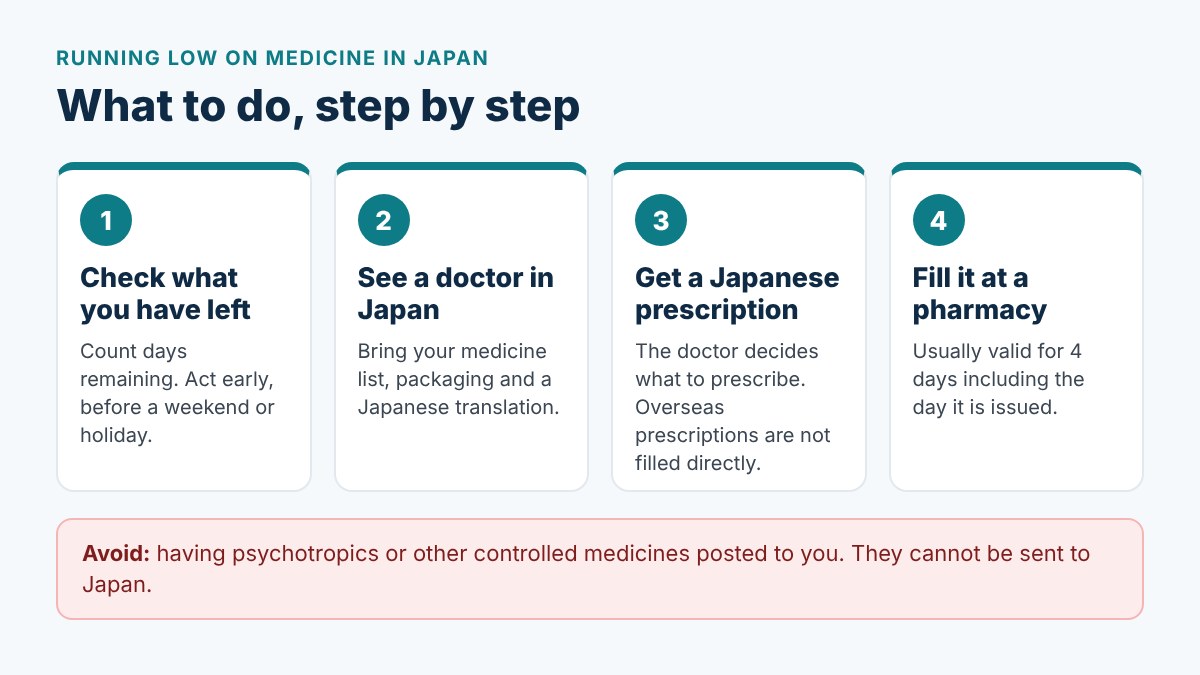
If you run out of medicine in Japan
Lost luggage, a longer stay or a miscount happens. Here is what to do.
- Act earlyCount how many days you have left. Many clinics close on Sundays and public holidays, so do not wait until the last tablet.
- See a doctor in JapanA Japanese pharmacy dispenses only against a prescription from a doctor under the Japanese system, so an overseas prescription is not filled directly. Bring your medicine list, packaging and translated prescription so the doctor can see exactly what you take.
- Let the doctor decideYour exact brand or strength may not be sold in Japan. The doctor chooses what to prescribe; do not change or stop a medicine on your own.
- Fill the prescription promptlyMHLW states that a Japanese prescription is normally valid for four days, including the day it is issued.
Do not ask family to post controlled medicines. Psychotropics, narcotics and similar medicines cannot be sent to Japan. Other medicines sent for your own use must stay within the limits, and customs may hold a parcel and ask for paperwork.
For longer stays, see continuing an overseas prescription in Japan. Once you have a Japanese prescription, keep a medicine notebook; our okusuri techo guide explains how.
Seeing a doctor in Japan: how it works
1. Find the right place
For everyday problems, a local clinic クリニック・医院 is usually the first stop. Large hospitals usually expect a referral letter 紹介状; without one, a first visit can carry an extra charge of at least ¥7,000 on top of treatment costs, except in emergencies. JNTO's medical institution search recommends calling the clinic before you go. You can also browse our clinic list.
2. At reception
Bring your passport, insurance details, medicine list and translated summary. The first-visit form 問診票 is usually in Japanese. Read what to bring to a clinic or hospital and how to book an appointment.
3. During the consultation
If hearing or language makes it hard to follow, an interpreter helps both sides understand each other. Our medical interpreters relay what is said; they do not give medical advice.
4. Paying
JNTO notes that large hospitals may take cards, but clinics often accept only cash. Ask for an estimate at reception, keep every receipt, and ask for a medical certificate if your insurer needs one. See medical costs in Japan without Japanese insurance.
Need help arranging an appointment? We can help you find a suitable clinic and coordinate the visit.
Arrange healthcare support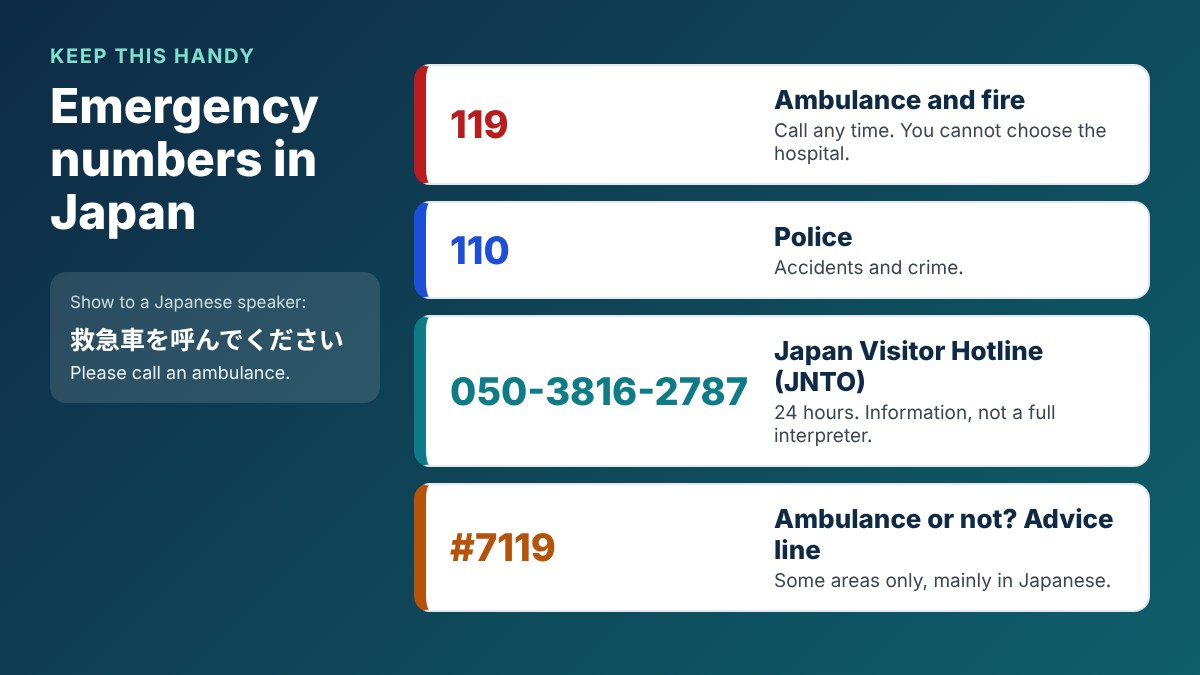
Emergencies and key numbers
| Number | What it is for | Good to know |
|---|---|---|
| 119 | Ambulance and fire | You cannot choose which hospital you are taken to. Show 救急車を呼んでください (please call an ambulance) to a Japanese speaker if needed. |
| 110 | Police | Accidents and crime. |
| 050-3816-2787 | Japan Visitor Hotline (JNTO) | 24 hours, every day. Helps with information; it does not interpret your whole appointment or make bookings. |
| #7119 | Advice on whether you need an ambulance | Available in 42 areas, not everywhere, and mainly in Japanese. |
- Chest pain, stroke signs, serious falls or breathing difficulty: call 119 straight away.
- Hospital admission: tell the hospital about your medicines and devices, contact your insurer early and keep all documents.
For step-by-step help with an ambulance call, read calling 119 in Japan.
Heat, walking and mobility for seniors visiting Japan
Japanese summers are hot and humid, and older travellers are more vulnerable to heatstroke. The Ministry of the Environment publishes a daily heat stress index (WBGT) in English, and the official Safety tips app, supervised by the Japan Tourism Agency, sends heatstroke, earthquake and weather alerts in 14 languages.
- Plan sightseeing for mornings and evenings in July to September; drink water regularly.
- Expect a lot of walking and stairs at stations, temples and shrines. Train station staff can help wheelchair users get on and off trains; tell them where you are going so they can meet you.
- JNTO's accessibility guide lists barrier-free routes and resources, especially for Tokyo.
- Send large luggage ahead with a luggage delivery service so you are not carrying cases up station stairs.
Pre-trip checklist for seniors visiting Japan
| When | What to do | Official source |
|---|---|---|
| 2–3 months before | List every medicine by generic name, strength and daily dose. Count how many days' supply you will carry. | MHLW |
| 6–8 weeks before | Check entry requirements for your passport. Many nationalities can visit without a visa for short stays. | MOFA |
| At least 14 days before (earlier is safer) | Apply for narcotic permission or an Import Confirmation if your list needs one. | MHLW / NCD |
| Before booking | Buy travel insurance that covers existing conditions and evacuation. | Japan Tourism Agency |
| 2–4 weeks before | Get a doctor's letter and translated medicine list; book interpreters for any planned appointments. | — |
| Before you fly | Install the Safety tips app and save 119 and 050-3816-2787 in your phone. | Japan Tourism Agency / JNTO |
How MedicTranslate helps seniors visiting Japan: use cases
These examples are based on the kinds of enquiries we receive. Details are changed and combined to protect privacy.
1. Six weeks in Japan with eight medicines
A retired couple from Australia take cholesterol, blood pressure, diabetes and thyroid medicines. Because they will carry more than a 1-month supply, our medication assessment flags which items need an Import Confirmation and what documents to prepare. They submit the application themselves.
2. Pain relief that needs permission
A traveller with arthritis takes oxycodone. The assessment flags it as a narcotic needing permission at least 14 days before travel, and we translate the doctor's letter so the application is complete.
3. A parent admitted to hospital
An adult child at home in Canada needs to understand what doctors in Osaka are saying about their father. We arrange a phone or video interpreter for the ward round and translate the discharge summary for the family doctor back home.
4. Check-ups on a multi-city trip
A traveller needs a routine follow-up while moving between Osaka, Kyoto and Tokyo. We contact clinics, request appointments and book an interpreter. The clinic confirms the booking.
5. Claiming the bill back
After a fall and an outpatient visit, the insurer asks for English versions of the receipt and medical certificate. We translate them, with the translator's name and our company contact details on the translation.
6. Travelling with a CPAP machine
A traveller with a sleep apnoea device and insulin pens checks both before flying. The assessment covers the medicines and points them to the right MHLW contact for the device question.
What we do not do: we are not a healthcare provider, customs authority or insurer. We do not give medical or legal advice, lodge applications for you, guarantee customs clearance or guarantee a clinic booking.
Plan a healthy trip to Japan
MedicTranslate helps older travellers and their families prepare medicines, documents and communication before and during a trip to Japan.
- Medicine list checked against MHLW rules
- Prescriptions and doctor's letters translated
- Medical interpreters in person or remote
- Clinic appointment requests and receipt translation
Reply within 1–3 business days. Price confirmed before work begins. See pricing.
Frequently asked questions
How much medicine can seniors bring into Japan?
MHLW allows up to a 1-month supply of prescription medicine and up to a 2-month supply of over-the-counter medicine without an Import Confirmation. For larger amounts, apply online and receive the Import Confirmation before you leave home.
Do I need permission to bring strong painkillers to Japan?
Yes, if they contain a narcotic such as oxycodone, morphine, fentanyl, or codeine above 1%. The MHLW Narcotics Control Department requires permission before you enter Japan and asks for applications at least 14 days before travel.
Does Japan's health insurance cover elderly tourists?
No. Tourists are not covered by Japan's public health insurance and pay the full cost of care. The Japan Tourism Agency recommends private medical insurance and warns that unpaid medical bills may lead to refusal of entry in future.
Who can I call for help in English in Japan?
Call 119 for an ambulance. For non-emergency help in English, call the Japan Visitor Hotline on 050-3816-2787, which operates 24 hours a day.
Can I bring a CPAP machine to Japan?
MHLW allows 1 set of a household medical device without an Import Confirmation, but it does not name CPAP machines specifically. Check your device with MHLW and ask your airline about carrying it on board.
Can MedicTranslate provide an interpreter for my parent's hospital visit?
Yes. We provide medical interpreters in person across Kansai and beyond and by phone or video anywhere in Japan. Book as early as possible, because short-notice attendance may not be available.
Can MedicTranslate tell me whether a medicine is safe for me?
No. We do not give medical advice. We check your medicines against Japan's published import rules and translate documents. Ask your own doctor or pharmacist about your treatment.
What should I do if I run out of medicine in Japan?
See a doctor in Japan early, before you run out. Bring your medicine list, the packaging and ideally a Japanese translation of your prescription. A Japanese pharmacy cannot fill an overseas prescription, so a Japanese doctor decides what to prescribe and writes a Japanese prescription.
Can my family post my medicine to me in Japan?
Some medicines can be sent for your own use within the quantity limits, but customs may hold the parcel and ask for paperwork. Psychotropics and other controlled medicines cannot be sent by post. It is usually simpler to see a doctor in Japan or plan enough supply before you travel.
Which documents should I have translated before the trip?
The most useful are a medicine list with active ingredients and doses, a short medical summary, allergies, and letters about devices such as a pacemaker or CPAP machine. A Japanese translation helps doctors and pharmacists read them quickly. Translation does not replace any import permission you need.
This article provides general information reviewed on 19 October 2026. It is not medical, legal or insurance advice. Japan's personal import rules are decided by MHLW and Japan Customs, and narcotic permissions by the MHLW Narcotics Control Department; check the official pages before you travel, because rules and limits change. Insurance cover depends on your policy. MedicTranslate provides translation, interpreting and coordination services. We are not a healthcare provider, customs authority or insurer, we do not submit applications on your behalf, and we cannot guarantee approval, clearance or a clinic booking. Do not stop or change a medicine without advice from a qualified clinician. In an emergency, call 119.
- MHLW: Information for those bringing medicines for personal use into Japan
- MHLW Narcotics Control Department: Bringing narcotics and psychotropics into Japan
- Japan Tourism Agency: Information on illnesses, injuries and disasters
- JNTO / Japan Tourism Agency: Guide for when you feel ill (medical institution search)
- MOFA: Exemption of visa (short-term stay)
- Ministry of the Environment: Heat stroke prevention information (WBGT)
- JNTO: Accessibility in Japan
- MHLW: Import Confirmation Q&A, including parcels sent to you (English, Word)
- MHLW: Prescription validity period (Japanese)
- MHLW: Special charge for first visits to large hospitals without a referral (Japanese, PDF)
- Fire and Disaster Management Agency: #7119 emergency advice line (Japanese)